Environment ministry unveils options to transform Czech power sector
Published:
31 October 2003 y., Friday
The Ministry of Environment last week unveiled a series of principles and policies that would radically transform the country's energy policy.
The philosophy underlying the 120-page policy document is that a fundamental change in current energy production must occur before the country can meet European Union (EU) demands to curb the greenhouse gases responsible for climate change.
The document is largely a response to the proposed future energy policy drawn up by the Ministry of Industry and Trade before the summer. Its favorite option, that of the country's biggest power company CEZ and, not surprisingly, the coal companies themselves, is for Czech power production to continue to be largely reliant on domestic power sources, notably coal-fired and nuclear plants.
The most serious flaw in that proposal, writes environmental ministry adviser Martin Bursik, the document's main author, is that it doesn't address how to counter the greenhouse gases produced and climate change caused by current Czech energy production and use. Czech membership in the EU and the EU's moves to take the global lead in countering climate change means the Czech Republic will come under increasing pressure to fall into line with this aspect of energy policy in the future, Bursik added.
Current emissions of greenhouse gases per person in the Czech Republic are around 30 percent higher than the EU average due to the heavy use of fossil fuels and inefficient production and use of energy.
Energy and transport together account for 42 percent of Czech emissions of carbon dioxide, the main greenhouse gas.
The Ministry of Industry and Trade also failed to take into account EU efforts to introduce ecological taxes, which would penalize the energy sources most responsible for greenhouse gases, namely brown and hard coal. A directive on ecological taxes is expected to be adopted by the European Commission within a few weeks. It will call for national taxes based on the carbon dioxide producing capacities of various fuels to be introduced by all countries including future members like the Czech Republic, Bursik said.
Such taxes would transform the current economics of the energy market and help to make renewable sources attractive. With the taxes and other incentives, renewable energy could account for 20 percent of Czech energy production by 2030, according to the environment ministry.
Šaltinis:
ceebiz.com
Copying, publishing, announcing any information from the News.lt portal without written permission of News.lt editorial office is prohibited.
The most popular articles
 The EBRD is making a €4 million equity investment in Geofoto, a Croatian geodetic company offering mapping, geodetic survey, photogrammetry, geoinformatics and aerial survey services, to support its drive to expand operations on international level.
more »
The EBRD is making a €4 million equity investment in Geofoto, a Croatian geodetic company offering mapping, geodetic survey, photogrammetry, geoinformatics and aerial survey services, to support its drive to expand operations on international level.
more »
 Nordea came out of 2009 in an even stronger position, despite one of the most challenging years for decades. Risk-adjusted profit increased 22% and our capital position and cost of funding are among the best in Europe.
more »
Nordea came out of 2009 in an even stronger position, despite one of the most challenging years for decades. Risk-adjusted profit increased 22% and our capital position and cost of funding are among the best in Europe.
more »
 MEPs gave the green light on Thursday for EU funding to help Europe's unemployed start up small businesses.
more »
MEPs gave the green light on Thursday for EU funding to help Europe's unemployed start up small businesses.
more »
 MEPs are deeply concerned about the long-standing and growing presence of al-Qaeda, and the deteriorating security, social and economic problems in Yemen, which they think could destabilise neighbouring countries.
more »
MEPs are deeply concerned about the long-standing and growing presence of al-Qaeda, and the deteriorating security, social and economic problems in Yemen, which they think could destabilise neighbouring countries.
more »
 At the start of a new decade, Sub Saharan Africa is reeling from the effects of three major global crises – food, fuel and financial – that have reversed many of the economic achievements of the last 10 years and left some growth projections at levels below those of 30 years ago.
more »
At the start of a new decade, Sub Saharan Africa is reeling from the effects of three major global crises – food, fuel and financial – that have reversed many of the economic achievements of the last 10 years and left some growth projections at levels below those of 30 years ago.
more »
 The 5th High-level Seminar of Central Banks in the East Asia-Pacific Region and the Euro Area was jointly organised by the European Central Bank and the Reserve Bank of Australia, in cooperation with the Hong Kong Monetary Authority.
more »
The 5th High-level Seminar of Central Banks in the East Asia-Pacific Region and the Euro Area was jointly organised by the European Central Bank and the Reserve Bank of Australia, in cooperation with the Hong Kong Monetary Authority.
more »
 The EBRD and European Fund for Southeast Europe are boosting the availability of financing to private businesses in Moldova with a $10 million loan to ProCredit Bank in Moldova for on-lending to micro and small enterprises.
more »
The EBRD and European Fund for Southeast Europe are boosting the availability of financing to private businesses in Moldova with a $10 million loan to ProCredit Bank in Moldova for on-lending to micro and small enterprises.
more »
 The EBRD is supporting the development of the retail infrastructure in Croatia with a €68 million loan to finance the construction of a modern shopping centre in Split, the second largest city in Croatia.
more »
The EBRD is supporting the development of the retail infrastructure in Croatia with a €68 million loan to finance the construction of a modern shopping centre in Split, the second largest city in Croatia.
more »
 The European Bank for Reconstruction and Development has agreed to sell its 15 percent stake in OAO Swedbank Russia to its parent and major stakeholder, Sweden’s Swedbank AB, a move which would give it full ownership of its Russian subsidiary.
more »
The European Bank for Reconstruction and Development has agreed to sell its 15 percent stake in OAO Swedbank Russia to its parent and major stakeholder, Sweden’s Swedbank AB, a move which would give it full ownership of its Russian subsidiary.
more »
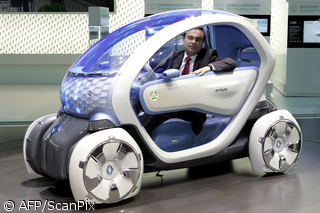 The Ministers of Industry took the first steps in San Sebastián today to make the electric vehicle a reality in Europe and agreed that European institutions, with the EC at the head, should lead a common strategy on electric vehicles.
more »
The Ministers of Industry took the first steps in San Sebastián today to make the electric vehicle a reality in Europe and agreed that European institutions, with the EC at the head, should lead a common strategy on electric vehicles.
more »