Poland Opposes Seven-Year Restriction on Free Movement of Labor After EU Entry
Published:
13 April 2001 y., Friday
Poland immediately rejected Wednesday a proposal by the European Commission to allow member states to keep out workers from candidate countries in eastern Europe for up to seven years after their accession.
"It is very clear we are not in agreement with the proposals of Commissioner Verheugen. They are very close to the German and Austrian proposals, with some changes. Naturally we don't accept that position," Poland's chief EU negotiator, Jan Kulakowski, was quoted as saying by PAP news agency.
Trying to strike a compromise on the sensitive issue of free movement of labor, Enlargement Commissioner Guenter Verheugen put forward a proposal for a general transition period of five years when member countries could impose their own restrictions.
Once the five years are up, any member state would be able to maintain its national provisions for an extra two years in the case of serious disturbances in its labor market. Germany and Austria have called for a seven-year transition period on the free movement of labor, fearful of a flood of workers from neighboring candidate states such as Poland and Hungary.
"Our position today is that no transition period is necessary in the area of free movement of people," said Kulakowski.
Šaltinis:
Agence France Presse
Copying, publishing, announcing any information from the News.lt portal without written permission of News.lt editorial office is prohibited.
The most popular articles
 A specific EU budget line for the new EU stabilisation mechanism should be created as soon as possible, to ensure its credibility, Council, Commission and Parliament negotiators agreed at a three-way meeting on Wednesday.
more »
A specific EU budget line for the new EU stabilisation mechanism should be created as soon as possible, to ensure its credibility, Council, Commission and Parliament negotiators agreed at a three-way meeting on Wednesday.
more »
 New EU rule will help phone-users avoid astronomical bills for web-surfing and downloads abroad.
more »
New EU rule will help phone-users avoid astronomical bills for web-surfing and downloads abroad.
more »
 The Communication approved today by the Commission builds on the principles presented on 12 May to reinforce the economic governance in the European Union.
more »
The Communication approved today by the Commission builds on the principles presented on 12 May to reinforce the economic governance in the European Union.
more »
 Eurostat report just published shows that the crisis has brought some lower taxes.
more »
Eurostat report just published shows that the crisis has brought some lower taxes.
more »
 New legislation is needed to ensure fair returns to farmers and transparent prices to consumers, by enforcing fair competition throughout the food supply chain, said Agriculture Committee MEPs on Monday.
more »
New legislation is needed to ensure fair returns to farmers and transparent prices to consumers, by enforcing fair competition throughout the food supply chain, said Agriculture Committee MEPs on Monday.
more »
 Fish imports play a crucial role in supplying the European market, yet fisheries and aquaculture are strategic sectors that do not lend themselves to a purely free-trade approach, believes the EP Fisheries Committee.
more »
Fish imports play a crucial role in supplying the European market, yet fisheries and aquaculture are strategic sectors that do not lend themselves to a purely free-trade approach, believes the EP Fisheries Committee.
more »
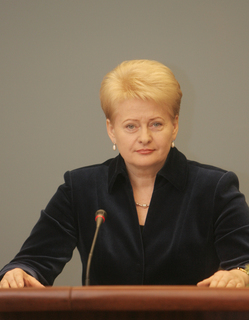 I will support every proposal that strengthens cooperation among the European Union's Member States and serves Lithuania's interests," President of the Republic of Lithuania Dalia Grybauskaitė said at the meeting with EU Member States' ambassadors resident in Lithuania.
more »
I will support every proposal that strengthens cooperation among the European Union's Member States and serves Lithuania's interests," President of the Republic of Lithuania Dalia Grybauskaitė said at the meeting with EU Member States' ambassadors resident in Lithuania.
more »
 The fourth World Lithuanian Economic Forum “High tech innovation & investment: local to global” will start in London on 22 June.
more »
The fourth World Lithuanian Economic Forum “High tech innovation & investment: local to global” will start in London on 22 June.
more »
 Lithuania aims for the five Nordic countries and three Baltic States to become single community of values, which would be linked by a versatile quality of democracy, security and everyday life.
more »
Lithuania aims for the five Nordic countries and three Baltic States to become single community of values, which would be linked by a versatile quality of democracy, security and everyday life.
more »
 MEPs decided on Wednesday to create a special committee to prepare for the EU's next long-term budgetary framework.
more »
MEPs decided on Wednesday to create a special committee to prepare for the EU's next long-term budgetary framework.
more »