Poland Opposes Seven-Year Restriction on Free Movement of Labor After EU Entry
Published:
13 April 2001 y., Friday
Poland immediately rejected Wednesday a proposal by the European Commission to allow member states to keep out workers from candidate countries in eastern Europe for up to seven years after their accession.
"It is very clear we are not in agreement with the proposals of Commissioner Verheugen. They are very close to the German and Austrian proposals, with some changes. Naturally we don't accept that position," Poland's chief EU negotiator, Jan Kulakowski, was quoted as saying by PAP news agency.
Trying to strike a compromise on the sensitive issue of free movement of labor, Enlargement Commissioner Guenter Verheugen put forward a proposal for a general transition period of five years when member countries could impose their own restrictions.
Once the five years are up, any member state would be able to maintain its national provisions for an extra two years in the case of serious disturbances in its labor market. Germany and Austria have called for a seven-year transition period on the free movement of labor, fearful of a flood of workers from neighboring candidate states such as Poland and Hungary.
"Our position today is that no transition period is necessary in the area of free movement of people," said Kulakowski.
Šaltinis:
Agence France Presse
Copying, publishing, announcing any information from the News.lt portal without written permission of News.lt editorial office is prohibited.
The most popular articles
 The finance chiefs from the leading economies met in southern England to discuss measures to deal with the global economic crisis.
more »
The finance chiefs from the leading economies met in southern England to discuss measures to deal with the global economic crisis.
more »
 Environmental projects up for bid at ‘auction floor’ conference in Brussels.
more »
Environmental projects up for bid at ‘auction floor’ conference in Brussels.
more »
 In the United States increasing numbers of men are having vasectomies to avoid any added strain on hard-pressed finances.
more »
In the United States increasing numbers of men are having vasectomies to avoid any added strain on hard-pressed finances.
more »
 Within last year the number of settlement operations made by using AB Bank SNORAS payment cards grew by 21 per cent or twice more than on the market where 10 per cent growth was fixed.
more »
Within last year the number of settlement operations made by using AB Bank SNORAS payment cards grew by 21 per cent or twice more than on the market where 10 per cent growth was fixed.
more »
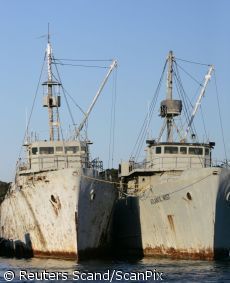 The “Erika III” package, aimed at protecting Europe's coasts from maritime disasters and improving passenger and crew safety, was adopted by Parliament on Wednesday.
more »
The “Erika III” package, aimed at protecting Europe's coasts from maritime disasters and improving passenger and crew safety, was adopted by Parliament on Wednesday.
more »
 Improving the transparency and the supervision of the financial system to ensure proper risk management in the banking sector is the aim of legislation approved on Monday by the Economic and Monetary Affairs Committee.
more »
Improving the transparency and the supervision of the financial system to ensure proper risk management in the banking sector is the aim of legislation approved on Monday by the Economic and Monetary Affairs Committee.
more »
 MEPs could back speeding up the rate at which Europe's regional funds are made available.
more »
MEPs could back speeding up the rate at which Europe's regional funds are made available.
more »
 The Commission has taken a humanitarian decision for €700,000 to provide assistance to communities affected by floods in Fiji, the Solomon Islands and Papua New Guinea.
more »
The Commission has taken a humanitarian decision for €700,000 to provide assistance to communities affected by floods in Fiji, the Solomon Islands and Papua New Guinea.
more »
 The international business magazine Euromoney has announced the results of its Private Banking Survey 2009, and Parex banka has received the award for “Best Private Banking Services Overall” in Latvia.
more »
The international business magazine Euromoney has announced the results of its Private Banking Survey 2009, and Parex banka has received the award for “Best Private Banking Services Overall” in Latvia.
more »
 Mass layoffs and inflation are pushing people to seek food aid.
more »
Mass layoffs and inflation are pushing people to seek food aid.
more »