A main motivation behind a recent to decision to sell a stake of Estonia's power stations to Americans was to boost national security.
Published:
9 August 2000 y., Wednesday
A main motivation behind a recent to decision to sell a stake of Estonia's power stations to Americans was to boost national security, Estonian Prime Minister Mart Laar wrote in an article published August 4.
Estonia, which has security concerns vis-a-vis neighboring Russia, agreed to sell a 49 percent stake in the plants to the U.S.-based NRG Energy for 55 million dollars and 361 million more in Opposition parties blasted the deal, saying it would lead to unnecessarily high energy prices. They also said the sale of the plants, which produce 95 percent of the country's electricity, would jeopardize Estonian sovereignty.
But writing in Estonia's Postimees daily, Laar said the controversial deal was not only sound economically, but would enhance national security by more closely enmeshing Estonia's vital interests with those of the United States.
"The NRG investment will guarantee an American presence here...ensuring that the only superpower in the world will have a continued interest in the stability and fast development of our region," he wrote.
"Who could be a better advocate (for Estonia) in the U.S. government than a company which seeks a profit in this region," said Laar, who also criticized the center-left opposition for what he said were displays of disturbing xenophobia in opposing the deal.
He said the price of electricity, which NRG energy will be allowed to raise by over 20 percent, shouldn't be the only criteria by which to judge the deal.
Šaltinis:
The Weekly Crier
Copying, publishing, announcing any information from the News.lt portal without written permission of News.lt editorial office is prohibited.
The most popular articles
 The mission held constructive discussions with Prime Minister Emmanuel Nadingar, Finance Minister Gata Ngoulou, Infrastructure Minister Adoum Younousmi, and other senior officials.
more »
The mission held constructive discussions with Prime Minister Emmanuel Nadingar, Finance Minister Gata Ngoulou, Infrastructure Minister Adoum Younousmi, and other senior officials.
more »
 The EBRD is helping to improve the quality of power supply and stimulate renewable sources of energy in the Caucasus with an €80 million sovereign loan to Georgia for the construction of a new high voltage transmission line - the Black Sea High Voltage line, which will interconnect Georgia and Turkey.
more »
The EBRD is helping to improve the quality of power supply and stimulate renewable sources of energy in the Caucasus with an €80 million sovereign loan to Georgia for the construction of a new high voltage transmission line - the Black Sea High Voltage line, which will interconnect Georgia and Turkey.
more »
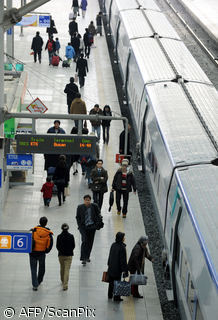 The EBRD is helping to improve the infrastructure of the Georgian capital, Tbilisi, with a €100 million loan for the construction of a new railway route bypassing the city.
more »
The EBRD is helping to improve the infrastructure of the Georgian capital, Tbilisi, with a €100 million loan for the construction of a new railway route bypassing the city.
more »
 One of the men considered to be the founding fathers of the euro currency met MEPs on the Foreign Affairs Committee Tuesday (16 March) to talk about transatlantic relations.
more »
One of the men considered to be the founding fathers of the euro currency met MEPs on the Foreign Affairs Committee Tuesday (16 March) to talk about transatlantic relations.
more »
 European Trade Commissioner Karel De Gucht today opened a conference focused on the European Union's trade policy towards developing countries.
more »
European Trade Commissioner Karel De Gucht today opened a conference focused on the European Union's trade policy towards developing countries.
more »
 At the beginning of the 2000s, state ownership in financial intermediation in Mexico accounted for about 20 percent of the total credit of the banking system, provided through development financial institutions and funds.
more »
At the beginning of the 2000s, state ownership in financial intermediation in Mexico accounted for about 20 percent of the total credit of the banking system, provided through development financial institutions and funds.
more »
 Halving the number of business failures by offering individual support, doubling the number of young people who want to start their own business or raising by 500% the number of enterprising new cooperatives are just some of the projects nominated for the European Enterprise Awards 2010.
more »
Halving the number of business failures by offering individual support, doubling the number of young people who want to start their own business or raising by 500% the number of enterprising new cooperatives are just some of the projects nominated for the European Enterprise Awards 2010.
more »
 The European Commission has published the fourth call for proposals for the creation and upgrade of freight transport services under the second Marco Polo programme.
more »
The European Commission has published the fourth call for proposals for the creation and upgrade of freight transport services under the second Marco Polo programme.
more »
 The European Central Bank (ECB) today announced a programme of technical cooperation with the Central Bank of Bosnia and Herzegovina, in collaboration with a number of euro area national central banks (NCBs).
more »
The European Central Bank (ECB) today announced a programme of technical cooperation with the Central Bank of Bosnia and Herzegovina, in collaboration with a number of euro area national central banks (NCBs).
more »
 The EU disbursed today €1 billion to Romania, the second instalment of a €5 billion loan, which was agreed in May 2009 as part of a multilateral financial assistance package.
more »
The EU disbursed today €1 billion to Romania, the second instalment of a €5 billion loan, which was agreed in May 2009 as part of a multilateral financial assistance package.
more »