OLAF and Europol strengthen cooperation in combating financial crime
Published:
9 April 2004 y., Friday
OLAF - The European Anti-fraud Office - and Europol - the European Police Office - shall sign an administrative arrangement putting in place the modalities for their practical co-operation.
Mr Jürgen Storbeck, Europol's Director and Mr Franz-Hermann Brüner, Director General of OLAF shall tomorrow, in Brussels, sign an administrative arrangement regarding co-operation between Europol and OLAF in order to fight fraud, corruption or any other criminal offence or illegal activity in the framework of international organised crime affecting the European Community's financial interests.
In order to step up the fight against fraud, corruption and any other illegal activity affecting the financial interests of the European Community, the European Anti-Fraud Office established by Commission Decision 1999/352/EC, ECSC, Euratom exercises the powers of investigation conferred on the Commission by the Community rules and Regulations and agreements in force in those areas.
The Office provides the Member States with assistance from the Commission in organising close and regular cooperation between their competent authorities in order to coordinate their activities for the purpose of protecting the European Community's financial interests against fraud.
The Treaty of the European Union mentions (art. 29 and 30) Europol as an important instrument of the Union's efforts to prevent and fight against organised crime in order to achieve the objective of providing its citizens with a high level of safety within an area of freedom, security and justice. Europol aims to improve the effectiveness and co operation between the competent authorities of the Member States in preventing and combating serious international organised crime. The mission of Europol is to make a significant contribution to the European Union's law enforcement action against organised crime, with an emphasis on targeting criminal organisations.
Based in The Hague, The Netherlands, Europol started limited operations on 3 January 1994 in the form of the Europol Drugs Unit (EDU) fighting against drugs. The Europol Convention was ratified by all Member States and came into force on 1 October 1998. Following a number of legal acts related to the Convention, Europol commenced its full activities on 1 July 1999.
Šaltinis:
europa.eu.int
Copying, publishing, announcing any information from the News.lt portal without written permission of News.lt editorial office is prohibited.
The most popular articles
 In another move to strengthen the financial system, the Commission is proposing controls on credit rating agencies - private companies that evaluate financial risks for investors.
more »
In another move to strengthen the financial system, the Commission is proposing controls on credit rating agencies - private companies that evaluate financial risks for investors.
more »
 Monday 10 November saw a large report land on the desk of MEPs in the Budgetary Control Committee.
more »
Monday 10 November saw a large report land on the desk of MEPs in the Budgetary Control Committee.
more »
 EU wants G20 meeting to pave the way for reform of the international financial system.
more »
EU wants G20 meeting to pave the way for reform of the international financial system.
more »
 New Yorkers reflect on the election of Barack Obama as the 44th President of the United States.
more »
New Yorkers reflect on the election of Barack Obama as the 44th President of the United States.
more »
 The ability of the EU's common agriculture policy (CAP) to cope with the challenges of affordable food and climate change was discussed in Brussels 3-4 November.
more »
The ability of the EU's common agriculture policy (CAP) to cope with the challenges of affordable food and climate change was discussed in Brussels 3-4 November.
more »
 European Union economic growth should be 1.4% in 2008, half what it was in 2007, and drop even more sharply in 2009 to 0.2% before recovering gradually to 1.1% in 2010 (1.2%, 0.1% and 0.9%, respectively, for the euro area).
more »
European Union economic growth should be 1.4% in 2008, half what it was in 2007, and drop even more sharply in 2009 to 0.2% before recovering gradually to 1.1% in 2010 (1.2%, 0.1% and 0.9%, respectively, for the euro area).
more »
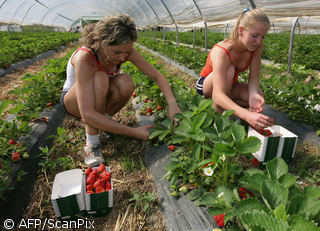 There are an estimated 4-8 million immigrants working illegally in the European Union.
more »
There are an estimated 4-8 million immigrants working illegally in the European Union.
more »
 Hit by economic turmoil and the sharp global downturn, growth in the EU slows almost to a halt.
more »
Hit by economic turmoil and the sharp global downturn, growth in the EU slows almost to a halt.
more »
 The top priority is to cushion the impact of the financial crisis on jobs, purchasing power and prosperity of EU citizens.
more »
The top priority is to cushion the impact of the financial crisis on jobs, purchasing power and prosperity of EU citizens.
more »
 The International Monetary Fund has approved short-term financing to help emerging market economies weather the global financial storm.
more »
The International Monetary Fund has approved short-term financing to help emerging market economies weather the global financial storm.
more »