Azerbaijan_s delegation to the latest round of talks in Turkey on the Baku Ceyhan oil pipeline project returned to Baku Wednesday evening.
Published:
3 March 2000 y., Friday
The expert working groups that took part in the talks, which began on February 26th, are carefully working out every point in the draft agreement between potential investors and Georgia accross whose territory the pipeline is due to pass, Natik Aliyev, president of Azerbaijani state oil company SOCAR, told reporters on Thursday. "All is being done to ensure the normal functioning of the pipeline over several decades," Aliyev said. Aliyev also said that the talks in Turkey had produced an agreement on one issue that had remained unresolved following talks in Georgia in mid-February.
As Interfax has learned from informed sources, until recently the main point of contention in the talks had been the issue of Georgia_s responsibility for pipeline security in force-majeur circumstances: natural disasters, terrorism or vandalism. The draft agreement contains a clause on "comprehensive damages" under which Georgia will be responsible for financing the costs of correcting damage to the pipeline within Georgia, as well as for paying compensation for damages to the consortium, including losses from lower oil production and idle tankers and refining capacity in Ceyhan. Georgia says it cannot afford to accept those liabilities. Officials in Tbilisi say the draft agreement is a threat to Georgia_s sovereignty and perhaps even its independence. If a terrorist attack were to take out one of three $55 million - $60 million substations in Georgia, the costs under the "comprehensive damages" clause would total at least $150 million.
Šaltinis:
Interfax
Copying, publishing, announcing any information from the News.lt portal without written permission of News.lt editorial office is prohibited.
The most popular articles
 When you fill up your car with petrol you often find that your hand will reek of petrol unless you have worn gloves.
more »
When you fill up your car with petrol you often find that your hand will reek of petrol unless you have worn gloves.
more »
 The EU is going through its worst recession since WWII. Inflation has slowed, but employment and public finances are hard hit. The situation should stabilise in 2010.
more »
The EU is going through its worst recession since WWII. Inflation has slowed, but employment and public finances are hard hit. The situation should stabilise in 2010.
more »
 In the current economic environment, banks should carefully analyze the current and future total cost of ownership of their technology assets, and evaluate the outsourcing alternative.
more »
In the current economic environment, banks should carefully analyze the current and future total cost of ownership of their technology assets, and evaluate the outsourcing alternative.
more »
 Commission proposes first EU law on hedge funds and issues guidelines on bank pay practices.
more »
Commission proposes first EU law on hedge funds and issues guidelines on bank pay practices.
more »
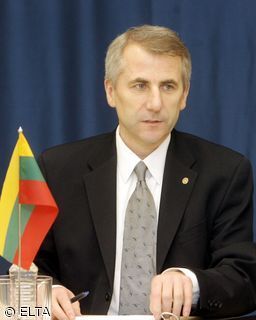 On 30 April, Lithuania’s Minister of Foreign Affairs Vygaudas Ušackas took part in the round table discussion “The European Union’s External Trade Policy and Lithuania’s Positions: Threats and Possibilities for the Lithuanian Industry”.
more »
On 30 April, Lithuania’s Minister of Foreign Affairs Vygaudas Ušackas took part in the round table discussion “The European Union’s External Trade Policy and Lithuania’s Positions: Threats and Possibilities for the Lithuanian Industry”.
more »
 Since 28 April this year, the clients of AB Bank SNORAS will be able to process their financial matters in a clearer and more user-friendly environment of “Internet Bank+” system.
more »
Since 28 April this year, the clients of AB Bank SNORAS will be able to process their financial matters in a clearer and more user-friendly environment of “Internet Bank+” system.
more »
 2009 ageing report: Europe tackling the challenge of an ageing population but the recession threatens a setback.
more »
2009 ageing report: Europe tackling the challenge of an ageing population but the recession threatens a setback.
more »
 More choice, investment and security of supply lie at the heart of the 3rd energy package.
more »
More choice, investment and security of supply lie at the heart of the 3rd energy package.
more »
 Swine flu, a new strain of influenza, has so far left more than a hundred dead. But in one sector, the illness could have huge benefits.
more »
Swine flu, a new strain of influenza, has so far left more than a hundred dead. But in one sector, the illness could have huge benefits.
more »
 Central European bargain hunters are crossing borders for the best buys. Slovakian shoppers in Hungary are making the most of their new eurozone membership.
more »
Central European bargain hunters are crossing borders for the best buys. Slovakian shoppers in Hungary are making the most of their new eurozone membership.
more »