Criminals disguising illicit earnings stay ahead of police efforts to crack down
Published:
28 March 2003 y., Friday
Chinese restaurants that stand empty day and night. Jewelry shops with no customers. Nightclubs without dancers. Travel agencies that don't organize travel.
These are all businesses known at times to launder money -- typically by disguising illicitly generated cash as legal earnings and passing the money through the mainstream banking system.
"There are businesses where it is easier to hide money. I know that Czechs like to travel, but you have a huge amount of travel agencies in Prague," said John Mottram, a European Union accession adviser working on money-laundering policy at the Interior Ministry. "There are also lots of restaurants and bars. I'm sure a number of those businesses are covers for criminal groups, even if the employees there don't realize it."
These days, however, such firms are at the low end of vehicles used to hide sources of ill-gotten gains, observers say. Financial authorities, forensic specialists and bank security officials said money launderers are increasingly using legal and accountancy services, modern computer and Internet technology, stock market transactions and shadowy shell companies in an effort to stay ahead of investigators. As a result, these observers say, authorities are having a harder time than ever finding and prosecuting offenders, even as lawmakers institute EU-compliant laws and banks become more watchful.
Šaltinis:
The Prague Post
Copying, publishing, announcing any information from the News.lt portal without written permission of News.lt editorial office is prohibited.
The most popular articles
 The EBRD is making a €4 million equity investment in Geofoto, a Croatian geodetic company offering mapping, geodetic survey, photogrammetry, geoinformatics and aerial survey services, to support its drive to expand operations on international level.
more »
The EBRD is making a €4 million equity investment in Geofoto, a Croatian geodetic company offering mapping, geodetic survey, photogrammetry, geoinformatics and aerial survey services, to support its drive to expand operations on international level.
more »
 Nordea came out of 2009 in an even stronger position, despite one of the most challenging years for decades. Risk-adjusted profit increased 22% and our capital position and cost of funding are among the best in Europe.
more »
Nordea came out of 2009 in an even stronger position, despite one of the most challenging years for decades. Risk-adjusted profit increased 22% and our capital position and cost of funding are among the best in Europe.
more »
 MEPs gave the green light on Thursday for EU funding to help Europe's unemployed start up small businesses.
more »
MEPs gave the green light on Thursday for EU funding to help Europe's unemployed start up small businesses.
more »
 MEPs are deeply concerned about the long-standing and growing presence of al-Qaeda, and the deteriorating security, social and economic problems in Yemen, which they think could destabilise neighbouring countries.
more »
MEPs are deeply concerned about the long-standing and growing presence of al-Qaeda, and the deteriorating security, social and economic problems in Yemen, which they think could destabilise neighbouring countries.
more »
 At the start of a new decade, Sub Saharan Africa is reeling from the effects of three major global crises – food, fuel and financial – that have reversed many of the economic achievements of the last 10 years and left some growth projections at levels below those of 30 years ago.
more »
At the start of a new decade, Sub Saharan Africa is reeling from the effects of three major global crises – food, fuel and financial – that have reversed many of the economic achievements of the last 10 years and left some growth projections at levels below those of 30 years ago.
more »
 The 5th High-level Seminar of Central Banks in the East Asia-Pacific Region and the Euro Area was jointly organised by the European Central Bank and the Reserve Bank of Australia, in cooperation with the Hong Kong Monetary Authority.
more »
The 5th High-level Seminar of Central Banks in the East Asia-Pacific Region and the Euro Area was jointly organised by the European Central Bank and the Reserve Bank of Australia, in cooperation with the Hong Kong Monetary Authority.
more »
 The EBRD and European Fund for Southeast Europe are boosting the availability of financing to private businesses in Moldova with a $10 million loan to ProCredit Bank in Moldova for on-lending to micro and small enterprises.
more »
The EBRD and European Fund for Southeast Europe are boosting the availability of financing to private businesses in Moldova with a $10 million loan to ProCredit Bank in Moldova for on-lending to micro and small enterprises.
more »
 The EBRD is supporting the development of the retail infrastructure in Croatia with a €68 million loan to finance the construction of a modern shopping centre in Split, the second largest city in Croatia.
more »
The EBRD is supporting the development of the retail infrastructure in Croatia with a €68 million loan to finance the construction of a modern shopping centre in Split, the second largest city in Croatia.
more »
 The European Bank for Reconstruction and Development has agreed to sell its 15 percent stake in OAO Swedbank Russia to its parent and major stakeholder, Sweden’s Swedbank AB, a move which would give it full ownership of its Russian subsidiary.
more »
The European Bank for Reconstruction and Development has agreed to sell its 15 percent stake in OAO Swedbank Russia to its parent and major stakeholder, Sweden’s Swedbank AB, a move which would give it full ownership of its Russian subsidiary.
more »
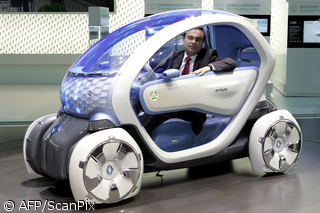 The Ministers of Industry took the first steps in San Sebastián today to make the electric vehicle a reality in Europe and agreed that European institutions, with the EC at the head, should lead a common strategy on electric vehicles.
more »
The Ministers of Industry took the first steps in San Sebastián today to make the electric vehicle a reality in Europe and agreed that European institutions, with the EC at the head, should lead a common strategy on electric vehicles.
more »