A Latvian business newspaper has expressed its scepticism at the IMF recommendation to repeal a planned cut in the corporate income tax rate in Latvia
Published:
9 July 2003 y., Wednesday
The newspaper said the cut has been promised to businesses and they have based their plans on it. The following is the text of the unsigned editorial, entitled "Disadvantageous recommendations" and published in the Latvian newspaper Dienas Bizness on 20 June:
The experts from the International Monetary Fund who are currently visiting our country's prime minister, economics minister and finance minister have recommended that the corporate income tax not be reduced from 19 to 15 per cent next year, as has been promised to the country's businessmen.
It would be all right if these experts had come to Latvia, submitted their recommendations and then left. Then the story would have ended. Sadly, it looks as if this might not happen, because high-ranking Latvian government officials, including Transport Minister [Roberts] Zile and the chairwoman of the Saeima [parliament] Budget and Finance Commission, [Baiba] Brigmane, have listened to these wise viewpoints, concluding that they will be good enough in terms of patching up holes in the national budget.
We must not forget that every single businessman in Latvia has counted on the previous government's decision to reduce the corporate income tax rate. They have planned their operations in line with this promise. There can be no doubt, it seems, that when government officials "listen" to IMF experts, that might cause serious losses to the business world. We must also remember that once Latvia joins the European Union, our businessmen will have to face many kinds of expenditures if their operations are to be in line with EU standards. The reduction in the corporate income tax rate would help them to a certain extent in this regard.
Šaltinis:
BBC Monitoring International Reports
Copying, publishing, announcing any information from the News.lt portal without written permission of News.lt editorial office is prohibited.
The most popular articles
 When you fill up your car with petrol you often find that your hand will reek of petrol unless you have worn gloves.
more »
When you fill up your car with petrol you often find that your hand will reek of petrol unless you have worn gloves.
more »
 The EU is going through its worst recession since WWII. Inflation has slowed, but employment and public finances are hard hit. The situation should stabilise in 2010.
more »
The EU is going through its worst recession since WWII. Inflation has slowed, but employment and public finances are hard hit. The situation should stabilise in 2010.
more »
 In the current economic environment, banks should carefully analyze the current and future total cost of ownership of their technology assets, and evaluate the outsourcing alternative.
more »
In the current economic environment, banks should carefully analyze the current and future total cost of ownership of their technology assets, and evaluate the outsourcing alternative.
more »
 Commission proposes first EU law on hedge funds and issues guidelines on bank pay practices.
more »
Commission proposes first EU law on hedge funds and issues guidelines on bank pay practices.
more »
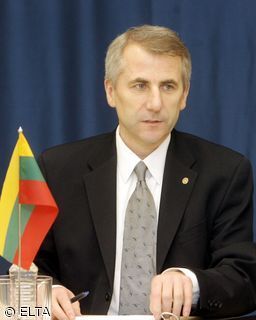 On 30 April, Lithuania’s Minister of Foreign Affairs Vygaudas Ušackas took part in the round table discussion “The European Union’s External Trade Policy and Lithuania’s Positions: Threats and Possibilities for the Lithuanian Industry”.
more »
On 30 April, Lithuania’s Minister of Foreign Affairs Vygaudas Ušackas took part in the round table discussion “The European Union’s External Trade Policy and Lithuania’s Positions: Threats and Possibilities for the Lithuanian Industry”.
more »
 Since 28 April this year, the clients of AB Bank SNORAS will be able to process their financial matters in a clearer and more user-friendly environment of “Internet Bank+” system.
more »
Since 28 April this year, the clients of AB Bank SNORAS will be able to process their financial matters in a clearer and more user-friendly environment of “Internet Bank+” system.
more »
 2009 ageing report: Europe tackling the challenge of an ageing population but the recession threatens a setback.
more »
2009 ageing report: Europe tackling the challenge of an ageing population but the recession threatens a setback.
more »
 More choice, investment and security of supply lie at the heart of the 3rd energy package.
more »
More choice, investment and security of supply lie at the heart of the 3rd energy package.
more »
 Swine flu, a new strain of influenza, has so far left more than a hundred dead. But in one sector, the illness could have huge benefits.
more »
Swine flu, a new strain of influenza, has so far left more than a hundred dead. But in one sector, the illness could have huge benefits.
more »
 Central European bargain hunters are crossing borders for the best buys. Slovakian shoppers in Hungary are making the most of their new eurozone membership.
more »
Central European bargain hunters are crossing borders for the best buys. Slovakian shoppers in Hungary are making the most of their new eurozone membership.
more »