The recent improvement in some statistical indicators does not necessarily mean that the Polish economy is recovering
Published:
1 March 2003 y., Saturday
The search for signs of recovery in the economy is like looking for signs of spring after a long, cold winter. Optimists welcome good figures in Polish exports despite unfavorable trends in Germany, Poland's main commercial partner. Domestic demand is less encouraging.
Pessimists note that even though industrial production has been growing from one month to the next, its rate of growth in January, 4.2 percent in year-on-year terms, was slower than in December 2002. Inflation, on the other hand, dropped in January to a record low of 0.4 percent, against 3.4 percent in January 2002 and more than 7 percent in January 2001. Some analysts fear deflation, or a general reduction in the prices of goods and services, accompanied by reduced production and higher unemployment due to a decreased influx of money into the economy.
That fact that inflation has been kept in check fuels expectations that, at its next monthly meeting, the Monetary Policy Council (RPP) will cut interest rates still further. However, despite calculations by those supporting radical rate cuts and hoping that this could boost economic growth, the first tangible results of rate cuts-in the form of concrete investment decisions made by entrepreneurs-may only be visible after several months at the earliest. In their day-to-day operations, investors are especially plagued by high taxes and bureaucracy.
Šaltinis:
warsawvoice.pl
Copying, publishing, announcing any information from the News.lt portal without written permission of News.lt editorial office is prohibited.
The most popular articles
 The EBRD is making a €4 million equity investment in Geofoto, a Croatian geodetic company offering mapping, geodetic survey, photogrammetry, geoinformatics and aerial survey services, to support its drive to expand operations on international level.
more »
The EBRD is making a €4 million equity investment in Geofoto, a Croatian geodetic company offering mapping, geodetic survey, photogrammetry, geoinformatics and aerial survey services, to support its drive to expand operations on international level.
more »
 Nordea came out of 2009 in an even stronger position, despite one of the most challenging years for decades. Risk-adjusted profit increased 22% and our capital position and cost of funding are among the best in Europe.
more »
Nordea came out of 2009 in an even stronger position, despite one of the most challenging years for decades. Risk-adjusted profit increased 22% and our capital position and cost of funding are among the best in Europe.
more »
 MEPs gave the green light on Thursday for EU funding to help Europe's unemployed start up small businesses.
more »
MEPs gave the green light on Thursday for EU funding to help Europe's unemployed start up small businesses.
more »
 MEPs are deeply concerned about the long-standing and growing presence of al-Qaeda, and the deteriorating security, social and economic problems in Yemen, which they think could destabilise neighbouring countries.
more »
MEPs are deeply concerned about the long-standing and growing presence of al-Qaeda, and the deteriorating security, social and economic problems in Yemen, which they think could destabilise neighbouring countries.
more »
 At the start of a new decade, Sub Saharan Africa is reeling from the effects of three major global crises – food, fuel and financial – that have reversed many of the economic achievements of the last 10 years and left some growth projections at levels below those of 30 years ago.
more »
At the start of a new decade, Sub Saharan Africa is reeling from the effects of three major global crises – food, fuel and financial – that have reversed many of the economic achievements of the last 10 years and left some growth projections at levels below those of 30 years ago.
more »
 The 5th High-level Seminar of Central Banks in the East Asia-Pacific Region and the Euro Area was jointly organised by the European Central Bank and the Reserve Bank of Australia, in cooperation with the Hong Kong Monetary Authority.
more »
The 5th High-level Seminar of Central Banks in the East Asia-Pacific Region and the Euro Area was jointly organised by the European Central Bank and the Reserve Bank of Australia, in cooperation with the Hong Kong Monetary Authority.
more »
 The EBRD and European Fund for Southeast Europe are boosting the availability of financing to private businesses in Moldova with a $10 million loan to ProCredit Bank in Moldova for on-lending to micro and small enterprises.
more »
The EBRD and European Fund for Southeast Europe are boosting the availability of financing to private businesses in Moldova with a $10 million loan to ProCredit Bank in Moldova for on-lending to micro and small enterprises.
more »
 The EBRD is supporting the development of the retail infrastructure in Croatia with a €68 million loan to finance the construction of a modern shopping centre in Split, the second largest city in Croatia.
more »
The EBRD is supporting the development of the retail infrastructure in Croatia with a €68 million loan to finance the construction of a modern shopping centre in Split, the second largest city in Croatia.
more »
 The European Bank for Reconstruction and Development has agreed to sell its 15 percent stake in OAO Swedbank Russia to its parent and major stakeholder, Sweden’s Swedbank AB, a move which would give it full ownership of its Russian subsidiary.
more »
The European Bank for Reconstruction and Development has agreed to sell its 15 percent stake in OAO Swedbank Russia to its parent and major stakeholder, Sweden’s Swedbank AB, a move which would give it full ownership of its Russian subsidiary.
more »
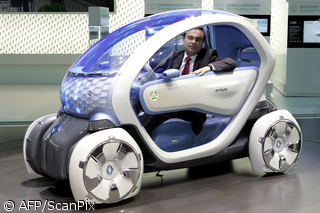 The Ministers of Industry took the first steps in San Sebastián today to make the electric vehicle a reality in Europe and agreed that European institutions, with the EC at the head, should lead a common strategy on electric vehicles.
more »
The Ministers of Industry took the first steps in San Sebastián today to make the electric vehicle a reality in Europe and agreed that European institutions, with the EC at the head, should lead a common strategy on electric vehicles.
more »