The recent improvement in some statistical indicators does not necessarily mean that the Polish economy is recovering
Published:
1 March 2003 y., Saturday
The search for signs of recovery in the economy is like looking for signs of spring after a long, cold winter. Optimists welcome good figures in Polish exports despite unfavorable trends in Germany, Poland's main commercial partner. Domestic demand is less encouraging.
Pessimists note that even though industrial production has been growing from one month to the next, its rate of growth in January, 4.2 percent in year-on-year terms, was slower than in December 2002. Inflation, on the other hand, dropped in January to a record low of 0.4 percent, against 3.4 percent in January 2002 and more than 7 percent in January 2001. Some analysts fear deflation, or a general reduction in the prices of goods and services, accompanied by reduced production and higher unemployment due to a decreased influx of money into the economy.
That fact that inflation has been kept in check fuels expectations that, at its next monthly meeting, the Monetary Policy Council (RPP) will cut interest rates still further. However, despite calculations by those supporting radical rate cuts and hoping that this could boost economic growth, the first tangible results of rate cuts-in the form of concrete investment decisions made by entrepreneurs-may only be visible after several months at the earliest. In their day-to-day operations, investors are especially plagued by high taxes and bureaucracy.
Šaltinis:
warsawvoice.pl
Copying, publishing, announcing any information from the News.lt portal without written permission of News.lt editorial office is prohibited.
The most popular articles
 How will economic policies adapt in 2020 when a quarter of the EU population is over 65? Can economics better predict how banks will react to credit crunches in the future, and what their impact will be on the wider economy?
more »
How will economic policies adapt in 2020 when a quarter of the EU population is over 65? Can economics better predict how banks will react to credit crunches in the future, and what their impact will be on the wider economy?
more »
 The EBRD is supporting the development of one of the first modern food retail chains in Turkmenistan with a $1.9 million equity investment in Ak Enar.
more »
The EBRD is supporting the development of one of the first modern food retail chains in Turkmenistan with a $1.9 million equity investment in Ak Enar.
more »
 While on a working visit to Ukraine, President of the Republic of Lithuania Dalia Grybauskaitė has underlined that Ukraine might become a very important energy partner for Lithuania and for the whole European Union but only transparent and open relations will lead to success in this area.
more »
While on a working visit to Ukraine, President of the Republic of Lithuania Dalia Grybauskaitė has underlined that Ukraine might become a very important energy partner for Lithuania and for the whole European Union but only transparent and open relations will lead to success in this area.
more »
 On 25 November in Vilnius, Lithuania’s Vice-Minister of Foreign Affairs and President of the Nordic Investment Bank discussed the issues of the Northern Dimension Partnership on Transport and Logistics (the secretariat of which is being established at the Bank), issues of the NIB cooperation with Lithuania and perspectives of the NIB’s activities in the country.
more »
On 25 November in Vilnius, Lithuania’s Vice-Minister of Foreign Affairs and President of the Nordic Investment Bank discussed the issues of the Northern Dimension Partnership on Transport and Logistics (the secretariat of which is being established at the Bank), issues of the NIB cooperation with Lithuania and perspectives of the NIB’s activities in the country.
more »
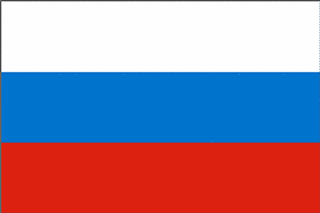 The European Bank for Reconstruction and Development has adopted a new strategy for the Russian Federation.
more »
The European Bank for Reconstruction and Development has adopted a new strategy for the Russian Federation.
more »
 Consumer protection requires transparent and consistent trade rules, believe MEPs.
more »
Consumer protection requires transparent and consistent trade rules, believe MEPs.
more »
 The European Investment Bank (EIB) is lending CZK 2 billion (approx. EUR 76 million) to the South Moravia Region for co-financing the Region’s priority infrastructure projects supported by the EU Structural and Cohesion Funds over the period 2007 – 2013.
more »
The European Investment Bank (EIB) is lending CZK 2 billion (approx. EUR 76 million) to the South Moravia Region for co-financing the Region’s priority infrastructure projects supported by the EU Structural and Cohesion Funds over the period 2007 – 2013.
more »
 Seeking to strengthen business partnership between Israel and Lithuania the Israel and Lithuania Chamber of Commerce has been recently established in Lithuania.
more »
Seeking to strengthen business partnership between Israel and Lithuania the Israel and Lithuania Chamber of Commerce has been recently established in Lithuania.
more »
 AB DnB NORD Bankas, notifies that on 24 November 2009, the member of the Management Board and Executive Vice-president of AB DnB NORD Bankas dr. Jekaterina Titarenko has been appointed as Chief Financial Officer of Bank DnB NORD Group.
more »
AB DnB NORD Bankas, notifies that on 24 November 2009, the member of the Management Board and Executive Vice-president of AB DnB NORD Bankas dr. Jekaterina Titarenko has been appointed as Chief Financial Officer of Bank DnB NORD Group.
more »
 Parliament gave its backing on Tuesday for €400 million-plus in budget aid to Serbia, Bosnia and Herzegovina, Armenia and Georgia.
more »
Parliament gave its backing on Tuesday for €400 million-plus in budget aid to Serbia, Bosnia and Herzegovina, Armenia and Georgia.
more »