The starring role in European most exciting financial theatrics.
Published:
5 April 1999 y., Monday
Ruggiero Magnoni, the 48-year-old co-head of European corporate finance at Lehman Brothers Inc.,
has been preparing all his life for his current starring role in some of Europe_s most exciting financial
theatrics. Born in Barcelona but bred in Milan, Magnoni got an MBA at Columbia University and in the mid- _70s joined the old Wall Street firm of Kuhn Loeb. During those years of political violence in Italy, New York seemed a good bet. Shortly after he signed on, Kuhn Loeb was snapped up by Lehman Brothers, and Magnoni rose to be head of international private placements. In the early 1980s, that meant Japan. Magnoni was soon taking the red-eye to Tokyo as often as once a week to help guide the flow of Japanese investment into U.S. real estate and equities. But by the mid-1980s, Europe was starting to stir. Lehman had become part of the American Express Co.-owned Shearson Lehman empire, and AmEx_ James D. Robinson III and Shearson_s Peter Cohen presciently chose Italy, with its backward business culture but high savings rate, as a place of potential. Magnoni took on Italian operations, based in Milan. Italy was soon booming, and Magnoni was cutting deals with magnates such as Carlo De Benedetti, in whose varied businesses Shearson ultimately invested more than $100 million. Magnoni is one of the only people in the world to have worked with both De Benedetti and his bitter political and business rival, media mogul-turned-politician Silvio Berlusconi. In 1995, Magnoni
structured the $1 billion deal that allowed Berlusconi to take his media group Mediaset public, a move
that smoothed the magnate_s push into politics.
Šaltinis:
Businessweek
Copying, publishing, announcing any information from the News.lt portal without written permission of News.lt editorial office is prohibited.
The most popular articles
 When you fill up your car with petrol you often find that your hand will reek of petrol unless you have worn gloves.
more »
When you fill up your car with petrol you often find that your hand will reek of petrol unless you have worn gloves.
more »
 The EU is going through its worst recession since WWII. Inflation has slowed, but employment and public finances are hard hit. The situation should stabilise in 2010.
more »
The EU is going through its worst recession since WWII. Inflation has slowed, but employment and public finances are hard hit. The situation should stabilise in 2010.
more »
 In the current economic environment, banks should carefully analyze the current and future total cost of ownership of their technology assets, and evaluate the outsourcing alternative.
more »
In the current economic environment, banks should carefully analyze the current and future total cost of ownership of their technology assets, and evaluate the outsourcing alternative.
more »
 Commission proposes first EU law on hedge funds and issues guidelines on bank pay practices.
more »
Commission proposes first EU law on hedge funds and issues guidelines on bank pay practices.
more »
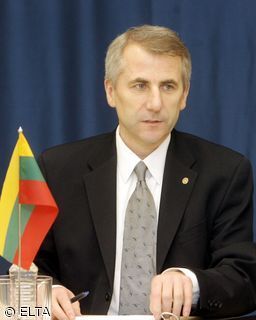 On 30 April, Lithuania’s Minister of Foreign Affairs Vygaudas Ušackas took part in the round table discussion “The European Union’s External Trade Policy and Lithuania’s Positions: Threats and Possibilities for the Lithuanian Industry”.
more »
On 30 April, Lithuania’s Minister of Foreign Affairs Vygaudas Ušackas took part in the round table discussion “The European Union’s External Trade Policy and Lithuania’s Positions: Threats and Possibilities for the Lithuanian Industry”.
more »
 Since 28 April this year, the clients of AB Bank SNORAS will be able to process their financial matters in a clearer and more user-friendly environment of “Internet Bank+” system.
more »
Since 28 April this year, the clients of AB Bank SNORAS will be able to process their financial matters in a clearer and more user-friendly environment of “Internet Bank+” system.
more »
 2009 ageing report: Europe tackling the challenge of an ageing population but the recession threatens a setback.
more »
2009 ageing report: Europe tackling the challenge of an ageing population but the recession threatens a setback.
more »
 More choice, investment and security of supply lie at the heart of the 3rd energy package.
more »
More choice, investment and security of supply lie at the heart of the 3rd energy package.
more »
 Swine flu, a new strain of influenza, has so far left more than a hundred dead. But in one sector, the illness could have huge benefits.
more »
Swine flu, a new strain of influenza, has so far left more than a hundred dead. But in one sector, the illness could have huge benefits.
more »
 Central European bargain hunters are crossing borders for the best buys. Slovakian shoppers in Hungary are making the most of their new eurozone membership.
more »
Central European bargain hunters are crossing borders for the best buys. Slovakian shoppers in Hungary are making the most of their new eurozone membership.
more »