Real interest rates mean great returns on the Hungarian forint
Published:
14 April 2004 y., Wednesday
Around the globe, people are looking at Hungary’s real interest rates. With consumer prices up 6.6% year-on-year in January and short-term interest rates close to 12%, there is no other emerging market that offers a better real return on your money.
Massive capital inflows confirm that there is indeed an opportunity. Hot money has pushed up the Hungarian forint to less than Ft 250 per euro. This was the level at which the forint was traded before a flow of adverse macroeconomic data and confused central bank statements drove the currency to its bottom level of over Ft 270 per euro during the second half of 2003.
Is it still worthwhile changing your humble savings into Hungarian forints to benefit from these high interest rates? The answer depends on the exchange rate at which you will convert your money back into your home currency at the end of the day.
Let us suppose you have Ђ100,000 to invest. You can invest it in T-bills from EU countries, giving you a return of around 2%. Alternatively, you change your Ђ100,000 into forints at a rate of Ft 248 and buy Hungarian T-bills for around Ft 24.8 million. This will render you a yield to maturity just below 12%, so that at the end of the year you will own around Ft 27 million.
Provided that you can change your money back into euros at the same rate, you would increase the yield on your investment sixfold compared to investing in euro T-bills! (from 2% to 12%). The problem is that you don’t know the future exchange rate. It is possible, however, to sell the whole amount on the futures market, but only at a rate of Ft 263. Hedging would cost you as much as you would gain from the interest rate differential. Alas, no free lunch.
More interesting returns are available if you’re willing to take a bet on the Hungarian forint. If you’re confident that the forint will stay firm below Ft 263 per euro until the end of December, there is no need to hedge your forint exposure. Is there any reason to be confident about this?
There are, in my opinion, two reasons that make it unlikely that the National Bank of Hungary (MNB) will let the forint depreciate again below a level of around Ft 263 per euro. The first reason is obvious, the second reason more complex in nature.
Šaltinis:
bbj.hu
Copying, publishing, announcing any information from the News.lt portal without written permission of News.lt editorial office is prohibited.
The most popular articles
 On August 4, the first chartered flight of "The Japan Airlines" will arrive from Tokyo in the Baltic States and land in Riga.
more »
On August 4, the first chartered flight of "The Japan Airlines" will arrive from Tokyo in the Baltic States and land in Riga.
more »
 1.6 billion rouble loan to overcome problems holding up expansion of city of Surgut
more »
1.6 billion rouble loan to overcome problems holding up expansion of city of Surgut
more »
 Nordic Shared Services & Outsourcing Forum 2009, 26 – 27 August, Sweden
more »
Nordic Shared Services & Outsourcing Forum 2009, 26 – 27 August, Sweden
more »
 Results of the latest price survey by Eurostat show that Lithuania is on the list of the TOP 10 least expensive countries in Europe.
more »
Results of the latest price survey by Eurostat show that Lithuania is on the list of the TOP 10 least expensive countries in Europe.
more »
 The European Commission's Digital Competitiveness report published today shows that Europe's digital sector has made strong progress since 2005.
more »
The European Commission's Digital Competitiveness report published today shows that Europe's digital sector has made strong progress since 2005.
more »
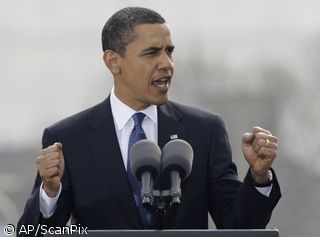 US President Barack Obama said that the economy was weaker than he thought when he took office, but there are signs of improvement.
more »
US President Barack Obama said that the economy was weaker than he thought when he took office, but there are signs of improvement.
more »
 The EIB and UniCredit Group strengthen their cooperation to implement the Joint Action Plan of the largest multilateral lenders in Central and Eastern Europe who have committed to provide up to EUR 24.5 bn lending to the SME sector hit by the global economic crisis.
more »
The EIB and UniCredit Group strengthen their cooperation to implement the Joint Action Plan of the largest multilateral lenders in Central and Eastern Europe who have committed to provide up to EUR 24.5 bn lending to the SME sector hit by the global economic crisis.
more »
 Within the first half of 2009, AB Bank SNORAS earned LTL 24 million of unaudited profit.
more »
Within the first half of 2009, AB Bank SNORAS earned LTL 24 million of unaudited profit.
more »
 10,000 workers were helped by the European Globalisation Adjustment Fund (EGF) last year and of these, more than two-thirds found a new job, according to a report adopted by the European Commission today.
more »
10,000 workers were helped by the European Globalisation Adjustment Fund (EGF) last year and of these, more than two-thirds found a new job, according to a report adopted by the European Commission today.
more »
 SEB recently won awards for best consumer Internet banks in Lithuania and Latvia in a ranking presented by Global Finance Magazine.
more »
SEB recently won awards for best consumer Internet banks in Lithuania and Latvia in a ranking presented by Global Finance Magazine.
more »