Microsoft sent a letter to Capitol Hill leaders claiming the recently proposed breakup of the company would prevent the addition of significant new features to Windows for up to a decade.
Published:
11 May 2000 y., Thursday
The proposed remedy amounts to "an elaborate set of software engineering and business restrictions" that would forestall Windows development for the near future, according to the letter sent last week from the software giant's Washington office. Many of the arguments from the letter will likely be incorporated into a brief that Microsoft is scheduled to file tomorrow. The court brief will outline how Microsoft thinks it should be punished in the landmark antitrust case, following the government's call for a split of the software giant. Although the company is required to propose business remedies, many industry observers expect Microsoft to simply reiterate its stance that it did not violate existing antitrust law.
Not surprisingly, Microsoft told congressional leaders the breakup proposal would unfairly punish the company and cripple its ability to compete. The company, which in the letter referred to the proposed operating system company as OS Co. and the applications operation as Apps. Co., argued such a division jeopardized existing and future products.
"The DOJ plan outlaws an innovative Microsoft product, Microsoft BackOffice, by assigning parts of the product to the OS Co. and part to the Apps. Co.," the letter said. The company also said the "DOJ plan appears to prohibit the development of exciting new products now under development at Microsoft, such as new versions of Web TV, the X-Box game console."
The Redmond, Wash.-based software maker added that "the regulations relate to products,markets and issues that were not involved in the DOJ's lawsuit against Microsoft."
Copying, publishing, announcing any information from the News.lt portal without written permission of News.lt editorial office is prohibited.
The most popular articles
 When you fill up your car with petrol you often find that your hand will reek of petrol unless you have worn gloves.
more »
When you fill up your car with petrol you often find that your hand will reek of petrol unless you have worn gloves.
more »
 The EU is going through its worst recession since WWII. Inflation has slowed, but employment and public finances are hard hit. The situation should stabilise in 2010.
more »
The EU is going through its worst recession since WWII. Inflation has slowed, but employment and public finances are hard hit. The situation should stabilise in 2010.
more »
 In the current economic environment, banks should carefully analyze the current and future total cost of ownership of their technology assets, and evaluate the outsourcing alternative.
more »
In the current economic environment, banks should carefully analyze the current and future total cost of ownership of their technology assets, and evaluate the outsourcing alternative.
more »
 Commission proposes first EU law on hedge funds and issues guidelines on bank pay practices.
more »
Commission proposes first EU law on hedge funds and issues guidelines on bank pay practices.
more »
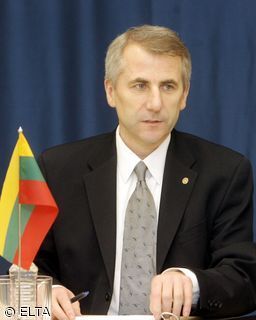 On 30 April, Lithuania’s Minister of Foreign Affairs Vygaudas Ušackas took part in the round table discussion “The European Union’s External Trade Policy and Lithuania’s Positions: Threats and Possibilities for the Lithuanian Industry”.
more »
On 30 April, Lithuania’s Minister of Foreign Affairs Vygaudas Ušackas took part in the round table discussion “The European Union’s External Trade Policy and Lithuania’s Positions: Threats and Possibilities for the Lithuanian Industry”.
more »
 Since 28 April this year, the clients of AB Bank SNORAS will be able to process their financial matters in a clearer and more user-friendly environment of “Internet Bank+” system.
more »
Since 28 April this year, the clients of AB Bank SNORAS will be able to process their financial matters in a clearer and more user-friendly environment of “Internet Bank+” system.
more »
 2009 ageing report: Europe tackling the challenge of an ageing population but the recession threatens a setback.
more »
2009 ageing report: Europe tackling the challenge of an ageing population but the recession threatens a setback.
more »
 More choice, investment and security of supply lie at the heart of the 3rd energy package.
more »
More choice, investment and security of supply lie at the heart of the 3rd energy package.
more »
 Swine flu, a new strain of influenza, has so far left more than a hundred dead. But in one sector, the illness could have huge benefits.
more »
Swine flu, a new strain of influenza, has so far left more than a hundred dead. But in one sector, the illness could have huge benefits.
more »
 Central European bargain hunters are crossing borders for the best buys. Slovakian shoppers in Hungary are making the most of their new eurozone membership.
more »
Central European bargain hunters are crossing borders for the best buys. Slovakian shoppers in Hungary are making the most of their new eurozone membership.
more »