Threat merely a mix-up, executive says.
Published:
21 February 1999 y., Sunday
Microsoft yesterday attempted to douse one of the most explosive charges in 1 1/2 years of federal antitrust scrutiny - that it threatened Compaq Computer with the industry equivalent of the death penalty for replacing Microsoft software with a competitor_s product. The allegation, which first arose in a 1997 lawsuit brought by the U.S. Department of Justice against Microsoft, is one example federal and state antitrust prosecutors cite to show that Microsoft attempted to illegally protect and extend an alleged monopoly held by its Windows operating system. In summer 1996, Microsoft told Compaq that it intended to revoke the Texas computer maker_s Windows license. The sticking point: Compaq had put Netscape Communications_ Internet browser on the desktop of its PCs, bumping Microsoft_s browser off the screen. The Justice Department and 19 states contend Microsoft_ reaction in this case was an example of an illegal attempt to use its power to harm Netscape and hurt it before its Navigator browser could gain enough popularity to challenge Windows as a kind of operating system. Over the past few days in federal court, Microsoft teamed up with Compaq to answer that allegation by showing a different version of events. Testifying for Microsoft, Compaq Senior Vice President John Rose said the dispute that led to Microsoft_s threat was actually the fault of an internal communications flub. Rose said that its handling of competitors_ software on the Compaq desktop had violated the terms of an agreement requiring that the Microsoft Internet browser remain on the desktop. Rose also testified that America Online pressured Compaq to ensure that AOL was the only Internet software accessible on the desktop through an icon.
The most popular articles
 When you fill up your car with petrol you often find that your hand will reek of petrol unless you have worn gloves.
more »
When you fill up your car with petrol you often find that your hand will reek of petrol unless you have worn gloves.
more »
 The EU is going through its worst recession since WWII. Inflation has slowed, but employment and public finances are hard hit. The situation should stabilise in 2010.
more »
The EU is going through its worst recession since WWII. Inflation has slowed, but employment and public finances are hard hit. The situation should stabilise in 2010.
more »
 In the current economic environment, banks should carefully analyze the current and future total cost of ownership of their technology assets, and evaluate the outsourcing alternative.
more »
In the current economic environment, banks should carefully analyze the current and future total cost of ownership of their technology assets, and evaluate the outsourcing alternative.
more »
 Commission proposes first EU law on hedge funds and issues guidelines on bank pay practices.
more »
Commission proposes first EU law on hedge funds and issues guidelines on bank pay practices.
more »
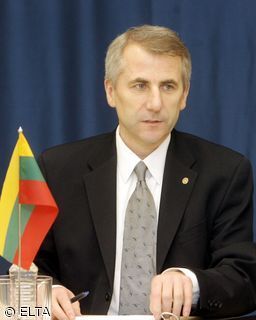 On 30 April, Lithuania’s Minister of Foreign Affairs Vygaudas Ušackas took part in the round table discussion “The European Union’s External Trade Policy and Lithuania’s Positions: Threats and Possibilities for the Lithuanian Industry”.
more »
On 30 April, Lithuania’s Minister of Foreign Affairs Vygaudas Ušackas took part in the round table discussion “The European Union’s External Trade Policy and Lithuania’s Positions: Threats and Possibilities for the Lithuanian Industry”.
more »
 Since 28 April this year, the clients of AB Bank SNORAS will be able to process their financial matters in a clearer and more user-friendly environment of “Internet Bank+” system.
more »
Since 28 April this year, the clients of AB Bank SNORAS will be able to process their financial matters in a clearer and more user-friendly environment of “Internet Bank+” system.
more »
 2009 ageing report: Europe tackling the challenge of an ageing population but the recession threatens a setback.
more »
2009 ageing report: Europe tackling the challenge of an ageing population but the recession threatens a setback.
more »
 More choice, investment and security of supply lie at the heart of the 3rd energy package.
more »
More choice, investment and security of supply lie at the heart of the 3rd energy package.
more »
 Swine flu, a new strain of influenza, has so far left more than a hundred dead. But in one sector, the illness could have huge benefits.
more »
Swine flu, a new strain of influenza, has so far left more than a hundred dead. But in one sector, the illness could have huge benefits.
more »
 Central European bargain hunters are crossing borders for the best buys. Slovakian shoppers in Hungary are making the most of their new eurozone membership.
more »
Central European bargain hunters are crossing borders for the best buys. Slovakian shoppers in Hungary are making the most of their new eurozone membership.
more »