The mobile Internet access market will cater to 136 million people by the end of 2007
Published:
6 August 2001 y., Monday
The mobile Internet access market will cater to 136 million people by the end of 2007, thanks to the increased mobility of the workforce and the introduction of mobile-specific applications, according to Frost & Sullivan. That's an increase from 2.9 million active subscribers in 2000.
Along with the increase in customers will come an increase in revenue for mobile access carriers. Revenue reached $417.6 million from Internet traffic in 2000, and this is projected to surge to $25.89 billion by 2007.
Subscribers to mobile Internet services will vary significantly, specifically as to their choice of access device, whether a smart phone, a PDA or a laptop, which will largely influence their usage patterns. Consumers and corporate users will utilize different devices, because they will have different needs.
According to Frost & Sullivan Research Analysts Brent Iadarola and Kshitij Moghe, the new packet-data environment requires new pricing strategies in order to regulate traffic. They expect operators to introduce "bucket" pricing for bundled voice and data services with varying bucket sizes for different user segments.
The 2001 edition of the "Mobile Cellular Communications" series from Web-Feet Research found that mobile Internet consumers using phones may have to wait a bit longer than originally expected because the recent downturn in the mobile market has caused significant delays in the 3G implementation, but only minor ones in the transition to 2.5G.
Šaltinis:
cyberatlas.internet.com
Copying, publishing, announcing any information from the News.lt portal without written permission of News.lt editorial office is prohibited.
The most popular articles
 The EBRD is making a €4 million equity investment in Geofoto, a Croatian geodetic company offering mapping, geodetic survey, photogrammetry, geoinformatics and aerial survey services, to support its drive to expand operations on international level.
more »
The EBRD is making a €4 million equity investment in Geofoto, a Croatian geodetic company offering mapping, geodetic survey, photogrammetry, geoinformatics and aerial survey services, to support its drive to expand operations on international level.
more »
 Nordea came out of 2009 in an even stronger position, despite one of the most challenging years for decades. Risk-adjusted profit increased 22% and our capital position and cost of funding are among the best in Europe.
more »
Nordea came out of 2009 in an even stronger position, despite one of the most challenging years for decades. Risk-adjusted profit increased 22% and our capital position and cost of funding are among the best in Europe.
more »
 MEPs gave the green light on Thursday for EU funding to help Europe's unemployed start up small businesses.
more »
MEPs gave the green light on Thursday for EU funding to help Europe's unemployed start up small businesses.
more »
 MEPs are deeply concerned about the long-standing and growing presence of al-Qaeda, and the deteriorating security, social and economic problems in Yemen, which they think could destabilise neighbouring countries.
more »
MEPs are deeply concerned about the long-standing and growing presence of al-Qaeda, and the deteriorating security, social and economic problems in Yemen, which they think could destabilise neighbouring countries.
more »
 At the start of a new decade, Sub Saharan Africa is reeling from the effects of three major global crises – food, fuel and financial – that have reversed many of the economic achievements of the last 10 years and left some growth projections at levels below those of 30 years ago.
more »
At the start of a new decade, Sub Saharan Africa is reeling from the effects of three major global crises – food, fuel and financial – that have reversed many of the economic achievements of the last 10 years and left some growth projections at levels below those of 30 years ago.
more »
 The 5th High-level Seminar of Central Banks in the East Asia-Pacific Region and the Euro Area was jointly organised by the European Central Bank and the Reserve Bank of Australia, in cooperation with the Hong Kong Monetary Authority.
more »
The 5th High-level Seminar of Central Banks in the East Asia-Pacific Region and the Euro Area was jointly organised by the European Central Bank and the Reserve Bank of Australia, in cooperation with the Hong Kong Monetary Authority.
more »
 The EBRD and European Fund for Southeast Europe are boosting the availability of financing to private businesses in Moldova with a $10 million loan to ProCredit Bank in Moldova for on-lending to micro and small enterprises.
more »
The EBRD and European Fund for Southeast Europe are boosting the availability of financing to private businesses in Moldova with a $10 million loan to ProCredit Bank in Moldova for on-lending to micro and small enterprises.
more »
 The EBRD is supporting the development of the retail infrastructure in Croatia with a €68 million loan to finance the construction of a modern shopping centre in Split, the second largest city in Croatia.
more »
The EBRD is supporting the development of the retail infrastructure in Croatia with a €68 million loan to finance the construction of a modern shopping centre in Split, the second largest city in Croatia.
more »
 The European Bank for Reconstruction and Development has agreed to sell its 15 percent stake in OAO Swedbank Russia to its parent and major stakeholder, Sweden’s Swedbank AB, a move which would give it full ownership of its Russian subsidiary.
more »
The European Bank for Reconstruction and Development has agreed to sell its 15 percent stake in OAO Swedbank Russia to its parent and major stakeholder, Sweden’s Swedbank AB, a move which would give it full ownership of its Russian subsidiary.
more »
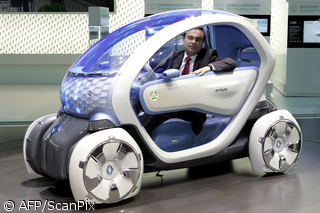 The Ministers of Industry took the first steps in San Sebastián today to make the electric vehicle a reality in Europe and agreed that European institutions, with the EC at the head, should lead a common strategy on electric vehicles.
more »
The Ministers of Industry took the first steps in San Sebastián today to make the electric vehicle a reality in Europe and agreed that European institutions, with the EC at the head, should lead a common strategy on electric vehicles.
more »