OPEC Planning to Maintain Oil Quotas as U.S. Winter Nears
Published:
24 September 2003 y., Wednesday
OPEC, supplier of a third of the world's oil, is planning to maintain output quotas through the end of the year as sabotage limits Iraqi exports and demand rises because of winter from the U.S. to Japan, officials said.
The group meets today in Vienna. Ministers from Saudi Arabia, Iran, Kuwait, the United Arab Emirates, Algeria, Venezuela and Indonesia have signaled no change is needed because prices are within their target of $22 to $28 a barrel.
``OPEC has no immediate need to act,'' said Chris Brown, director of energy consulting at Wood Mackenzie Consultants Ltd. in London. ``We could see a cut in the next two months depending on how more Iraqi oil comes on line. The last thing OPEC wants is a glut forming.''
Crude oil in London has averaged $28.29 a barrel in 2003, $10 more than the 1990s average, boosting income within the Organization of Petroleum Exporting Countries and profit at oil companies such as BP and Exxon Mobil Corp. Prices may fall in 2004 as Iraqi exports and rising output in Russia overwhelm demand, according to a Bloomberg News survey.
Iraqi Oil Minister Ibrahim Mohammad Bahr al-Ulum traveled to Vienna for the gathering, where Venezuela objected to the country's participation in the formal meeting. The minister was appointed with the help of the U.S.-led authority in Baghdad, and Iraq's interim government has yet to be recognized by the United Nations.
Concern is mounting among ministers that prices will decline in 2004, and Algerian and Kuwaiti officials said OPEC may have to assemble again in December. Oil prices have dropped 15 percent in the past month for OPEC's benchmark, to $24.82 a barrel.
Šaltinis:
Bloomberg
Copying, publishing, announcing any information from the News.lt portal without written permission of News.lt editorial office is prohibited.
The most popular articles
 The EBRD is making a €4 million equity investment in Geofoto, a Croatian geodetic company offering mapping, geodetic survey, photogrammetry, geoinformatics and aerial survey services, to support its drive to expand operations on international level.
more »
The EBRD is making a €4 million equity investment in Geofoto, a Croatian geodetic company offering mapping, geodetic survey, photogrammetry, geoinformatics and aerial survey services, to support its drive to expand operations on international level.
more »
 Nordea came out of 2009 in an even stronger position, despite one of the most challenging years for decades. Risk-adjusted profit increased 22% and our capital position and cost of funding are among the best in Europe.
more »
Nordea came out of 2009 in an even stronger position, despite one of the most challenging years for decades. Risk-adjusted profit increased 22% and our capital position and cost of funding are among the best in Europe.
more »
 MEPs gave the green light on Thursday for EU funding to help Europe's unemployed start up small businesses.
more »
MEPs gave the green light on Thursday for EU funding to help Europe's unemployed start up small businesses.
more »
 MEPs are deeply concerned about the long-standing and growing presence of al-Qaeda, and the deteriorating security, social and economic problems in Yemen, which they think could destabilise neighbouring countries.
more »
MEPs are deeply concerned about the long-standing and growing presence of al-Qaeda, and the deteriorating security, social and economic problems in Yemen, which they think could destabilise neighbouring countries.
more »
 At the start of a new decade, Sub Saharan Africa is reeling from the effects of three major global crises – food, fuel and financial – that have reversed many of the economic achievements of the last 10 years and left some growth projections at levels below those of 30 years ago.
more »
At the start of a new decade, Sub Saharan Africa is reeling from the effects of three major global crises – food, fuel and financial – that have reversed many of the economic achievements of the last 10 years and left some growth projections at levels below those of 30 years ago.
more »
 The 5th High-level Seminar of Central Banks in the East Asia-Pacific Region and the Euro Area was jointly organised by the European Central Bank and the Reserve Bank of Australia, in cooperation with the Hong Kong Monetary Authority.
more »
The 5th High-level Seminar of Central Banks in the East Asia-Pacific Region and the Euro Area was jointly organised by the European Central Bank and the Reserve Bank of Australia, in cooperation with the Hong Kong Monetary Authority.
more »
 The EBRD and European Fund for Southeast Europe are boosting the availability of financing to private businesses in Moldova with a $10 million loan to ProCredit Bank in Moldova for on-lending to micro and small enterprises.
more »
The EBRD and European Fund for Southeast Europe are boosting the availability of financing to private businesses in Moldova with a $10 million loan to ProCredit Bank in Moldova for on-lending to micro and small enterprises.
more »
 The EBRD is supporting the development of the retail infrastructure in Croatia with a €68 million loan to finance the construction of a modern shopping centre in Split, the second largest city in Croatia.
more »
The EBRD is supporting the development of the retail infrastructure in Croatia with a €68 million loan to finance the construction of a modern shopping centre in Split, the second largest city in Croatia.
more »
 The European Bank for Reconstruction and Development has agreed to sell its 15 percent stake in OAO Swedbank Russia to its parent and major stakeholder, Sweden’s Swedbank AB, a move which would give it full ownership of its Russian subsidiary.
more »
The European Bank for Reconstruction and Development has agreed to sell its 15 percent stake in OAO Swedbank Russia to its parent and major stakeholder, Sweden’s Swedbank AB, a move which would give it full ownership of its Russian subsidiary.
more »
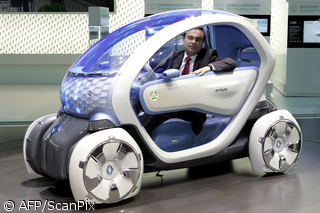 The Ministers of Industry took the first steps in San Sebastián today to make the electric vehicle a reality in Europe and agreed that European institutions, with the EC at the head, should lead a common strategy on electric vehicles.
more »
The Ministers of Industry took the first steps in San Sebastián today to make the electric vehicle a reality in Europe and agreed that European institutions, with the EC at the head, should lead a common strategy on electric vehicles.
more »