BELARUSIAN PREMIER ASSURES IMF OF ECONOMIC LIBERALIZATION...
Published:
8 November 2001 y., Thursday
Premier Henadz Navitski met on 6 November with an IMF mission that is currently in Belarus to monitor the results of an economic program implemented by the government in April-September. Navitski assured the mission that his government is working to further liberalize monetary controls, tighten tax policy, curb inflation, speed up price liberalization, get rid of cross-subsidies, step up privatization, adopt universally recognized principles for tariff control, and remove any obstacles to free trade in anticipation of entry to the World Trade Organization. The premier also underscored his cabinet's intention to encourage small and medium-sized enterprises.
Meanwhile, IMF European II Department Director John Odling-Smee said in Minsk the same day that the Belarusian government has implemented the six-month program only in part. According to Odling-Smee, it is too early to talk about the possibility of the IMF's support for Belarus. Odling-Smee noted that a major cause of the Belarusian government's failure to observe some parameters stipulated by the program is its decision to increase the average monthly pay to the equivalent of $100.
President Alyaksandr Lukashenka said in Hrodna on 6 November that there are some 100,000 illegal immigrants in Belarus, Belarusian Television reported. According to him, Hrodna Oblast has become a "storeroom" for illegal immigrants heading for Western Europe. He threatened that the West will have problems unless it pays Belarus money for dealing with illegal immigration.
Šaltinis:
rferl.org
Copying, publishing, announcing any information from the News.lt portal without written permission of News.lt editorial office is prohibited.
The most popular articles
 When you fill up your car with petrol you often find that your hand will reek of petrol unless you have worn gloves.
more »
When you fill up your car with petrol you often find that your hand will reek of petrol unless you have worn gloves.
more »
 The EU is going through its worst recession since WWII. Inflation has slowed, but employment and public finances are hard hit. The situation should stabilise in 2010.
more »
The EU is going through its worst recession since WWII. Inflation has slowed, but employment and public finances are hard hit. The situation should stabilise in 2010.
more »
 In the current economic environment, banks should carefully analyze the current and future total cost of ownership of their technology assets, and evaluate the outsourcing alternative.
more »
In the current economic environment, banks should carefully analyze the current and future total cost of ownership of their technology assets, and evaluate the outsourcing alternative.
more »
 Commission proposes first EU law on hedge funds and issues guidelines on bank pay practices.
more »
Commission proposes first EU law on hedge funds and issues guidelines on bank pay practices.
more »
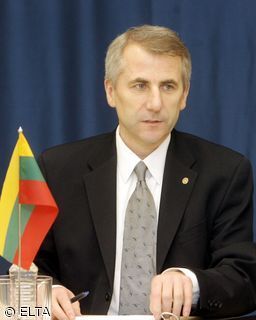 On 30 April, Lithuania’s Minister of Foreign Affairs Vygaudas Ušackas took part in the round table discussion “The European Union’s External Trade Policy and Lithuania’s Positions: Threats and Possibilities for the Lithuanian Industry”.
more »
On 30 April, Lithuania’s Minister of Foreign Affairs Vygaudas Ušackas took part in the round table discussion “The European Union’s External Trade Policy and Lithuania’s Positions: Threats and Possibilities for the Lithuanian Industry”.
more »
 Since 28 April this year, the clients of AB Bank SNORAS will be able to process their financial matters in a clearer and more user-friendly environment of “Internet Bank+” system.
more »
Since 28 April this year, the clients of AB Bank SNORAS will be able to process their financial matters in a clearer and more user-friendly environment of “Internet Bank+” system.
more »
 2009 ageing report: Europe tackling the challenge of an ageing population but the recession threatens a setback.
more »
2009 ageing report: Europe tackling the challenge of an ageing population but the recession threatens a setback.
more »
 More choice, investment and security of supply lie at the heart of the 3rd energy package.
more »
More choice, investment and security of supply lie at the heart of the 3rd energy package.
more »
 Swine flu, a new strain of influenza, has so far left more than a hundred dead. But in one sector, the illness could have huge benefits.
more »
Swine flu, a new strain of influenza, has so far left more than a hundred dead. But in one sector, the illness could have huge benefits.
more »
 Central European bargain hunters are crossing borders for the best buys. Slovakian shoppers in Hungary are making the most of their new eurozone membership.
more »
Central European bargain hunters are crossing borders for the best buys. Slovakian shoppers in Hungary are making the most of their new eurozone membership.
more »