Consumers Not Ready for EBPP
Published:
17 July 1999 y., Saturday
Consumers` interest in electronic bill presentment and payment (EBPP)
services lags behind that of companies, particularly high-volume
billers that want to switch from paper-based to electronic systems,
according to research conducted by PSI Global. According to PSI`s
research, only 7 percent of US households think they will be capable
of sending and receiving bills via the Internet within six to 12
months, and only 16 percent said they would like to use the
Internet both to receive and pay bills within the next three years.
PSI predicts that up to 15 percent of US households are likely to
be immediate adopters of EBPP services when they become available.
Close to 50 percent of US households already have PCs, and more than
a third of these PC owners actively use financial management
software. The use of checks to pay bills has also declined from 90
percent in 1990 to 76 percent this year, according to PSI. The most
likely agent to drive the change from paper-based billing to
electronics, according to PSI, is the potential cost savings for the
leading billing sectors. Consumers are expected to pay 15.9 billion
bill payments. The leading billing sectors - primarily lenders,
utilities, communications, insurance and credit card issuers-account
for more than 80 percent of all bills to consumers. For these
firms, EBPP potentially means billions of dollars in cost savings
annually. Among the factors that could delay consumer acceptance of
EBPP are concerns over privacy and convenience. Almost three-quarters
(63 percent) of households believe that receiving and paying bills
using the US Postal Service is more reliable and secure than
electronic delivery options; 74 percent of households like the
privacy of paying bills by check; and 72 percent like the
convenience of paying bills by check. One-quarter of households
believe that the Internet is not secure, and 65 percent are not
certain about Internet security. For nearly half of all households,
retaining control of payment timing is important.
Copying, publishing, announcing any information from the News.lt portal without written permission of News.lt editorial office is prohibited.
The most popular articles
 Business to get a break under streamlined EU VAT rules.
more »
Business to get a break under streamlined EU VAT rules.
more »
 Thales UK`s naval business has yesterday signed a major sub-contract with Finning (UK) Ltd for the supply of propulsion engines and machinery for its new Lithuanian warship reactivation programme.
more »
Thales UK`s naval business has yesterday signed a major sub-contract with Finning (UK) Ltd for the supply of propulsion engines and machinery for its new Lithuanian warship reactivation programme.
more »
 The EU Budget 2009 provides more money for growth, the environment, jobs, research and food aid for developing countries.
more »
The EU Budget 2009 provides more money for growth, the environment, jobs, research and food aid for developing countries.
more »
 On day one of the World Economic Forum in Davos, the mood of this traditionally bullish event -- pure gloom.
more »
On day one of the World Economic Forum in Davos, the mood of this traditionally bullish event -- pure gloom.
more »
 In December 2008 against December 2007 the turnover of retail trade enterprises decreased by 8.8 per cent.
more »
In December 2008 against December 2007 the turnover of retail trade enterprises decreased by 8.8 per cent.
more »
 Mexican financial institution Banco Santander has awarded Wincor Nixdorf AG a contract to service all 4,000 of its ATMs installed in Mexico.
more »
Mexican financial institution Banco Santander has awarded Wincor Nixdorf AG a contract to service all 4,000 of its ATMs installed in Mexico.
more »
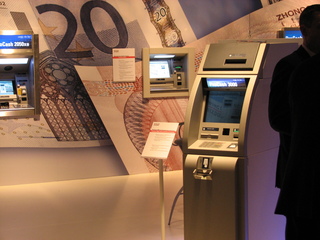 Wincor Nixdorf AG spent much of its time at this year's Wincor World demonstrating how Wincor Nixdorf can support financial institutions and retailers through innovation.
more »
Wincor Nixdorf AG spent much of its time at this year's Wincor World demonstrating how Wincor Nixdorf can support financial institutions and retailers through innovation.
more »
 South Korea may be feeling the chill wind of recession but the country's lucrative gambling industry is cashing in.
more »
South Korea may be feeling the chill wind of recession but the country's lucrative gambling industry is cashing in.
more »
 Modest revenue growth despite difficult economy; announces cost management initiatives.
more »
Modest revenue growth despite difficult economy; announces cost management initiatives.
more »
 Tens of thousands of export firms on China's seaboard have closed due to falling demand in major European and North American markets.
more »
Tens of thousands of export firms on China's seaboard have closed due to falling demand in major European and North American markets.
more »