Consumers Not Ready for EBPP
Published:
17 July 1999 y., Saturday
Consumers` interest in electronic bill presentment and payment (EBPP)
services lags behind that of companies, particularly high-volume
billers that want to switch from paper-based to electronic systems,
according to research conducted by PSI Global. According to PSI`s
research, only 7 percent of US households think they will be capable
of sending and receiving bills via the Internet within six to 12
months, and only 16 percent said they would like to use the
Internet both to receive and pay bills within the next three years.
PSI predicts that up to 15 percent of US households are likely to
be immediate adopters of EBPP services when they become available.
Close to 50 percent of US households already have PCs, and more than
a third of these PC owners actively use financial management
software. The use of checks to pay bills has also declined from 90
percent in 1990 to 76 percent this year, according to PSI. The most
likely agent to drive the change from paper-based billing to
electronics, according to PSI, is the potential cost savings for the
leading billing sectors. Consumers are expected to pay 15.9 billion
bill payments. The leading billing sectors - primarily lenders,
utilities, communications, insurance and credit card issuers-account
for more than 80 percent of all bills to consumers. For these
firms, EBPP potentially means billions of dollars in cost savings
annually. Among the factors that could delay consumer acceptance of
EBPP are concerns over privacy and convenience. Almost three-quarters
(63 percent) of households believe that receiving and paying bills
using the US Postal Service is more reliable and secure than
electronic delivery options; 74 percent of households like the
privacy of paying bills by check; and 72 percent like the
convenience of paying bills by check. One-quarter of households
believe that the Internet is not secure, and 65 percent are not
certain about Internet security. For nearly half of all households,
retaining control of payment timing is important.
Copying, publishing, announcing any information from the News.lt portal without written permission of News.lt editorial office is prohibited.
The most popular articles
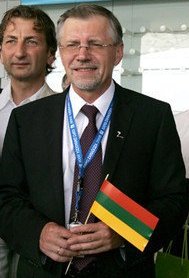 In Brussels, Prime Minister Gediminas Kirkilas participated in the meeting of Nordic and Baltic (NB6) Prime Ministers which focused on the pressing topics on the agenda of the European Council: global finance crisis, energy, climate change, EU-Russia relations, and financial situation in Iceland.
more »
In Brussels, Prime Minister Gediminas Kirkilas participated in the meeting of Nordic and Baltic (NB6) Prime Ministers which focused on the pressing topics on the agenda of the European Council: global finance crisis, energy, climate change, EU-Russia relations, and financial situation in Iceland.
more »
 Prime Minister Gediminas Kirkilas attended the working dinner with President of the European Commission José Manuel Barroso, Danish, Estonian, Finnish, Latvian, Polish Prime Ministers – Anders Fogh Rasmussen, Andrus Ansip, Matti Vanhanen, Ivars Godmanis, Donald Tusk – and Swedish Minister of Foreign Affairs Carl Bildt.
more »
Prime Minister Gediminas Kirkilas attended the working dinner with President of the European Commission José Manuel Barroso, Danish, Estonian, Finnish, Latvian, Polish Prime Ministers – Anders Fogh Rasmussen, Andrus Ansip, Matti Vanhanen, Ivars Godmanis, Donald Tusk – and Swedish Minister of Foreign Affairs Carl Bildt.
more »
 The European Commission has put forward a revision of EU rules on deposit guarantee schemes that puts into action the commitments made by EU Finance Ministers on 7 October.
more »
The European Commission has put forward a revision of EU rules on deposit guarantee schemes that puts into action the commitments made by EU Finance Ministers on 7 October.
more »
 The United States began releasing long-awaited details of its $700 billion rescue plan.
more »
The United States began releasing long-awaited details of its $700 billion rescue plan.
more »
 Australia's Prime Minister announces plans for the government to guarantee bank deposits for the next three years.
more »
Australia's Prime Minister announces plans for the government to guarantee bank deposits for the next three years.
more »
 Ethical bank, Triodos, says it is offering customers an alternative way to invest their funds.
more »
Ethical bank, Triodos, says it is offering customers an alternative way to invest their funds.
more »
 Energy security was the dominant theme during the meeting between Lithuanian Prime Minister Gediminas Kirkilas and Latvian Prime Minister Ivars Godmanis.
more »
Energy security was the dominant theme during the meeting between Lithuanian Prime Minister Gediminas Kirkilas and Latvian Prime Minister Ivars Godmanis.
more »
 The draft law would require utilities to separate – or unbundle – the distribution of electricity and gas from production.
more »
The draft law would require utilities to separate – or unbundle – the distribution of electricity and gas from production.
more »
 A holistic approach to eradicating poverty, which seeks to ensure adequate incomes, quality jobs and better access to social services, is advocated by the EP in an own-initiative report.
more »
A holistic approach to eradicating poverty, which seeks to ensure adequate incomes, quality jobs and better access to social services, is advocated by the EP in an own-initiative report.
more »
 Dubai showcases multi-billion dollar development projects at the annual Cityscape exhibition.
more »
Dubai showcases multi-billion dollar development projects at the annual Cityscape exhibition.
more »