WTO negotiators reach tentative accord on major global trade issues
Published:
5 August 2004 y., Thursday
Key trade ministers tentatively agreed Saturday on a plan to end export subsidies on farm products and cut import duties around the world, a key step toward a comprehensive global accord under discussion since 2001, trade officials said.
The deal was expected to be approved by all 147 members of the World Trade Organization later Saturday, opening the way for full negotiations to start in September.
"Developed countries have recognized that agricultural trade with a heavy subsidy component is not free trade," said Indian Trade Minister Kamal Nath.
But he said the United States, European Union and other developed countries will also benefit by removing heavy agricultural subsidies from their budgets.
Ken Ritter, president of the Canadian Wheat Board, said he's concerned the tentative deal would break a promise the Canadian government made to protect the grain marketing monopoly. In a breakthrough Saturday some 20 key countries approved a document setting out the framework for a legally binding treaty, World Trade Organization spokesman Keith Rockwell said.
The document will commit countries to lowering import duties and reducing government support in the three major areas of international trade - industrial goods, agriculture and service industries, such as telecommunications and banking.
The deal sets back in motion the long-stalled "round" of trade liberalization treaty talks that were launched by WTO members in Doha, Qatar, in 2001 but delayed by the collapse of the body's ministerial meeting in Cancun, Mexico, last year.
In agriculture, the document agrees to eliminate export subsidies and other forms of government support for exports, while making big cuts to other subsidies. It includes a "down payment" that would see an immediate 20-per-cent cut in the maximum permitted payments by rich countries.
Šaltinis:
Canadian Press
Copying, publishing, announcing any information from the News.lt portal without written permission of News.lt editorial office is prohibited.
The most popular articles
 When you fill up your car with petrol you often find that your hand will reek of petrol unless you have worn gloves.
more »
When you fill up your car with petrol you often find that your hand will reek of petrol unless you have worn gloves.
more »
 The EU is going through its worst recession since WWII. Inflation has slowed, but employment and public finances are hard hit. The situation should stabilise in 2010.
more »
The EU is going through its worst recession since WWII. Inflation has slowed, but employment and public finances are hard hit. The situation should stabilise in 2010.
more »
 In the current economic environment, banks should carefully analyze the current and future total cost of ownership of their technology assets, and evaluate the outsourcing alternative.
more »
In the current economic environment, banks should carefully analyze the current and future total cost of ownership of their technology assets, and evaluate the outsourcing alternative.
more »
 Commission proposes first EU law on hedge funds and issues guidelines on bank pay practices.
more »
Commission proposes first EU law on hedge funds and issues guidelines on bank pay practices.
more »
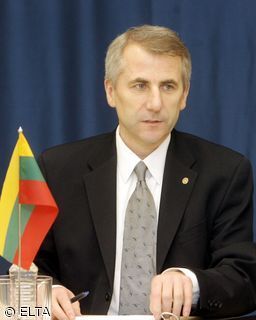 On 30 April, Lithuania’s Minister of Foreign Affairs Vygaudas Ušackas took part in the round table discussion “The European Union’s External Trade Policy and Lithuania’s Positions: Threats and Possibilities for the Lithuanian Industry”.
more »
On 30 April, Lithuania’s Minister of Foreign Affairs Vygaudas Ušackas took part in the round table discussion “The European Union’s External Trade Policy and Lithuania’s Positions: Threats and Possibilities for the Lithuanian Industry”.
more »
 Since 28 April this year, the clients of AB Bank SNORAS will be able to process their financial matters in a clearer and more user-friendly environment of “Internet Bank+” system.
more »
Since 28 April this year, the clients of AB Bank SNORAS will be able to process their financial matters in a clearer and more user-friendly environment of “Internet Bank+” system.
more »
 2009 ageing report: Europe tackling the challenge of an ageing population but the recession threatens a setback.
more »
2009 ageing report: Europe tackling the challenge of an ageing population but the recession threatens a setback.
more »
 More choice, investment and security of supply lie at the heart of the 3rd energy package.
more »
More choice, investment and security of supply lie at the heart of the 3rd energy package.
more »
 Swine flu, a new strain of influenza, has so far left more than a hundred dead. But in one sector, the illness could have huge benefits.
more »
Swine flu, a new strain of influenza, has so far left more than a hundred dead. But in one sector, the illness could have huge benefits.
more »
 Central European bargain hunters are crossing borders for the best buys. Slovakian shoppers in Hungary are making the most of their new eurozone membership.
more »
Central European bargain hunters are crossing borders for the best buys. Slovakian shoppers in Hungary are making the most of their new eurozone membership.
more »