Pentagon took an hour out on Tuesday to recall one of its largely forgotten low-tech triumphs -- code talking.
Published:
7 December 1999 y., Tuesday
As four American Indians beat a drum and chanted, Charles Chibitty, a 78-year-old Comanche elder, received a medal for his work in a war that ended half a century ago. It_s a medal he believes was long overdue.
Chibitty was honoured as the last living member among 17 Comanches recruited in Oklahoma during World War II to use their language to fool the Germans. As with the Choctaws in World War I and the Navajos in the Pacific Theater during World War II, the US Army took advantage of the obscure native language to provide a simple code for relaying battlefield messages that confounded the enemy.
Chibitty recalled one of his first messages, when he and some of his fellow Comanches were dispatched with forward units while others manned radios at headquarters to relay information that would have endangered other troops had it been overheard.
"The regiment is five miles to the right of it_s designated area. There is furious fighting. Needs help," was his message in English. As it was relayed over the radio, it was in his native language, with a series of intricate codes that they had spent months mastering back in the United States.
Comanche is not a written language and bears no resemblance to European or Asian languages. While the British employed thousands of mathematicians, crossword puzzle experts, and other cryptanalysts to crack the highly sophisticated German Enigma code -- a major breakthrough in the war -- the American code talkers were never knowingly cracked.
Many of the words of 20th century warfare were not in the Comanche vocabulary. For tank, they used the word for turtle. A machine gun was a "sewing machine gun." A bomber was "a pregnant machine that flies."
Copying, publishing, announcing any information from the News.lt portal without written permission of News.lt editorial office is prohibited.
The most popular articles
 A new exhibition at The Guggenheim Museum reveals winners of a worldwide competition of video art submitted via YouTube.
more »
A new exhibition at The Guggenheim Museum reveals winners of a worldwide competition of video art submitted via YouTube.
more »
 Tourists will soon be able to get a gladiator-eye view of Rome’s Colosseum, as the dungeons and the upper third tier of the world's most famous fighting arena open to the public.
more »
Tourists will soon be able to get a gladiator-eye view of Rome’s Colosseum, as the dungeons and the upper third tier of the world's most famous fighting arena open to the public.
more »
 The President of the European Commission said, “With this Nobel Prize, the international community acknowledges the fruitful work of one of the best writers of our times.
more »
The President of the European Commission said, “With this Nobel Prize, the international community acknowledges the fruitful work of one of the best writers of our times.
more »
 At its four-day meeting in Madrid, the selection panel appointed to assess the cities applying to be a European Capital of Culture in 2016 recommended that the following be preselected from a fiercely competitive field: Burgos, Córdoba, Donostia-San Sebastián, Las Palmas de Gran Canaria, Segovia and Zaragoza.
more »
At its four-day meeting in Madrid, the selection panel appointed to assess the cities applying to be a European Capital of Culture in 2016 recommended that the following be preselected from a fiercely competitive field: Burgos, Córdoba, Donostia-San Sebastián, Las Palmas de Gran Canaria, Segovia and Zaragoza.
more »
 Archaeologists in Peru discover a burial site from an ancient civilization that predates the Incas and would have been in existence near the time of Christ.
more »
Archaeologists in Peru discover a burial site from an ancient civilization that predates the Incas and would have been in existence near the time of Christ.
more »
 The World Cup Tango competition gets under way in Buenos Aires.
more »
The World Cup Tango competition gets under way in Buenos Aires.
more »
 An amateur artist from St. Petersburg, Russia, offers paintings which she creates with her breasts.
more »
An amateur artist from St. Petersburg, Russia, offers paintings which she creates with her breasts.
more »
Summer is the season for cultural festivals. With a bumper harvest of cultural events out there, what better time of year to head off and sample the exceptional places and world-class artists that Europe has to offer?
more »
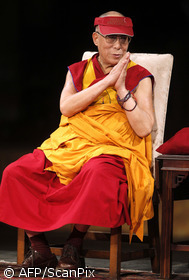 The Dalai Lama inaugurates a 106-foot-tall Buddha statue in India's Kashmir.
more »
The Dalai Lama inaugurates a 106-foot-tall Buddha statue in India's Kashmir.
more »
 Akadimia Platonos, Die Fremde and Illégal were the three films shortlisted on Tuesday for the European Parliament's 2010 LUX film prize, during an event at the Venice International Film Festival.
more »
Akadimia Platonos, Die Fremde and Illégal were the three films shortlisted on Tuesday for the European Parliament's 2010 LUX film prize, during an event at the Venice International Film Festival.
more »