From Smart Cards to Biometrics.
Published:
19 March 1999 y., Friday
More than ever before industry and commerce are dependent on electronic access control systems and electronic payment systems. The growth of the internet and the widely predicted boom in e-commerce will increase this dependency further as we move into the next millennium. This has prompted science and industry to explore the possibilities for improving methods of user identification. PIN and password systems will gradually be replaced by more robust systems; initially by such methods as smart cards and ultimately by the use of biometrics whereby the human body is used as its own identity card. Chip cards, the highest-volume electronics end product in the world today, can perform various duties such as pocket change, paper money, debit and credit cards, acting as a means of identification, access, or payment. By combining the Java programming language and smart cards manufacturers hope to open up a new world of applications for the mobile telephone user. Java will enable applications to be added to a handset_s smart card while on the move or via an ATM. At CeBIT Schlumberger is showing a new Java smart card which combines multi-application flexibility with built-in cryptographic services. It allows transactions - including the remote loading of applications - to be authenticated using digital signatures. Claimed to be the first commercially available card of this type in the world, the platform provides the means for developers to implement a host of new portable applications including unique ID tokens for securing virtual intranet transactions, custom network access security, pay TV and authenticated monetary or information transfer. Like many other technologies biometrics began life as a military application. The user is identified on the basis of his or her unique physical characteristics (eyes, facial characteristics, gestures, voice, fingerprints). The human body functions as a forgery-proof identity card and security is no longer dependent on the ability of the person to memorise his or her PIN or password. Last year Compaq, IBM, Identicator Technology, Microsoft, Miros and Novell announced the formation of the BioAPI consortium dedicated to developing standards to improve the identification and authentication of PC users. The BioAPI Consortium is committed to making biometrics technologies - initially fingerprint, voice and face recognition - available to the mainstream commercial marketplace. The Consortium plans to provide APIs that can be incorporated into operating systems and application software which will provide customers access to a wide variety of biometric hardware and software products, as well as allow them to readily utilise products from different vendors. Compaq was one of the first to market with a computer access system with its Fingerprint Identification Technology (FIT) launched last year. A hardware/software combination, FIT uses biometric technology to tighten network security and simplify logon by eliminating the need to enter end-user passwords. A small camera in the FIT reader captures an image of the fingerprint and uses complex algorithms to convert the image into a unique "map" of the fingerprint_s minutiae.This fingerprint template is then encrypted and stored in the network user credential database.
Copying, publishing, announcing any information from the News.lt portal without written permission of News.lt editorial office is prohibited.
The most popular articles
 A new exhibition at The Guggenheim Museum reveals winners of a worldwide competition of video art submitted via YouTube.
more »
A new exhibition at The Guggenheim Museum reveals winners of a worldwide competition of video art submitted via YouTube.
more »
 Tourists will soon be able to get a gladiator-eye view of Rome’s Colosseum, as the dungeons and the upper third tier of the world's most famous fighting arena open to the public.
more »
Tourists will soon be able to get a gladiator-eye view of Rome’s Colosseum, as the dungeons and the upper third tier of the world's most famous fighting arena open to the public.
more »
 The President of the European Commission said, “With this Nobel Prize, the international community acknowledges the fruitful work of one of the best writers of our times.
more »
The President of the European Commission said, “With this Nobel Prize, the international community acknowledges the fruitful work of one of the best writers of our times.
more »
 At its four-day meeting in Madrid, the selection panel appointed to assess the cities applying to be a European Capital of Culture in 2016 recommended that the following be preselected from a fiercely competitive field: Burgos, Córdoba, Donostia-San Sebastián, Las Palmas de Gran Canaria, Segovia and Zaragoza.
more »
At its four-day meeting in Madrid, the selection panel appointed to assess the cities applying to be a European Capital of Culture in 2016 recommended that the following be preselected from a fiercely competitive field: Burgos, Córdoba, Donostia-San Sebastián, Las Palmas de Gran Canaria, Segovia and Zaragoza.
more »
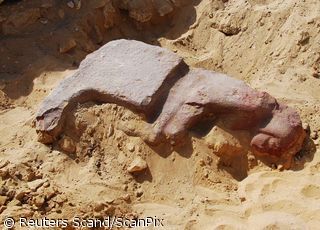 Archaeologists in Peru discover a burial site from an ancient civilization that predates the Incas and would have been in existence near the time of Christ.
more »
Archaeologists in Peru discover a burial site from an ancient civilization that predates the Incas and would have been in existence near the time of Christ.
more »
 The World Cup Tango competition gets under way in Buenos Aires.
more »
The World Cup Tango competition gets under way in Buenos Aires.
more »
 An amateur artist from St. Petersburg, Russia, offers paintings which she creates with her breasts.
more »
An amateur artist from St. Petersburg, Russia, offers paintings which she creates with her breasts.
more »
Summer is the season for cultural festivals. With a bumper harvest of cultural events out there, what better time of year to head off and sample the exceptional places and world-class artists that Europe has to offer?
more »
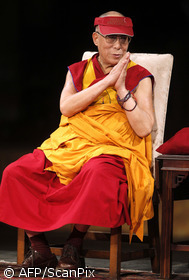 The Dalai Lama inaugurates a 106-foot-tall Buddha statue in India's Kashmir.
more »
The Dalai Lama inaugurates a 106-foot-tall Buddha statue in India's Kashmir.
more »
 Akadimia Platonos, Die Fremde and Illégal were the three films shortlisted on Tuesday for the European Parliament's 2010 LUX film prize, during an event at the Venice International Film Festival.
more »
Akadimia Platonos, Die Fremde and Illégal were the three films shortlisted on Tuesday for the European Parliament's 2010 LUX film prize, during an event at the Venice International Film Festival.
more »