SMALL TECH COULD BE KEY COMPONENT OF A BETTER ANTI-TERRORISM STRATEGY
Published:
13 September 2001 y., Thursday
Small tech could help prevent future terrorist attacks like those in New York and Washington, D.C., on Tuesday that destroyed the World Trade Center and part of the Pentagon, said a leading authority on MEMS and microsystems.
David Williams, former director of the microsystems program at Sandia National Laboratories, outlined three key areas where small tech can be part of a solution before, during or after a terrorist attack: Microsystems and nanotechnology can help gather intelligence, make potential targets more secure and increase the value of forensic evidence after an attack.
Pacific Northwest National Laboratory, a U.S. Department of Energy lab, created a scanning technology for the Federal Aviation Administration to screen airline passengers for plastic weapons and explosives that today’s X-ray and metal detectors don’t register.
The scanner sends out millimeter waves that penetrate materials such as clothing but not flesh or other solid objects. Instead, the waves bounce back to a transceiver that converts the signal to digital form that a computer interprets as a three-dimensional holographic image. The transceiver utilizes microfabrication technologies.
PNNL said the scanner has been tested in the Seattle-Tacoma International Airport and could be used to improve security in government buildings, mass transit operations, prisons and numerous other institutions.
Small tech can also help fortify a building, subway or other public gathering place by detecting explosives and chemical or biological weapons.
Šaltinis:
smalltimes.com
Copying, publishing, announcing any information from the News.lt portal without written permission of News.lt editorial office is prohibited.
The most popular articles
 “Be healthy – be yourself” campaign encourages young people to become more proactive in protecting their health.
more »
“Be healthy – be yourself” campaign encourages young people to become more proactive in protecting their health.
more »
 When 28 year-old Artyom Sidorkin went to see his doctor to complain about pains in his chest and coughing blood his doctors made a rather bizarre discovery.
more »
When 28 year-old Artyom Sidorkin went to see his doctor to complain about pains in his chest and coughing blood his doctors made a rather bizarre discovery.
more »
 Last year French Professor Luc Montagnier jointly won the Nobel Prize for Medicine with Françoise Barré-Sinoussi for their discovery of the HIV virus in 1983.
more »
Last year French Professor Luc Montagnier jointly won the Nobel Prize for Medicine with Françoise Barré-Sinoussi for their discovery of the HIV virus in 1983.
more »
 To mark World Health Day, European Commissioner for Health, Androulla Vassiliou will visit several community health projects in Kenya on 6 and 7 April.
more »
To mark World Health Day, European Commissioner for Health, Androulla Vassiliou will visit several community health projects in Kenya on 6 and 7 April.
more »
 Autism, which affects roughly 67 million people worldwide, is still relatively unheard of in China.
more »
Autism, which affects roughly 67 million people worldwide, is still relatively unheard of in China.
more »
 The courses are arranged for the fifth time in a row; this year Estonian, Georgian, Latvian, and Lithuanian military medics are joined by three Armenian representatives.
more »
The courses are arranged for the fifth time in a row; this year Estonian, Georgian, Latvian, and Lithuanian military medics are joined by three Armenian representatives.
more »
 The choice of food in the EU is huge, but are you well-informed enough to choose well?
more »
The choice of food in the EU is huge, but are you well-informed enough to choose well?
more »
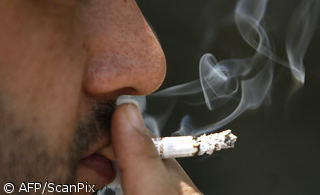 MEPs Tuesday backed a minimum tax of €1.28 per pack of 20 cigarettes within 3 years, in an effort to reduce smoking across Europe through higher prices.
more »
MEPs Tuesday backed a minimum tax of €1.28 per pack of 20 cigarettes within 3 years, in an effort to reduce smoking across Europe through higher prices.
more »
 Parliament approved an update of EU legislation on cosmetics when it votes on a first-reading agreement thrashed out between EP and Council representatives.
more »
Parliament approved an update of EU legislation on cosmetics when it votes on a first-reading agreement thrashed out between EP and Council representatives.
more »
 German doctors are treating a woman they say may have contracted the deadly ebola virus while working in a laboratory nt he city of Hamburg.
more »
German doctors are treating a woman they say may have contracted the deadly ebola virus while working in a laboratory nt he city of Hamburg.
more »