Astronomers from the University of Colorado at Boulder and the University of California at Berkeley have discovered a key building block for new stars in the rapidly expanding remains of an ancient stellar explosion.
Published:
11 June 2001 y., Monday
Presented at the 197th meeting of the American Astronomical Society meeting June 3 to June 7 in Pasadena, Calif., the study provides insights into the early stages of a process by which violent stellar explosions help produce new stars.
"This finding is important because it gives us an example of how a supernova explosion can create new clouds of star-forming material," said Brian Rachford, a postdoctoral researcher at CU-Boulder's Center for Astrophysics and Space Astronomy.
Other participants in the study include Barry Welsh, a senior research scientist at UC-Berkeley's Space Sciences Laboratory and Jason Tumlinson, a doctoral student in CU-Boulder's astrophysical and planetary sciences department and a CASA research assistant.
The Monoceros Loop Supernova Remnant under study resulted from the cataclysmic explosion of a star nearly 100,000 years ago some 5,000 light-years from Earth, said Rachford. The supernova has formed a shell of gas 350 light-years across that is still expanding at a rate of 100,000 miles per hour.
One light-year -- the distance light travels through the universe in a year -- is equal to roughly 6 trillion miles.
The astronomers detected the presence of molecular hydrogen gas in the rapidly moving shell using a spectrograph onboard NASA's Far Ultraviolet Spectrographic Explorer, or FUSE, satellite. The spectrograph breaks up the ultraviolet light in a manner similar to the way a prism breaks up sunlight into a spectrum of individual colors.
Šaltinis:
sciencedaily.com
Copying, publishing, announcing any information from the News.lt portal without written permission of News.lt editorial office is prohibited.
The most popular articles
 With the new influenza season underway, MEPs have criticised the EU's "disproportionate" response to the outbreak of the H1N1 ("swine flu") virus in 2009-2010.
more »
With the new influenza season underway, MEPs have criticised the EU's "disproportionate" response to the outbreak of the H1N1 ("swine flu") virus in 2009-2010.
more »
 Over half the EU adult population is now overweight or obese according to the “Health at a Glance: Europe 2010” report published by the European Commission and the OECD today.
more »
Over half the EU adult population is now overweight or obese according to the “Health at a Glance: Europe 2010” report published by the European Commission and the OECD today.
more »
 Over 130 people die in central Haiti due to a suspected outbreak of cholera.
more »
Over 130 people die in central Haiti due to a suspected outbreak of cholera.
more »
 The Influenza A (H1N1) pandemic returned to the Parliament last week but fortunately not in the literal sense.
more »
The Influenza A (H1N1) pandemic returned to the Parliament last week but fortunately not in the literal sense.
more »
 The Commission announced today its intention to restructure the process of progressive adoption of the list of permitted health claims on food products (also known as “Article 13 claims”).
more »
The Commission announced today its intention to restructure the process of progressive adoption of the list of permitted health claims on food products (also known as “Article 13 claims”).
more »
 Patients will be better informed on how to use medicines, and enabled to report their adverse effects directly to national authorities, thanks to updates of EU laws agreed with the Council and endorsed by Parliament on Wednesday.
more »
Patients will be better informed on how to use medicines, and enabled to report their adverse effects directly to national authorities, thanks to updates of EU laws agreed with the Council and endorsed by Parliament on Wednesday.
more »
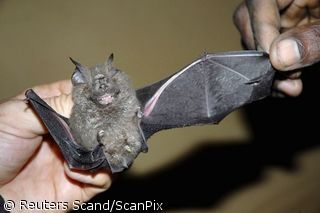 Doctors in Peru are facing outbreaks of two killer diseases, rabies and the plague, being spread by bats and rats.
more »
Doctors in Peru are facing outbreaks of two killer diseases, rabies and the plague, being spread by bats and rats.
more »
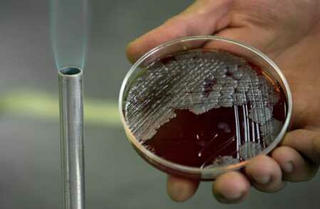 Scientists warn a new drug-resistant superbug could spread worldwide, fuelled in part by medical tourism.
more »
Scientists warn a new drug-resistant superbug could spread worldwide, fuelled in part by medical tourism.
more »
 Chinese officials say they are investigating reports that tainted milk powder has caused premature sexual development in baby girls.
more »
Chinese officials say they are investigating reports that tainted milk powder has caused premature sexual development in baby girls.
more »
 A woman in India says she has to sell her 6-month-old baby in order to pay her husband's medical expenses.
more »
A woman in India says she has to sell her 6-month-old baby in order to pay her husband's medical expenses.
more »