The concept that each person on the planet is just six handshakes removed from every other person has frightening implications
Published:
2 June 2003 y., Monday
The concept that each person on the planet is just six handshakes removed from every other person has frightening implications when it comes to a highly communicable disease like SARS.
Yet the "small world" effect, also known as the "six degrees of separation" phenomenon, may also help explain how severe acute respiratory syndrome has spread so rapidly around the globe, some researchers believe. The disease has infected 8,221 people and killed 735 worldwide, according to the World Health.
Physicists, psychologists and mathematicians who study network effects, the scientific field that the six-degrees-of-separation notion has engendered, are busy creating mathematical models that attempt to explain the quick spread of SARS.
Mathematicians have long used equations to examine the spread of epidemics, and to help public health officials control them. A recent paper in Science applied these methods to SARS.
In the Science article, the researchers assume that most people -- excluding those who come in contact with so-called superspreaders, have about the same chance of developing SARS. Superspreaders, researchers believe, have the ability to infect more people than most patients.
Network science, on the other hand, assumes that each person's social habits can increase or lessen his or her chances of getting infected. For example, one might be much more likely to come into contact with someone with SARS by traveling on a plane to Taiwan, a country that has recently seen a high rate of SARS infections.
Šaltinis:
wired.com
Copying, publishing, announcing any information from the News.lt portal without written permission of News.lt editorial office is prohibited.
The most popular articles
 Some 56 000 people in the EU are currently waiting for a transplant operation. Every day 12 of them die waiting for an organ to be donated.
more »
Some 56 000 people in the EU are currently waiting for a transplant operation. Every day 12 of them die waiting for an organ to be donated.
more »
 Every day, across the vast country, Chinese school children put down their pens and perform a series of government-devised exercises intended to strengthen their eyes.
more »
Every day, across the vast country, Chinese school children put down their pens and perform a series of government-devised exercises intended to strengthen their eyes.
more »
 D. Simmons said the experience of living for so long with a machine pumping her blood was "scary."
more »
D. Simmons said the experience of living for so long with a machine pumping her blood was "scary."
more »
 A recent report found that children in Europe are not getting enough fruit and vegetables, so the European Commission is proposing to set aside money to ensure they get weekly fruit.
more »
A recent report found that children in Europe are not getting enough fruit and vegetables, so the European Commission is proposing to set aside money to ensure they get weekly fruit.
more »
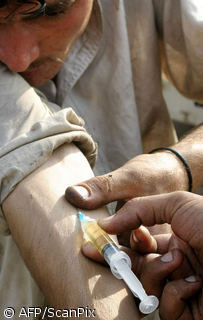 Every year 7,000-8,000 people in the EU die because of drug use and a drugs overdose remains one of the main causes of death among young people.
more »
Every year 7,000-8,000 people in the EU die because of drug use and a drugs overdose remains one of the main causes of death among young people.
more »
 Bad health through a bad diet is a growing problem across Europe.
more »
Bad health through a bad diet is a growing problem across Europe.
more »
 In accordance with the EC Treaty rules on state aid, the European Commission has approved aid worth €90 million to be granted by France to the R&D programme “ADNA” covering the development of personalised medicine for infectious diseases, cancer and genetic diseases.
more »
In accordance with the EC Treaty rules on state aid, the European Commission has approved aid worth €90 million to be granted by France to the R&D programme “ADNA” covering the development of personalised medicine for infectious diseases, cancer and genetic diseases.
more »
 October is international breast cancer awareness month. In Europe alone there are an estimated 430,000 new cases a year and in the EU breast cancer will affect one in 10 women before the age of 80.
more »
October is international breast cancer awareness month. In Europe alone there are an estimated 430,000 new cases a year and in the EU breast cancer will affect one in 10 women before the age of 80.
more »
 Today in the afternoon, President Valdas Adamkus had a lens replacement surgery in his right eye at Santariškių Clinical Hospital.
more »
Today in the afternoon, President Valdas Adamkus had a lens replacement surgery in his right eye at Santariškių Clinical Hospital.
more »
The last four suspected bird flu patients two of them confirmed to have contracted the deadly H5N1 strain were discharged from a hospital in eastern Turkey, signalling an end to the recent outbreak, a doctor said on Saturday.
more »