A controversial Italian embryologist is preparing to impregnate up to 200 women with cloned embryos in the world's first attempt to produce a human clone.
Published:
7 August 2001 y., Tuesday
Professor Severino Antinori will tell the National Academy of Sciences in Washington on Thursday that he expects to start his cloning programme in November. The announcement will reignite an explosive debate about the ethics and safety of cloning for infertility treatment.
Antinori, whose Rome clinic enabled a 62-year-old woman to have a baby in 1994, said that up to 200 couples from several countries, including eight from Britain, were being selected for the cloning project and would be treated free of charge. His team consists of 20 international specialists.
Antinori said the males in most of the couples under consideration were infertile. "They have no natural way of becoming fathers."
The technique he intends to use is similar to that developed to produce Dolly the sheep. A nucleus is taken from a cell belonging to the man; it is inserted into a woman's egg cell, from which the nucleus has been removed. The embryo is then implanted in her womb.
However, Antinori acknowledged that international hostility to cloning is such that he may be forced to work in a remote country or even on a boat in international waters.
In Britain the Human Fertilisation and Embryology Authority, which has said it will never approve an application to clone a person, warned that any British doctor working on such a project abroad would come under intense scrutiny.
Scientists have expressed concern that cloned babies would be at high risk of miscarriage, stillbirth or disability. According to Antinori, the risk will be reduced by a refined method of cloning and by meticulous screening of embryos. "I can guarantee 99% that I will not produce any monsters," Antinori said.
Šaltinis:
sunday-times.co.uk
Copying, publishing, announcing any information from the News.lt portal without written permission of News.lt editorial office is prohibited.
The most popular articles
 With the new influenza season underway, MEPs have criticised the EU's "disproportionate" response to the outbreak of the H1N1 ("swine flu") virus in 2009-2010.
more »
With the new influenza season underway, MEPs have criticised the EU's "disproportionate" response to the outbreak of the H1N1 ("swine flu") virus in 2009-2010.
more »
 Over half the EU adult population is now overweight or obese according to the “Health at a Glance: Europe 2010” report published by the European Commission and the OECD today.
more »
Over half the EU adult population is now overweight or obese according to the “Health at a Glance: Europe 2010” report published by the European Commission and the OECD today.
more »
 Over 130 people die in central Haiti due to a suspected outbreak of cholera.
more »
Over 130 people die in central Haiti due to a suspected outbreak of cholera.
more »
 The Influenza A (H1N1) pandemic returned to the Parliament last week but fortunately not in the literal sense.
more »
The Influenza A (H1N1) pandemic returned to the Parliament last week but fortunately not in the literal sense.
more »
 The Commission announced today its intention to restructure the process of progressive adoption of the list of permitted health claims on food products (also known as “Article 13 claims”).
more »
The Commission announced today its intention to restructure the process of progressive adoption of the list of permitted health claims on food products (also known as “Article 13 claims”).
more »
 Patients will be better informed on how to use medicines, and enabled to report their adverse effects directly to national authorities, thanks to updates of EU laws agreed with the Council and endorsed by Parliament on Wednesday.
more »
Patients will be better informed on how to use medicines, and enabled to report their adverse effects directly to national authorities, thanks to updates of EU laws agreed with the Council and endorsed by Parliament on Wednesday.
more »
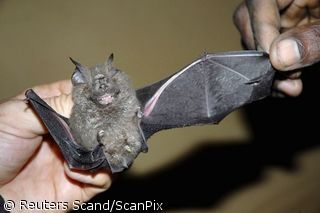 Doctors in Peru are facing outbreaks of two killer diseases, rabies and the plague, being spread by bats and rats.
more »
Doctors in Peru are facing outbreaks of two killer diseases, rabies and the plague, being spread by bats and rats.
more »
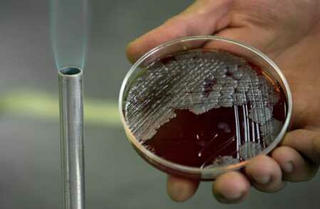 Scientists warn a new drug-resistant superbug could spread worldwide, fuelled in part by medical tourism.
more »
Scientists warn a new drug-resistant superbug could spread worldwide, fuelled in part by medical tourism.
more »
 Chinese officials say they are investigating reports that tainted milk powder has caused premature sexual development in baby girls.
more »
Chinese officials say they are investigating reports that tainted milk powder has caused premature sexual development in baby girls.
more »
 A woman in India says she has to sell her 6-month-old baby in order to pay her husband's medical expenses.
more »
A woman in India says she has to sell her 6-month-old baby in order to pay her husband's medical expenses.
more »