A controversial Italian embryologist is preparing to impregnate up to 200 women with cloned embryos in the world's first attempt to produce a human clone.
Published:
7 August 2001 y., Tuesday
Professor Severino Antinori will tell the National Academy of Sciences in Washington on Thursday that he expects to start his cloning programme in November. The announcement will reignite an explosive debate about the ethics and safety of cloning for infertility treatment.
Antinori, whose Rome clinic enabled a 62-year-old woman to have a baby in 1994, said that up to 200 couples from several countries, including eight from Britain, were being selected for the cloning project and would be treated free of charge. His team consists of 20 international specialists.
Antinori said the males in most of the couples under consideration were infertile. "They have no natural way of becoming fathers."
The technique he intends to use is similar to that developed to produce Dolly the sheep. A nucleus is taken from a cell belonging to the man; it is inserted into a woman's egg cell, from which the nucleus has been removed. The embryo is then implanted in her womb.
However, Antinori acknowledged that international hostility to cloning is such that he may be forced to work in a remote country or even on a boat in international waters.
In Britain the Human Fertilisation and Embryology Authority, which has said it will never approve an application to clone a person, warned that any British doctor working on such a project abroad would come under intense scrutiny.
Scientists have expressed concern that cloned babies would be at high risk of miscarriage, stillbirth or disability. According to Antinori, the risk will be reduced by a refined method of cloning and by meticulous screening of embryos. "I can guarantee 99% that I will not produce any monsters," Antinori said.
Šaltinis:
sunday-times.co.uk
Copying, publishing, announcing any information from the News.lt portal without written permission of News.lt editorial office is prohibited.
The most popular articles
 “Be healthy – be yourself” campaign encourages young people to become more proactive in protecting their health.
more »
“Be healthy – be yourself” campaign encourages young people to become more proactive in protecting their health.
more »
 When 28 year-old Artyom Sidorkin went to see his doctor to complain about pains in his chest and coughing blood his doctors made a rather bizarre discovery.
more »
When 28 year-old Artyom Sidorkin went to see his doctor to complain about pains in his chest and coughing blood his doctors made a rather bizarre discovery.
more »
 Last year French Professor Luc Montagnier jointly won the Nobel Prize for Medicine with Françoise Barré-Sinoussi for their discovery of the HIV virus in 1983.
more »
Last year French Professor Luc Montagnier jointly won the Nobel Prize for Medicine with Françoise Barré-Sinoussi for their discovery of the HIV virus in 1983.
more »
 To mark World Health Day, European Commissioner for Health, Androulla Vassiliou will visit several community health projects in Kenya on 6 and 7 April.
more »
To mark World Health Day, European Commissioner for Health, Androulla Vassiliou will visit several community health projects in Kenya on 6 and 7 April.
more »
 Autism, which affects roughly 67 million people worldwide, is still relatively unheard of in China.
more »
Autism, which affects roughly 67 million people worldwide, is still relatively unheard of in China.
more »
 The courses are arranged for the fifth time in a row; this year Estonian, Georgian, Latvian, and Lithuanian military medics are joined by three Armenian representatives.
more »
The courses are arranged for the fifth time in a row; this year Estonian, Georgian, Latvian, and Lithuanian military medics are joined by three Armenian representatives.
more »
 The choice of food in the EU is huge, but are you well-informed enough to choose well?
more »
The choice of food in the EU is huge, but are you well-informed enough to choose well?
more »
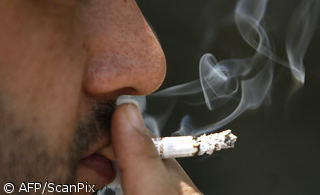 MEPs Tuesday backed a minimum tax of €1.28 per pack of 20 cigarettes within 3 years, in an effort to reduce smoking across Europe through higher prices.
more »
MEPs Tuesday backed a minimum tax of €1.28 per pack of 20 cigarettes within 3 years, in an effort to reduce smoking across Europe through higher prices.
more »
 Parliament approved an update of EU legislation on cosmetics when it votes on a first-reading agreement thrashed out between EP and Council representatives.
more »
Parliament approved an update of EU legislation on cosmetics when it votes on a first-reading agreement thrashed out between EP and Council representatives.
more »
 German doctors are treating a woman they say may have contracted the deadly ebola virus while working in a laboratory nt he city of Hamburg.
more »
German doctors are treating a woman they say may have contracted the deadly ebola virus while working in a laboratory nt he city of Hamburg.
more »