A controversial Italian embryologist is preparing to impregnate up to 200 women with cloned embryos in the world's first attempt to produce a human clone.
Published:
7 August 2001 y., Tuesday
Professor Severino Antinori will tell the National Academy of Sciences in Washington on Thursday that he expects to start his cloning programme in November. The announcement will reignite an explosive debate about the ethics and safety of cloning for infertility treatment.
Antinori, whose Rome clinic enabled a 62-year-old woman to have a baby in 1994, said that up to 200 couples from several countries, including eight from Britain, were being selected for the cloning project and would be treated free of charge. His team consists of 20 international specialists.
Antinori said the males in most of the couples under consideration were infertile. "They have no natural way of becoming fathers."
The technique he intends to use is similar to that developed to produce Dolly the sheep. A nucleus is taken from a cell belonging to the man; it is inserted into a woman's egg cell, from which the nucleus has been removed. The embryo is then implanted in her womb.
However, Antinori acknowledged that international hostility to cloning is such that he may be forced to work in a remote country or even on a boat in international waters.
In Britain the Human Fertilisation and Embryology Authority, which has said it will never approve an application to clone a person, warned that any British doctor working on such a project abroad would come under intense scrutiny.
Scientists have expressed concern that cloned babies would be at high risk of miscarriage, stillbirth or disability. According to Antinori, the risk will be reduced by a refined method of cloning and by meticulous screening of embryos. "I can guarantee 99% that I will not produce any monsters," Antinori said.
Šaltinis:
sunday-times.co.uk
Copying, publishing, announcing any information from the News.lt portal without written permission of News.lt editorial office is prohibited.
The most popular articles
 Some 56 000 people in the EU are currently waiting for a transplant operation. Every day 12 of them die waiting for an organ to be donated.
more »
Some 56 000 people in the EU are currently waiting for a transplant operation. Every day 12 of them die waiting for an organ to be donated.
more »
 Every day, across the vast country, Chinese school children put down their pens and perform a series of government-devised exercises intended to strengthen their eyes.
more »
Every day, across the vast country, Chinese school children put down their pens and perform a series of government-devised exercises intended to strengthen their eyes.
more »
 D. Simmons said the experience of living for so long with a machine pumping her blood was "scary."
more »
D. Simmons said the experience of living for so long with a machine pumping her blood was "scary."
more »
 A recent report found that children in Europe are not getting enough fruit and vegetables, so the European Commission is proposing to set aside money to ensure they get weekly fruit.
more »
A recent report found that children in Europe are not getting enough fruit and vegetables, so the European Commission is proposing to set aside money to ensure they get weekly fruit.
more »
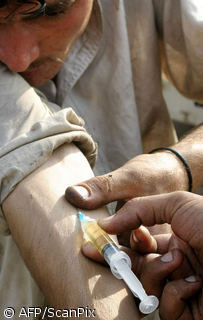 Every year 7,000-8,000 people in the EU die because of drug use and a drugs overdose remains one of the main causes of death among young people.
more »
Every year 7,000-8,000 people in the EU die because of drug use and a drugs overdose remains one of the main causes of death among young people.
more »
 Bad health through a bad diet is a growing problem across Europe.
more »
Bad health through a bad diet is a growing problem across Europe.
more »
 In accordance with the EC Treaty rules on state aid, the European Commission has approved aid worth €90 million to be granted by France to the R&D programme “ADNA” covering the development of personalised medicine for infectious diseases, cancer and genetic diseases.
more »
In accordance with the EC Treaty rules on state aid, the European Commission has approved aid worth €90 million to be granted by France to the R&D programme “ADNA” covering the development of personalised medicine for infectious diseases, cancer and genetic diseases.
more »
 October is international breast cancer awareness month. In Europe alone there are an estimated 430,000 new cases a year and in the EU breast cancer will affect one in 10 women before the age of 80.
more »
October is international breast cancer awareness month. In Europe alone there are an estimated 430,000 new cases a year and in the EU breast cancer will affect one in 10 women before the age of 80.
more »
 Today in the afternoon, President Valdas Adamkus had a lens replacement surgery in his right eye at Santariškių Clinical Hospital.
more »
Today in the afternoon, President Valdas Adamkus had a lens replacement surgery in his right eye at Santariškių Clinical Hospital.
more »
The last four suspected bird flu patients two of them confirmed to have contracted the deadly H5N1 strain were discharged from a hospital in eastern Turkey, signalling an end to the recent outbreak, a doctor said on Saturday.
more »