A controversial Italian embryologist is preparing to impregnate up to 200 women with cloned embryos in the world's first attempt to produce a human clone.
Published:
7 August 2001 y., Tuesday
Professor Severino Antinori will tell the National Academy of Sciences in Washington on Thursday that he expects to start his cloning programme in November. The announcement will reignite an explosive debate about the ethics and safety of cloning for infertility treatment.
Antinori, whose Rome clinic enabled a 62-year-old woman to have a baby in 1994, said that up to 200 couples from several countries, including eight from Britain, were being selected for the cloning project and would be treated free of charge. His team consists of 20 international specialists.
Antinori said the males in most of the couples under consideration were infertile. "They have no natural way of becoming fathers."
The technique he intends to use is similar to that developed to produce Dolly the sheep. A nucleus is taken from a cell belonging to the man; it is inserted into a woman's egg cell, from which the nucleus has been removed. The embryo is then implanted in her womb.
However, Antinori acknowledged that international hostility to cloning is such that he may be forced to work in a remote country or even on a boat in international waters.
In Britain the Human Fertilisation and Embryology Authority, which has said it will never approve an application to clone a person, warned that any British doctor working on such a project abroad would come under intense scrutiny.
Scientists have expressed concern that cloned babies would be at high risk of miscarriage, stillbirth or disability. According to Antinori, the risk will be reduced by a refined method of cloning and by meticulous screening of embryos. "I can guarantee 99% that I will not produce any monsters," Antinori said.
Šaltinis:
sunday-times.co.uk
Copying, publishing, announcing any information from the News.lt portal without written permission of News.lt editorial office is prohibited.
The most popular articles
 The only physician in her village of Tsoniarisi, Mzevinar Bolkvadze sees patients all day in a newly built and equipped ambulatory.
more »
The only physician in her village of Tsoniarisi, Mzevinar Bolkvadze sees patients all day in a newly built and equipped ambulatory.
more »
 As of 7 September 2009, 48 of the 53 Member States in the WHO European Region had reported over 49 000 laboratory-confirmed cases of pandemic (H1N1) 2009 virus infection.
more »
As of 7 September 2009, 48 of the 53 Member States in the WHO European Region had reported over 49 000 laboratory-confirmed cases of pandemic (H1N1) 2009 virus infection.
more »
 China's food and drug administration say clinical trials of a vaccine against the H1N1 flu strain have been successful.
more »
China's food and drug administration say clinical trials of a vaccine against the H1N1 flu strain have been successful.
more »
As of 31 August 2009, 48 of the 53 Member States in the WHO European Region had reported laboratory-confirmed cases of pandemic (H1N1) 2009 virus infection.
more »
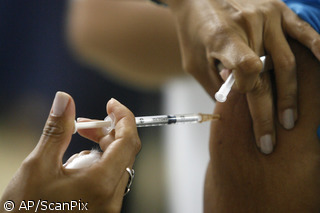 The European Union Health Security Committee and the Early Warning and Response authorities adopted a policy statement proposed by the European Commission which outlines a shared European approach towards identifying target and priority groups for A H1N1 vaccination.
more »
The European Union Health Security Committee and the Early Warning and Response authorities adopted a policy statement proposed by the European Commission which outlines a shared European approach towards identifying target and priority groups for A H1N1 vaccination.
more »
 As of 20 August 2009, 47 of the 53 Member States in the WHO European Region had reported over 42 000 laboratory-confirmed cases of pandemic (H1N1) 2009 virus infection.
more »
As of 20 August 2009, 47 of the 53 Member States in the WHO European Region had reported over 42 000 laboratory-confirmed cases of pandemic (H1N1) 2009 virus infection.
more »
 About 1000 participants, mostly from North America, debated solutions to the obesity epidemic in the United States (US) at the Weight of the Nation conference, organized in Washington, USA, by the US Centers for Disease Control.
more »
About 1000 participants, mostly from North America, debated solutions to the obesity epidemic in the United States (US) at the Weight of the Nation conference, organized in Washington, USA, by the US Centers for Disease Control.
more »
 The European Union Health Security Committee and the Early Warning and Response authorities (HSC/EWRS) unanimously adopted for the first time two policy statements proposed by the European Commission on public health measures for pandemic influenza A (H1N1) 2009.
more »
The European Union Health Security Committee and the Early Warning and Response authorities (HSC/EWRS) unanimously adopted for the first time two policy statements proposed by the European Commission on public health measures for pandemic influenza A (H1N1) 2009.
more »
As of 10 August 2009, 46 of the 53 countries in the WHO European Region had reported over 33 000 laboratory-confirmed cases of pandemic (H1N1) 2009 virus infection, including 55 fatalities in 7 countries.
more »
 The U.S. company Moog Medical Devices which acquired the company the Lithuanian Viltechmeda at the beginning of the year 2009, intends to invest EUR 2M in Lithuania in the nearest future, to establish a modern services centre.
more »
The U.S. company Moog Medical Devices which acquired the company the Lithuanian Viltechmeda at the beginning of the year 2009, intends to invest EUR 2M in Lithuania in the nearest future, to establish a modern services centre.
more »