Questions from military and public about how well it works
Published:
30 September 2001 y., Sunday
The nation’s only vaccine approved against anthrax has never been a best-seller. The only civilians who ever needed it were ranchers, hide handlers, veterinarians and the few scientists who worked with the deadly soil bacterium.
Sept. 11 changed all that. Doctors’ offices and travel clinics around the country have been swamped with requests for the vaccine amid concern that the tragedies in New York and Washington might foreshadow a bioterrorist attack. More than 1,000 people in the past two weeks have tried to get shots directly from the vaccine’s maker, BioPort of Lansing, Mich. Callers there are being shunted to a recorded message that reflects what doctors everywhere are saying: “All the stockpile that currently exists is owned by the Department of Defense. At this time there is no opportunity for any commercial sales.”
Yet BioPort’s vaccine was until two weeks ago perhaps the most shunned and controversial shot ever produced. For years it has been at the center of a political, medical and legal struggle, with more than 400 members of the military opting to quit or be court-martialed rather than roll up their sleeves.
In May, two Air Force officers filed a federal class action suit, contending that the vaccine should be classified as “investigational” for inhaled anthrax and should be offered only to volunteers who sign informed-consent documents clearly stating they are subjects in an experiment.
Šaltinis:
THE WASHINGTON POST
Copying, publishing, announcing any information from the News.lt portal without written permission of News.lt editorial office is prohibited.
The most popular articles
 MEPs last week backed a new report for food labelling that clarifies the origin of food and where it is processed.
more »
MEPs last week backed a new report for food labelling that clarifies the origin of food and where it is processed.
more »
 Mental health problems can affect our “daily life, family, school, work and leisure” and early diagnosis and treatment is the best way to avert personal catastrophe, according to Greek Socialist Evangelia Tzampazi, who is preparing a report on the subject.
more »
Mental health problems can affect our “daily life, family, school, work and leisure” and early diagnosis and treatment is the best way to avert personal catastrophe, according to Greek Socialist Evangelia Tzampazi, who is preparing a report on the subject.
more »
 In 2003, EU health ministers advised governments to put in place large-scale screening programmes for people at a higher risk of cancer because of generic factors like age and gender.
more »
In 2003, EU health ministers advised governments to put in place large-scale screening programmes for people at a higher risk of cancer because of generic factors like age and gender.
more »
 Parliament will today debate new measures to make sure that cancer causing pesticides are banned from going on sale whilst also ensuring that the amounts of current pesticides used are greatly reduced.
more »
Parliament will today debate new measures to make sure that cancer causing pesticides are banned from going on sale whilst also ensuring that the amounts of current pesticides used are greatly reduced.
more »
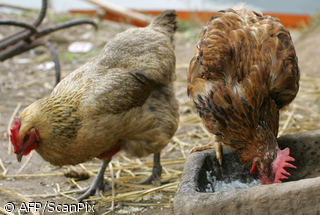 Vets across India's West Bengal state are carrying out a mass cull of birds after a fresh outbreak of avian flu.
more »
Vets across India's West Bengal state are carrying out a mass cull of birds after a fresh outbreak of avian flu.
more »
 Roy Carter - the retired British postman - is game for anything after his damaged knuckles were replaced with ones made from a similar material used to line atomic reactors.
more »
Roy Carter - the retired British postman - is game for anything after his damaged knuckles were replaced with ones made from a similar material used to line atomic reactors.
more »
 Begun only one month ago, stressed out passers-by dish out about two dollars to smash a cup or saucer and relieve their anxieties to the encouragement of staff.
more »
Begun only one month ago, stressed out passers-by dish out about two dollars to smash a cup or saucer and relieve their anxieties to the encouragement of staff.
more »
 MEPs adopted the toy safety proposal with 481 votes in favour, 73 against, 40 abstentions.
more »
MEPs adopted the toy safety proposal with 481 votes in favour, 73 against, 40 abstentions.
more »
 Dairy farmers in some parts of India are getting a boost from a new line of business - cow urine.
more »
Dairy farmers in some parts of India are getting a boost from a new line of business - cow urine.
more »
 The commission has tabled proposals to improve how the European pharmaceutical market operates and ensure that patients benefit from safe, innovative and accessible medicines.
more »
The commission has tabled proposals to improve how the European pharmaceutical market operates and ensure that patients benefit from safe, innovative and accessible medicines.
more »