Some of the starkest early reports about the deadly SARS pneumonia came not from health authorities, but from Internet discussions in which emergency-room physicians swapped details about the start of the epidemic
Published:
17 April 2003 y., Thursday
An intensive-care specialist at a hospital in Hong Kong, a community virtually shuttered by the virus, riveted his colleagues with dispatches from the SARS, or Severe Acute Respiratory Syndrome, front lines.
"There are now 145 confirmed cases in the Prince of Wales Hospital," Tom Buckley wrote in an e-mail message last month. "New cases (first contact) tend to bring their families (second contact). Close family contacts seem to have a very high rate of infectivity. The outbreak within the hospital appears to have been contained, but it has put an enormous strain on the system."
At a time when the world was paying far more attention to the war on Iraq than to a still-mysterious disease, these notes stand out as a prescient warning about the risks of SARS, a contagious lung infection with a fatality rate of about 5 percent. As of that date, Hong Kong authorities had reported more than 260 cases of SARS, including 10 deaths. By this week, Hong Kong's total had ballooned to 1,232 cases and 56 deaths. Meanwhile, economists lopped a few percentage points off their Asia GDP forecasts, Intel and Hewlett-Packard temporarily closed their Hong Kong offices, and business and tourist travel to the area has plummeted.
The World Health Organization has responded to the threat of SARS by using its Web site to publish daily updates about the number of worldwide cases--which has allowed analysts to graph the progress of the outbreak.
Šaltinis:
CNET News.com
Copying, publishing, announcing any information from the News.lt portal without written permission of News.lt editorial office is prohibited.
The most popular articles
 MEPs last week backed a new report for food labelling that clarifies the origin of food and where it is processed.
more »
MEPs last week backed a new report for food labelling that clarifies the origin of food and where it is processed.
more »
 Mental health problems can affect our “daily life, family, school, work and leisure” and early diagnosis and treatment is the best way to avert personal catastrophe, according to Greek Socialist Evangelia Tzampazi, who is preparing a report on the subject.
more »
Mental health problems can affect our “daily life, family, school, work and leisure” and early diagnosis and treatment is the best way to avert personal catastrophe, according to Greek Socialist Evangelia Tzampazi, who is preparing a report on the subject.
more »
 In 2003, EU health ministers advised governments to put in place large-scale screening programmes for people at a higher risk of cancer because of generic factors like age and gender.
more »
In 2003, EU health ministers advised governments to put in place large-scale screening programmes for people at a higher risk of cancer because of generic factors like age and gender.
more »
 Parliament will today debate new measures to make sure that cancer causing pesticides are banned from going on sale whilst also ensuring that the amounts of current pesticides used are greatly reduced.
more »
Parliament will today debate new measures to make sure that cancer causing pesticides are banned from going on sale whilst also ensuring that the amounts of current pesticides used are greatly reduced.
more »
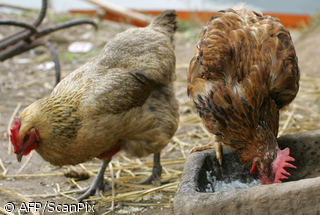 Vets across India's West Bengal state are carrying out a mass cull of birds after a fresh outbreak of avian flu.
more »
Vets across India's West Bengal state are carrying out a mass cull of birds after a fresh outbreak of avian flu.
more »
 Roy Carter - the retired British postman - is game for anything after his damaged knuckles were replaced with ones made from a similar material used to line atomic reactors.
more »
Roy Carter - the retired British postman - is game for anything after his damaged knuckles were replaced with ones made from a similar material used to line atomic reactors.
more »
 Begun only one month ago, stressed out passers-by dish out about two dollars to smash a cup or saucer and relieve their anxieties to the encouragement of staff.
more »
Begun only one month ago, stressed out passers-by dish out about two dollars to smash a cup or saucer and relieve their anxieties to the encouragement of staff.
more »
 MEPs adopted the toy safety proposal with 481 votes in favour, 73 against, 40 abstentions.
more »
MEPs adopted the toy safety proposal with 481 votes in favour, 73 against, 40 abstentions.
more »
 Dairy farmers in some parts of India are getting a boost from a new line of business - cow urine.
more »
Dairy farmers in some parts of India are getting a boost from a new line of business - cow urine.
more »
 The commission has tabled proposals to improve how the European pharmaceutical market operates and ensure that patients benefit from safe, innovative and accessible medicines.
more »
The commission has tabled proposals to improve how the European pharmaceutical market operates and ensure that patients benefit from safe, innovative and accessible medicines.
more »