Some of the starkest early reports about the deadly SARS pneumonia came not from health authorities, but from Internet discussions in which emergency-room physicians swapped details about the start of the epidemic
Published:
17 April 2003 y., Thursday
An intensive-care specialist at a hospital in Hong Kong, a community virtually shuttered by the virus, riveted his colleagues with dispatches from the SARS, or Severe Acute Respiratory Syndrome, front lines.
"There are now 145 confirmed cases in the Prince of Wales Hospital," Tom Buckley wrote in an e-mail message last month. "New cases (first contact) tend to bring their families (second contact). Close family contacts seem to have a very high rate of infectivity. The outbreak within the hospital appears to have been contained, but it has put an enormous strain on the system."
At a time when the world was paying far more attention to the war on Iraq than to a still-mysterious disease, these notes stand out as a prescient warning about the risks of SARS, a contagious lung infection with a fatality rate of about 5 percent. As of that date, Hong Kong authorities had reported more than 260 cases of SARS, including 10 deaths. By this week, Hong Kong's total had ballooned to 1,232 cases and 56 deaths. Meanwhile, economists lopped a few percentage points off their Asia GDP forecasts, Intel and Hewlett-Packard temporarily closed their Hong Kong offices, and business and tourist travel to the area has plummeted.
The World Health Organization has responded to the threat of SARS by using its Web site to publish daily updates about the number of worldwide cases--which has allowed analysts to graph the progress of the outbreak.
Šaltinis:
CNET News.com
Copying, publishing, announcing any information from the News.lt portal without written permission of News.lt editorial office is prohibited.
The most popular articles
 The only physician in her village of Tsoniarisi, Mzevinar Bolkvadze sees patients all day in a newly built and equipped ambulatory.
more »
The only physician in her village of Tsoniarisi, Mzevinar Bolkvadze sees patients all day in a newly built and equipped ambulatory.
more »
 As of 7 September 2009, 48 of the 53 Member States in the WHO European Region had reported over 49 000 laboratory-confirmed cases of pandemic (H1N1) 2009 virus infection.
more »
As of 7 September 2009, 48 of the 53 Member States in the WHO European Region had reported over 49 000 laboratory-confirmed cases of pandemic (H1N1) 2009 virus infection.
more »
 China's food and drug administration say clinical trials of a vaccine against the H1N1 flu strain have been successful.
more »
China's food and drug administration say clinical trials of a vaccine against the H1N1 flu strain have been successful.
more »
As of 31 August 2009, 48 of the 53 Member States in the WHO European Region had reported laboratory-confirmed cases of pandemic (H1N1) 2009 virus infection.
more »
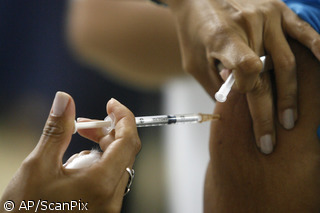 The European Union Health Security Committee and the Early Warning and Response authorities adopted a policy statement proposed by the European Commission which outlines a shared European approach towards identifying target and priority groups for A H1N1 vaccination.
more »
The European Union Health Security Committee and the Early Warning and Response authorities adopted a policy statement proposed by the European Commission which outlines a shared European approach towards identifying target and priority groups for A H1N1 vaccination.
more »
 As of 20 August 2009, 47 of the 53 Member States in the WHO European Region had reported over 42 000 laboratory-confirmed cases of pandemic (H1N1) 2009 virus infection.
more »
As of 20 August 2009, 47 of the 53 Member States in the WHO European Region had reported over 42 000 laboratory-confirmed cases of pandemic (H1N1) 2009 virus infection.
more »
 About 1000 participants, mostly from North America, debated solutions to the obesity epidemic in the United States (US) at the Weight of the Nation conference, organized in Washington, USA, by the US Centers for Disease Control.
more »
About 1000 participants, mostly from North America, debated solutions to the obesity epidemic in the United States (US) at the Weight of the Nation conference, organized in Washington, USA, by the US Centers for Disease Control.
more »
 The European Union Health Security Committee and the Early Warning and Response authorities (HSC/EWRS) unanimously adopted for the first time two policy statements proposed by the European Commission on public health measures for pandemic influenza A (H1N1) 2009.
more »
The European Union Health Security Committee and the Early Warning and Response authorities (HSC/EWRS) unanimously adopted for the first time two policy statements proposed by the European Commission on public health measures for pandemic influenza A (H1N1) 2009.
more »
As of 10 August 2009, 46 of the 53 countries in the WHO European Region had reported over 33 000 laboratory-confirmed cases of pandemic (H1N1) 2009 virus infection, including 55 fatalities in 7 countries.
more »
 The U.S. company Moog Medical Devices which acquired the company the Lithuanian Viltechmeda at the beginning of the year 2009, intends to invest EUR 2M in Lithuania in the nearest future, to establish a modern services centre.
more »
The U.S. company Moog Medical Devices which acquired the company the Lithuanian Viltechmeda at the beginning of the year 2009, intends to invest EUR 2M in Lithuania in the nearest future, to establish a modern services centre.
more »