Imagine a day scientists discover that foods you like are more nutritious than those you don't.
Published:
6 March 2005 y., Sunday
That day occurred more than 25 years ago. A series of experiments run by researchers in Sweden and Thailand showed that people absorb more iron from meals that appeal to them than from meals they find less appetizing.
Promoters of good nutrition throughout much of the world appear to have taken note. Britain's number-one guideline, ahead of admonitions to eat more fiber and less fat, is simply: ''Enjoy your food." Norway, in its own set of guidelines, reminds its citizens that ''food and joy equal health," while Vietnam counsels people to have food ''that is delicious . . . and served with affection."
In stark contrast, the latest edition of the US Dietary Guidelines, released last month, make no allusion that nutrition and taking pleasure in eating have anything to do with each other. Some believe it may be that very disconnection that is contributing to Americans' less-than-optimal diets, not to mention obesity.
Part of the problem occurs on a gut level -- literally. In the late 1970s, Swedish and Thai researchers collaborated on a study that centered on a Thai meal of rice and vegetables spiked with chili paste, fish sauce, and coconut cream. They fed the meal to a group of Thai women and a group of Swedish women.
The Thai women absorbed almost 50 percent more of the dish's iron than the Swedes, who ''liked the meal" up to a point, reported the researchers, ''but considered it very spicy."
Šaltinis:
boston.com
Copying, publishing, announcing any information from the News.lt portal without written permission of News.lt editorial office is prohibited.
The most popular articles
 With the new influenza season underway, MEPs have criticised the EU's "disproportionate" response to the outbreak of the H1N1 ("swine flu") virus in 2009-2010.
more »
With the new influenza season underway, MEPs have criticised the EU's "disproportionate" response to the outbreak of the H1N1 ("swine flu") virus in 2009-2010.
more »
 Over half the EU adult population is now overweight or obese according to the “Health at a Glance: Europe 2010” report published by the European Commission and the OECD today.
more »
Over half the EU adult population is now overweight or obese according to the “Health at a Glance: Europe 2010” report published by the European Commission and the OECD today.
more »
 Over 130 people die in central Haiti due to a suspected outbreak of cholera.
more »
Over 130 people die in central Haiti due to a suspected outbreak of cholera.
more »
 The Influenza A (H1N1) pandemic returned to the Parliament last week but fortunately not in the literal sense.
more »
The Influenza A (H1N1) pandemic returned to the Parliament last week but fortunately not in the literal sense.
more »
 The Commission announced today its intention to restructure the process of progressive adoption of the list of permitted health claims on food products (also known as “Article 13 claims”).
more »
The Commission announced today its intention to restructure the process of progressive adoption of the list of permitted health claims on food products (also known as “Article 13 claims”).
more »
 Patients will be better informed on how to use medicines, and enabled to report their adverse effects directly to national authorities, thanks to updates of EU laws agreed with the Council and endorsed by Parliament on Wednesday.
more »
Patients will be better informed on how to use medicines, and enabled to report their adverse effects directly to national authorities, thanks to updates of EU laws agreed with the Council and endorsed by Parliament on Wednesday.
more »
 Doctors in Peru are facing outbreaks of two killer diseases, rabies and the plague, being spread by bats and rats.
more »
Doctors in Peru are facing outbreaks of two killer diseases, rabies and the plague, being spread by bats and rats.
more »
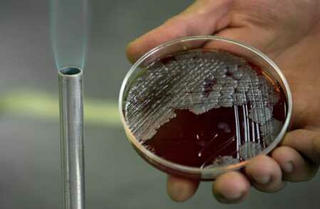 Scientists warn a new drug-resistant superbug could spread worldwide, fuelled in part by medical tourism.
more »
Scientists warn a new drug-resistant superbug could spread worldwide, fuelled in part by medical tourism.
more »
 Chinese officials say they are investigating reports that tainted milk powder has caused premature sexual development in baby girls.
more »
Chinese officials say they are investigating reports that tainted milk powder has caused premature sexual development in baby girls.
more »
 A woman in India says she has to sell her 6-month-old baby in order to pay her husband's medical expenses.
more »
A woman in India says she has to sell her 6-month-old baby in order to pay her husband's medical expenses.
more »