About 10,000 times smaller in diameter than a human hair, nanotubes will revolutionize engineering, TVs, and computing
Published:
3 May 2001 y., Thursday
It looks just like soot. But unlike the mess caked on your barbecue grill, this substance consists of billions of tiny tubes of pure carbon resembling rolled-up chicken wire. And these striking structures, called nanotubes, are poised to have an impact on fields as diverse as computing, materials engineering, and medical devices.
Discovered in 1991 when Sumio Iijima, a physicist at Japan's NEC Corp., zapped carbon with laser beams, nanotubes set off an international race among researchers. So far, laboratories have revealed a steadily lengthening list of their remarkable properties.
Nanotubes are a descendant of buckyballs, which became a scientific sensation in 1985. Until then, the only known forms of pure carbon were the rigid crystal structure of diamond and slippery sheets of graphite. The arrangement of 60 carbon atoms into round balls -- dubbed buckyballs, or fullerenes, because they resembled the dome structures designed by architect R. Buckminster Fuller -- seemed to presage a new carbon chemistry.
Nanotubes haven't transformed any industries yet, either. But while practical applications still are years away, a steady stream of recent discoveries point to real commercial potential. The most promise lies in computing and electronics.
Šaltinis:
businessweek.com
Copying, publishing, announcing any information from the News.lt portal without written permission of News.lt editorial office is prohibited.
The most popular articles
 MEPs last week backed a new report for food labelling that clarifies the origin of food and where it is processed.
more »
MEPs last week backed a new report for food labelling that clarifies the origin of food and where it is processed.
more »
 Mental health problems can affect our “daily life, family, school, work and leisure” and early diagnosis and treatment is the best way to avert personal catastrophe, according to Greek Socialist Evangelia Tzampazi, who is preparing a report on the subject.
more »
Mental health problems can affect our “daily life, family, school, work and leisure” and early diagnosis and treatment is the best way to avert personal catastrophe, according to Greek Socialist Evangelia Tzampazi, who is preparing a report on the subject.
more »
 In 2003, EU health ministers advised governments to put in place large-scale screening programmes for people at a higher risk of cancer because of generic factors like age and gender.
more »
In 2003, EU health ministers advised governments to put in place large-scale screening programmes for people at a higher risk of cancer because of generic factors like age and gender.
more »
 Parliament will today debate new measures to make sure that cancer causing pesticides are banned from going on sale whilst also ensuring that the amounts of current pesticides used are greatly reduced.
more »
Parliament will today debate new measures to make sure that cancer causing pesticides are banned from going on sale whilst also ensuring that the amounts of current pesticides used are greatly reduced.
more »
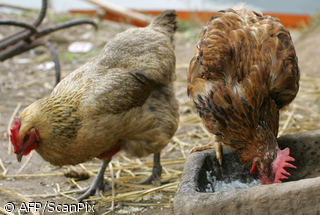 Vets across India's West Bengal state are carrying out a mass cull of birds after a fresh outbreak of avian flu.
more »
Vets across India's West Bengal state are carrying out a mass cull of birds after a fresh outbreak of avian flu.
more »
 Roy Carter - the retired British postman - is game for anything after his damaged knuckles were replaced with ones made from a similar material used to line atomic reactors.
more »
Roy Carter - the retired British postman - is game for anything after his damaged knuckles were replaced with ones made from a similar material used to line atomic reactors.
more »
 Begun only one month ago, stressed out passers-by dish out about two dollars to smash a cup or saucer and relieve their anxieties to the encouragement of staff.
more »
Begun only one month ago, stressed out passers-by dish out about two dollars to smash a cup or saucer and relieve their anxieties to the encouragement of staff.
more »
 MEPs adopted the toy safety proposal with 481 votes in favour, 73 against, 40 abstentions.
more »
MEPs adopted the toy safety proposal with 481 votes in favour, 73 against, 40 abstentions.
more »
 Dairy farmers in some parts of India are getting a boost from a new line of business - cow urine.
more »
Dairy farmers in some parts of India are getting a boost from a new line of business - cow urine.
more »
 The commission has tabled proposals to improve how the European pharmaceutical market operates and ensure that patients benefit from safe, innovative and accessible medicines.
more »
The commission has tabled proposals to improve how the European pharmaceutical market operates and ensure that patients benefit from safe, innovative and accessible medicines.
more »