"Orgasm" hormone involved in interpersonal relations: study.
Published:
21 July 1999 y., Wednesday
The hormone best known for its role in orgasms and labor may influence our ability to bond with others, according to researchers at the University of California, San Francisco. In a preliminary study, the hormone oxytocin was shown to be associated with the ability to maintain healthy interpersonal relationships and healthy psychological boundaries with other people. The study appears in the July issue of Psychiatry. "This is one of the first looks into the biological basis for human attachment and bonding," said Rebecca Turner, adjunct assistant professor of psychiatry and lead author of the study. "Our study indicates that oxytocin may be mediating emotional experiences in close relationships."The study builds upon previous knowledge of the important role oxytocin plays in the reproductive life of mammals. The hormone facilitates nest building and pup retrieval in rats, acceptance of offspring in sheep and the formation of adult pair-bonds in prairie voles. In humans, oxytocin stimulates milk ejection during lactation, uterine contraction during birth and is released during sexual orgasm in both men and women.In the new study, 26 non-lactating women between the ages of 23 and 35 were asked to recall a past relationship event that was associated with positive emotions, such as love or infatuation, and then a negative emotion, such as loss or abandonment.
Copying, publishing, announcing any information from the News.lt portal without written permission of News.lt editorial office is prohibited.
The most popular articles
 The only physician in her village of Tsoniarisi, Mzevinar Bolkvadze sees patients all day in a newly built and equipped ambulatory.
more »
The only physician in her village of Tsoniarisi, Mzevinar Bolkvadze sees patients all day in a newly built and equipped ambulatory.
more »
 As of 7 September 2009, 48 of the 53 Member States in the WHO European Region had reported over 49 000 laboratory-confirmed cases of pandemic (H1N1) 2009 virus infection.
more »
As of 7 September 2009, 48 of the 53 Member States in the WHO European Region had reported over 49 000 laboratory-confirmed cases of pandemic (H1N1) 2009 virus infection.
more »
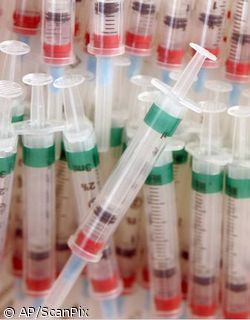 China's food and drug administration say clinical trials of a vaccine against the H1N1 flu strain have been successful.
more »
China's food and drug administration say clinical trials of a vaccine against the H1N1 flu strain have been successful.
more »
As of 31 August 2009, 48 of the 53 Member States in the WHO European Region had reported laboratory-confirmed cases of pandemic (H1N1) 2009 virus infection.
more »
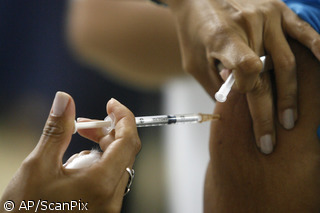 The European Union Health Security Committee and the Early Warning and Response authorities adopted a policy statement proposed by the European Commission which outlines a shared European approach towards identifying target and priority groups for A H1N1 vaccination.
more »
The European Union Health Security Committee and the Early Warning and Response authorities adopted a policy statement proposed by the European Commission which outlines a shared European approach towards identifying target and priority groups for A H1N1 vaccination.
more »
 As of 20 August 2009, 47 of the 53 Member States in the WHO European Region had reported over 42 000 laboratory-confirmed cases of pandemic (H1N1) 2009 virus infection.
more »
As of 20 August 2009, 47 of the 53 Member States in the WHO European Region had reported over 42 000 laboratory-confirmed cases of pandemic (H1N1) 2009 virus infection.
more »
 About 1000 participants, mostly from North America, debated solutions to the obesity epidemic in the United States (US) at the Weight of the Nation conference, organized in Washington, USA, by the US Centers for Disease Control.
more »
About 1000 participants, mostly from North America, debated solutions to the obesity epidemic in the United States (US) at the Weight of the Nation conference, organized in Washington, USA, by the US Centers for Disease Control.
more »
 The European Union Health Security Committee and the Early Warning and Response authorities (HSC/EWRS) unanimously adopted for the first time two policy statements proposed by the European Commission on public health measures for pandemic influenza A (H1N1) 2009.
more »
The European Union Health Security Committee and the Early Warning and Response authorities (HSC/EWRS) unanimously adopted for the first time two policy statements proposed by the European Commission on public health measures for pandemic influenza A (H1N1) 2009.
more »
As of 10 August 2009, 46 of the 53 countries in the WHO European Region had reported over 33 000 laboratory-confirmed cases of pandemic (H1N1) 2009 virus infection, including 55 fatalities in 7 countries.
more »
 The U.S. company Moog Medical Devices which acquired the company the Lithuanian Viltechmeda at the beginning of the year 2009, intends to invest EUR 2M in Lithuania in the nearest future, to establish a modern services centre.
more »
The U.S. company Moog Medical Devices which acquired the company the Lithuanian Viltechmeda at the beginning of the year 2009, intends to invest EUR 2M in Lithuania in the nearest future, to establish a modern services centre.
more »