Eastern Europe is actively preparing to fight the greatest plague of our times-the HIV virus and AIDS
Published:
7 November 2003 y., Friday
Eastern Europe is actively preparing to fight the greatest plague of our times-the HIV virus and AIDS. The latest weapon against the disease was the subject of a congress of the European AIDS Clinical Society (EACS) held in Warsaw Oct. 26-29.
Around 7,300 cases of HIV infection were reported in Poland in 2001, but experts believe the actual number of carriers to be much higher, between 15,000 and 20,000. The multi-sector National Program for HIV Prevention and Care for People Living with HIV/AIDS adopted for 1999-2003, defines two main goals in the fight against the virus: to prevent the further spreading of HIV in Poland and to improve the quality of treatment, providing all infected individuals with access to it.
Pharmacological treatment to prevent the development of HIV has been available in Poland for five years. The period has shown that actions undertaken in this area are still insufficient and must be radically increased to efficiently prevent the disease and help infected patients. Doctors will now be assisted by a new kind of weapon, a medication called Fuzeon (enfuvirtide, previously known as T-20). Fuzeon is a new hope in the fight against HIV, as the virus is becoming increasingly drug resistant.
The growing accessibility of medications hampering the progress of HIV has made the constantly mutating virus resistant to most drugs present on the market. Unlike other existing anti-HIV agents, which act outside of affected cells, Fuzeon affects the external environment of cells as well, disabling the fusion of viruses and penetration of healthy cells of the immune system (CD4 cells).
Šaltinis:
warsawvoice.pl
Copying, publishing, announcing any information from the News.lt portal without written permission of News.lt editorial office is prohibited.
The most popular articles
 The only physician in her village of Tsoniarisi, Mzevinar Bolkvadze sees patients all day in a newly built and equipped ambulatory.
more »
The only physician in her village of Tsoniarisi, Mzevinar Bolkvadze sees patients all day in a newly built and equipped ambulatory.
more »
 As of 7 September 2009, 48 of the 53 Member States in the WHO European Region had reported over 49 000 laboratory-confirmed cases of pandemic (H1N1) 2009 virus infection.
more »
As of 7 September 2009, 48 of the 53 Member States in the WHO European Region had reported over 49 000 laboratory-confirmed cases of pandemic (H1N1) 2009 virus infection.
more »
 China's food and drug administration say clinical trials of a vaccine against the H1N1 flu strain have been successful.
more »
China's food and drug administration say clinical trials of a vaccine against the H1N1 flu strain have been successful.
more »
As of 31 August 2009, 48 of the 53 Member States in the WHO European Region had reported laboratory-confirmed cases of pandemic (H1N1) 2009 virus infection.
more »
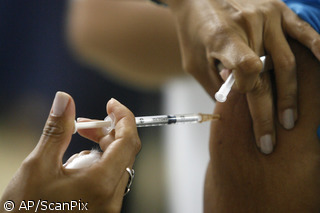 The European Union Health Security Committee and the Early Warning and Response authorities adopted a policy statement proposed by the European Commission which outlines a shared European approach towards identifying target and priority groups for A H1N1 vaccination.
more »
The European Union Health Security Committee and the Early Warning and Response authorities adopted a policy statement proposed by the European Commission which outlines a shared European approach towards identifying target and priority groups for A H1N1 vaccination.
more »
 As of 20 August 2009, 47 of the 53 Member States in the WHO European Region had reported over 42 000 laboratory-confirmed cases of pandemic (H1N1) 2009 virus infection.
more »
As of 20 August 2009, 47 of the 53 Member States in the WHO European Region had reported over 42 000 laboratory-confirmed cases of pandemic (H1N1) 2009 virus infection.
more »
 About 1000 participants, mostly from North America, debated solutions to the obesity epidemic in the United States (US) at the Weight of the Nation conference, organized in Washington, USA, by the US Centers for Disease Control.
more »
About 1000 participants, mostly from North America, debated solutions to the obesity epidemic in the United States (US) at the Weight of the Nation conference, organized in Washington, USA, by the US Centers for Disease Control.
more »
 The European Union Health Security Committee and the Early Warning and Response authorities (HSC/EWRS) unanimously adopted for the first time two policy statements proposed by the European Commission on public health measures for pandemic influenza A (H1N1) 2009.
more »
The European Union Health Security Committee and the Early Warning and Response authorities (HSC/EWRS) unanimously adopted for the first time two policy statements proposed by the European Commission on public health measures for pandemic influenza A (H1N1) 2009.
more »
As of 10 August 2009, 46 of the 53 countries in the WHO European Region had reported over 33 000 laboratory-confirmed cases of pandemic (H1N1) 2009 virus infection, including 55 fatalities in 7 countries.
more »
 The U.S. company Moog Medical Devices which acquired the company the Lithuanian Viltechmeda at the beginning of the year 2009, intends to invest EUR 2M in Lithuania in the nearest future, to establish a modern services centre.
more »
The U.S. company Moog Medical Devices which acquired the company the Lithuanian Viltechmeda at the beginning of the year 2009, intends to invest EUR 2M in Lithuania in the nearest future, to establish a modern services centre.
more »