Transplanting scalp cells shows promise for baldness.
Published:
5 November 1999 y., Friday
Scientists transplanted scalp cells from one person to another and, for the first time ever, grew new hair on a human without the use of drugs. The approach could someday enable just about any head to sprout hair, researchers said. It also raises hopes of someday spurring the growth of new tissue or even whole organs inside patients, such as cartilage in arthritic joints. In the new work, scientists at Durham University in northern England transplanted cells from a male hair follicle and grafted them on to a woman_s arm. Within five weeks, the transplanted tissue - no bigger than the head of a pin - made a total of five fully grown hairs in the woman_s arm. Although the research was designed to test whether the graft would be rejected by the unrelated woman, the researchers were pleased by the surprising results. "It does show the potential of being able to induce new hair follicles in human skin which I don_t think has been done before," said study head Colin Jahoda.
Jahoda said normally the foreign cells would be rejected by the recipient. But the scientists suspect the cells taken from the base of follicle may have some type of immune privilege which allows them to mix with foreign cells. So instead of being cast out by the woman_s immune system, the male cells interacted with her cells to create new follicles. "The cells have got instructions to tell other cells to create the structure," explained Jahoda. "These cells instructed the host cells to make a new follicle."
DNA samples taken from the newly sprouted hair contained the Y male chromosome, proving that the new hair was from the man_s cells.
As would be epxected with male hair, the new hair was longer, thicker and darker than arm hair, but it combined some characteristics of both donor and recipient. Such success had been achieved before only in animal experiments.
Copying, publishing, announcing any information from the News.lt portal without written permission of News.lt editorial office is prohibited.
The most popular articles
 With the new influenza season underway, MEPs have criticised the EU's "disproportionate" response to the outbreak of the H1N1 ("swine flu") virus in 2009-2010.
more »
With the new influenza season underway, MEPs have criticised the EU's "disproportionate" response to the outbreak of the H1N1 ("swine flu") virus in 2009-2010.
more »
 Over half the EU adult population is now overweight or obese according to the “Health at a Glance: Europe 2010” report published by the European Commission and the OECD today.
more »
Over half the EU adult population is now overweight or obese according to the “Health at a Glance: Europe 2010” report published by the European Commission and the OECD today.
more »
 Over 130 people die in central Haiti due to a suspected outbreak of cholera.
more »
Over 130 people die in central Haiti due to a suspected outbreak of cholera.
more »
 The Influenza A (H1N1) pandemic returned to the Parliament last week but fortunately not in the literal sense.
more »
The Influenza A (H1N1) pandemic returned to the Parliament last week but fortunately not in the literal sense.
more »
 The Commission announced today its intention to restructure the process of progressive adoption of the list of permitted health claims on food products (also known as “Article 13 claims”).
more »
The Commission announced today its intention to restructure the process of progressive adoption of the list of permitted health claims on food products (also known as “Article 13 claims”).
more »
 Patients will be better informed on how to use medicines, and enabled to report their adverse effects directly to national authorities, thanks to updates of EU laws agreed with the Council and endorsed by Parliament on Wednesday.
more »
Patients will be better informed on how to use medicines, and enabled to report their adverse effects directly to national authorities, thanks to updates of EU laws agreed with the Council and endorsed by Parliament on Wednesday.
more »
 Doctors in Peru are facing outbreaks of two killer diseases, rabies and the plague, being spread by bats and rats.
more »
Doctors in Peru are facing outbreaks of two killer diseases, rabies and the plague, being spread by bats and rats.
more »
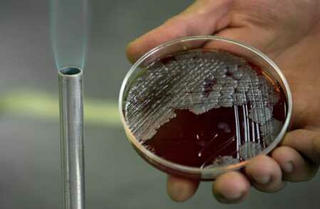 Scientists warn a new drug-resistant superbug could spread worldwide, fuelled in part by medical tourism.
more »
Scientists warn a new drug-resistant superbug could spread worldwide, fuelled in part by medical tourism.
more »
 Chinese officials say they are investigating reports that tainted milk powder has caused premature sexual development in baby girls.
more »
Chinese officials say they are investigating reports that tainted milk powder has caused premature sexual development in baby girls.
more »
 A woman in India says she has to sell her 6-month-old baby in order to pay her husband's medical expenses.
more »
A woman in India says she has to sell her 6-month-old baby in order to pay her husband's medical expenses.
more »