Many anguished Brazilian women want to reverse procedure
Published:
24 December 2000 y., Sunday
By the early 1990s, Brazil’s fertility rate had nose-dived to 2.1 children per woman. But officials were jolted by a simultaneous rise in cesarean sections, which had become the nation’s most popular method of childbirth. By 1986, 44 percent of Brazilian births were performed by C-section. The connection between sterilization and C-sections soon became clear. Taking advantage of a legal loophole that permitted sterilization under exceptional circumstances, such as cesarean births, doctors and their patients routinely agreed to have the surgery performed immediately after C-sections.
As the number of cesareans increased, so did the rate of birth-related deaths among mothers. Brazil’s maternal mortality rate peaked at 220 per 100,000 births during the early 1990s, with some cities reporting rates as high as 350 per 100,000 births. The maternal mortality rate in the United States is 8 deaths per 100,000 births, according to UNICEF.
The sterilization crisis was especially acute in such places as Goiania, a city of 1.2 million and the capital of the state of Goias in central Brazil. By the 1990s, Goias had a 60 percent sterilization rate among women of child-bearing age, one of the highest in the country.
Many women who were sterilized without knowing of other options ended up protecting themselves from pregnancy, but not from sexually transmitted diseases, such as HIV, the virus that causes AIDS.
In recent years, the number of HIV cases in Brazil has stabilized, but in many states, cases among women-especially married women-has continued to rise. Goiania officials said that in 1988, there were 13 cases of HIV among men for every one among women. Today the numbers are equal.
Šaltinis:
THE WASHINGTON POST
Copying, publishing, announcing any information from the News.lt portal without written permission of News.lt editorial office is prohibited.
The most popular articles
 MEPs last week backed a new report for food labelling that clarifies the origin of food and where it is processed.
more »
MEPs last week backed a new report for food labelling that clarifies the origin of food and where it is processed.
more »
 Mental health problems can affect our “daily life, family, school, work and leisure” and early diagnosis and treatment is the best way to avert personal catastrophe, according to Greek Socialist Evangelia Tzampazi, who is preparing a report on the subject.
more »
Mental health problems can affect our “daily life, family, school, work and leisure” and early diagnosis and treatment is the best way to avert personal catastrophe, according to Greek Socialist Evangelia Tzampazi, who is preparing a report on the subject.
more »
 In 2003, EU health ministers advised governments to put in place large-scale screening programmes for people at a higher risk of cancer because of generic factors like age and gender.
more »
In 2003, EU health ministers advised governments to put in place large-scale screening programmes for people at a higher risk of cancer because of generic factors like age and gender.
more »
 Parliament will today debate new measures to make sure that cancer causing pesticides are banned from going on sale whilst also ensuring that the amounts of current pesticides used are greatly reduced.
more »
Parliament will today debate new measures to make sure that cancer causing pesticides are banned from going on sale whilst also ensuring that the amounts of current pesticides used are greatly reduced.
more »
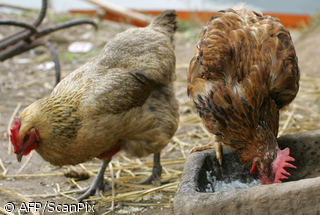 Vets across India's West Bengal state are carrying out a mass cull of birds after a fresh outbreak of avian flu.
more »
Vets across India's West Bengal state are carrying out a mass cull of birds after a fresh outbreak of avian flu.
more »
 Roy Carter - the retired British postman - is game for anything after his damaged knuckles were replaced with ones made from a similar material used to line atomic reactors.
more »
Roy Carter - the retired British postman - is game for anything after his damaged knuckles were replaced with ones made from a similar material used to line atomic reactors.
more »
 Begun only one month ago, stressed out passers-by dish out about two dollars to smash a cup or saucer and relieve their anxieties to the encouragement of staff.
more »
Begun only one month ago, stressed out passers-by dish out about two dollars to smash a cup or saucer and relieve their anxieties to the encouragement of staff.
more »
 MEPs adopted the toy safety proposal with 481 votes in favour, 73 against, 40 abstentions.
more »
MEPs adopted the toy safety proposal with 481 votes in favour, 73 against, 40 abstentions.
more »
 Dairy farmers in some parts of India are getting a boost from a new line of business - cow urine.
more »
Dairy farmers in some parts of India are getting a boost from a new line of business - cow urine.
more »
 The commission has tabled proposals to improve how the European pharmaceutical market operates and ensure that patients benefit from safe, innovative and accessible medicines.
more »
The commission has tabled proposals to improve how the European pharmaceutical market operates and ensure that patients benefit from safe, innovative and accessible medicines.
more »