People who use the Internet to find real-life sex partners are more likely to have had sexually transmitted diseases or engaged in risky intimate behavior, a government-led study found.
Published:
27 July 2000 y., Thursday
Another study, based on San Francisco's handling of syphilis cases linked to an Internet chat room, suggests the Internet can help public health officials curb disease outbreaks.
Both studies appear in Wednesday's Journal of the American Medical Association.
In the first study, led by Centers of Disease Control researcher Mary McFarlane, investigators looked at the habits of 856 clients at a Denver HIV testing and counseling center. Nearly 16 percent — 135 subjects — reported seeking sex partners online.
Nearly a third of those online seekers said they had contracted sexually transmitted diseases and had been exposed to HIV-positive sex partners. In comparison, 20 percent of those who tried to find partners in more conventional ways said they'd had venereal diseases and just 14 percent said they'd had HIV-positive partners.
A JAMA editorial said the findings weren't surprising, since the anonymity of sex facilitated by the Internet would be expected to appeal to "sexual adventurers" willing to take risks.
The San Francisco health officials determined last year that two men may have contracted syphilis from partners they met online. Because the patients said they knew only their partners' chat room aliases, officials couldn't use conventional methods of tracking them down or alerting others about the danger.
With help from the service provider that hosted the chat room, officials posted alerts there encouraging men who may have met sexual partners online to seek medical evaluation. That helped them find five additional men with syphilis linked to the chat room, said the authors, led by Dr. Jeffrey Klausner of the city's public health department.
Šaltinis:
discovery.com
Copying, publishing, announcing any information from the News.lt portal without written permission of News.lt editorial office is prohibited.
The most popular articles
 “Be healthy – be yourself” campaign encourages young people to become more proactive in protecting their health.
more »
“Be healthy – be yourself” campaign encourages young people to become more proactive in protecting their health.
more »
 When 28 year-old Artyom Sidorkin went to see his doctor to complain about pains in his chest and coughing blood his doctors made a rather bizarre discovery.
more »
When 28 year-old Artyom Sidorkin went to see his doctor to complain about pains in his chest and coughing blood his doctors made a rather bizarre discovery.
more »
 Last year French Professor Luc Montagnier jointly won the Nobel Prize for Medicine with Françoise Barré-Sinoussi for their discovery of the HIV virus in 1983.
more »
Last year French Professor Luc Montagnier jointly won the Nobel Prize for Medicine with Françoise Barré-Sinoussi for their discovery of the HIV virus in 1983.
more »
 To mark World Health Day, European Commissioner for Health, Androulla Vassiliou will visit several community health projects in Kenya on 6 and 7 April.
more »
To mark World Health Day, European Commissioner for Health, Androulla Vassiliou will visit several community health projects in Kenya on 6 and 7 April.
more »
 Autism, which affects roughly 67 million people worldwide, is still relatively unheard of in China.
more »
Autism, which affects roughly 67 million people worldwide, is still relatively unheard of in China.
more »
 The courses are arranged for the fifth time in a row; this year Estonian, Georgian, Latvian, and Lithuanian military medics are joined by three Armenian representatives.
more »
The courses are arranged for the fifth time in a row; this year Estonian, Georgian, Latvian, and Lithuanian military medics are joined by three Armenian representatives.
more »
 The choice of food in the EU is huge, but are you well-informed enough to choose well?
more »
The choice of food in the EU is huge, but are you well-informed enough to choose well?
more »
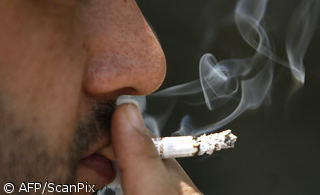 MEPs Tuesday backed a minimum tax of €1.28 per pack of 20 cigarettes within 3 years, in an effort to reduce smoking across Europe through higher prices.
more »
MEPs Tuesday backed a minimum tax of €1.28 per pack of 20 cigarettes within 3 years, in an effort to reduce smoking across Europe through higher prices.
more »
 Parliament approved an update of EU legislation on cosmetics when it votes on a first-reading agreement thrashed out between EP and Council representatives.
more »
Parliament approved an update of EU legislation on cosmetics when it votes on a first-reading agreement thrashed out between EP and Council representatives.
more »
 German doctors are treating a woman they say may have contracted the deadly ebola virus while working in a laboratory nt he city of Hamburg.
more »
German doctors are treating a woman they say may have contracted the deadly ebola virus while working in a laboratory nt he city of Hamburg.
more »