A major oil company in the Baltic states says it is installing blue lights in its gas station toilettes to dissuade growing numbers of drug addicts from using the facilities to inject narcotics.
Published:
5 February 2001 y., Monday
The Norwegian-owned Statoil, a leading gasoline distributor in the region, said intravenous drug users had difficulty finding veins under the low, bluish light and so began avoiding places with such specially fitted bulbs. Before they restored independence in 1991, narcotics use in the Baltic states was rare. But as Estonia, Latvia and Lithuania have opened up to the rest of the world, illegal drug use has risen sharply.
Statoil said the problem was dramatically highlighted when an employee at a gas station in Latvia recently pricked herself with a needle that had been discarded in the bathroom. It was found to be infected with the HIV virus that causes AIDS. Statoil has some 90 stations across the region, but only those near large cities, where narcotics use is more common, were putting up the blue lights. Several outlets already installed the lights and others will do so soon. Spokesmen for the oil company said some Western European nations have already put blue lights in airport bathrooms and at other public places. They said the scheme had already proven effective at dissuading addicts.
Šaltinis:
The Weekly Crier
Copying, publishing, announcing any information from the News.lt portal without written permission of News.lt editorial office is prohibited.
The most popular articles
 The only physician in her village of Tsoniarisi, Mzevinar Bolkvadze sees patients all day in a newly built and equipped ambulatory.
more »
The only physician in her village of Tsoniarisi, Mzevinar Bolkvadze sees patients all day in a newly built and equipped ambulatory.
more »
 As of 7 September 2009, 48 of the 53 Member States in the WHO European Region had reported over 49 000 laboratory-confirmed cases of pandemic (H1N1) 2009 virus infection.
more »
As of 7 September 2009, 48 of the 53 Member States in the WHO European Region had reported over 49 000 laboratory-confirmed cases of pandemic (H1N1) 2009 virus infection.
more »
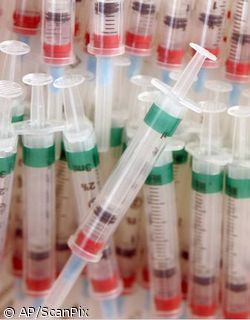 China's food and drug administration say clinical trials of a vaccine against the H1N1 flu strain have been successful.
more »
China's food and drug administration say clinical trials of a vaccine against the H1N1 flu strain have been successful.
more »
As of 31 August 2009, 48 of the 53 Member States in the WHO European Region had reported laboratory-confirmed cases of pandemic (H1N1) 2009 virus infection.
more »
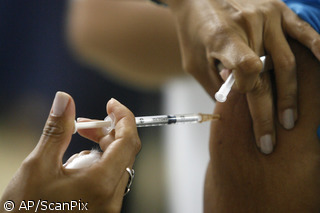 The European Union Health Security Committee and the Early Warning and Response authorities adopted a policy statement proposed by the European Commission which outlines a shared European approach towards identifying target and priority groups for A H1N1 vaccination.
more »
The European Union Health Security Committee and the Early Warning and Response authorities adopted a policy statement proposed by the European Commission which outlines a shared European approach towards identifying target and priority groups for A H1N1 vaccination.
more »
 As of 20 August 2009, 47 of the 53 Member States in the WHO European Region had reported over 42 000 laboratory-confirmed cases of pandemic (H1N1) 2009 virus infection.
more »
As of 20 August 2009, 47 of the 53 Member States in the WHO European Region had reported over 42 000 laboratory-confirmed cases of pandemic (H1N1) 2009 virus infection.
more »
 About 1000 participants, mostly from North America, debated solutions to the obesity epidemic in the United States (US) at the Weight of the Nation conference, organized in Washington, USA, by the US Centers for Disease Control.
more »
About 1000 participants, mostly from North America, debated solutions to the obesity epidemic in the United States (US) at the Weight of the Nation conference, organized in Washington, USA, by the US Centers for Disease Control.
more »
 The European Union Health Security Committee and the Early Warning and Response authorities (HSC/EWRS) unanimously adopted for the first time two policy statements proposed by the European Commission on public health measures for pandemic influenza A (H1N1) 2009.
more »
The European Union Health Security Committee and the Early Warning and Response authorities (HSC/EWRS) unanimously adopted for the first time two policy statements proposed by the European Commission on public health measures for pandemic influenza A (H1N1) 2009.
more »
As of 10 August 2009, 46 of the 53 countries in the WHO European Region had reported over 33 000 laboratory-confirmed cases of pandemic (H1N1) 2009 virus infection, including 55 fatalities in 7 countries.
more »
 The U.S. company Moog Medical Devices which acquired the company the Lithuanian Viltechmeda at the beginning of the year 2009, intends to invest EUR 2M in Lithuania in the nearest future, to establish a modern services centre.
more »
The U.S. company Moog Medical Devices which acquired the company the Lithuanian Viltechmeda at the beginning of the year 2009, intends to invest EUR 2M in Lithuania in the nearest future, to establish a modern services centre.
more »