The scientists build the biggest botanical garden in the World, which will contain the plants from three climate zones. The project is called the Eden Project.
Published:
20 June 2000 y., Tuesday
The British scientists try to create the eighth wonder of the World in small town of Cornwall. The Eden Project is to establish three world climate zones under the huge domes built on geodesic craters. The enormous variety of world plants are going to be brought on September. During the transmission the building works will be stopped. The building works are planned to be finished by next spring.
This building will be the biggest and the tallest in the world so far. The 35 football stadiums size and high enough to hold Pizza Tower structure is being built from ETFE (ethyl tetra fluoro ethylene) material, which is expected to serve at least 25 years. "It is extremely strong, very lightweight and more transparent than glass, antistatic and self-cleaning," said construction facilities manager Neal Barnes.
The mission of this project is to is to promote an understanding of the importance of plants and their relationship to humans, what could be the attention to the ecological problems. The idea of building Garden of Eden belong to scientists Philip McMillan Browse, Peter Thoday and Tim Smit. This wonder should also attract the tourists and money to the remote country side. Even though the Project is not finished yet, it attract about 4,000 visitors a day. Organizers hope to lure 75,000 visitors a year when the 80 million pound ($120 million) project is completed next year, giving a big boost to Cornwall, which has been designated one of the poorest areas in the European Union.
"We decided we had to do something pretty big and thought 'Why don't we build the biggest greenhouse in the world?'" said McMillan Browse. "It is a botanical garden for the 21st century."
Copying, publishing, announcing any information from the News.lt portal without written permission of News.lt editorial office is prohibited.
The most popular articles
 The only physician in her village of Tsoniarisi, Mzevinar Bolkvadze sees patients all day in a newly built and equipped ambulatory.
more »
The only physician in her village of Tsoniarisi, Mzevinar Bolkvadze sees patients all day in a newly built and equipped ambulatory.
more »
 As of 7 September 2009, 48 of the 53 Member States in the WHO European Region had reported over 49 000 laboratory-confirmed cases of pandemic (H1N1) 2009 virus infection.
more »
As of 7 September 2009, 48 of the 53 Member States in the WHO European Region had reported over 49 000 laboratory-confirmed cases of pandemic (H1N1) 2009 virus infection.
more »
 China's food and drug administration say clinical trials of a vaccine against the H1N1 flu strain have been successful.
more »
China's food and drug administration say clinical trials of a vaccine against the H1N1 flu strain have been successful.
more »
As of 31 August 2009, 48 of the 53 Member States in the WHO European Region had reported laboratory-confirmed cases of pandemic (H1N1) 2009 virus infection.
more »
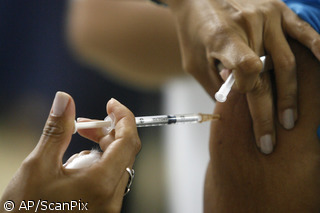 The European Union Health Security Committee and the Early Warning and Response authorities adopted a policy statement proposed by the European Commission which outlines a shared European approach towards identifying target and priority groups for A H1N1 vaccination.
more »
The European Union Health Security Committee and the Early Warning and Response authorities adopted a policy statement proposed by the European Commission which outlines a shared European approach towards identifying target and priority groups for A H1N1 vaccination.
more »
 As of 20 August 2009, 47 of the 53 Member States in the WHO European Region had reported over 42 000 laboratory-confirmed cases of pandemic (H1N1) 2009 virus infection.
more »
As of 20 August 2009, 47 of the 53 Member States in the WHO European Region had reported over 42 000 laboratory-confirmed cases of pandemic (H1N1) 2009 virus infection.
more »
 About 1000 participants, mostly from North America, debated solutions to the obesity epidemic in the United States (US) at the Weight of the Nation conference, organized in Washington, USA, by the US Centers for Disease Control.
more »
About 1000 participants, mostly from North America, debated solutions to the obesity epidemic in the United States (US) at the Weight of the Nation conference, organized in Washington, USA, by the US Centers for Disease Control.
more »
 The European Union Health Security Committee and the Early Warning and Response authorities (HSC/EWRS) unanimously adopted for the first time two policy statements proposed by the European Commission on public health measures for pandemic influenza A (H1N1) 2009.
more »
The European Union Health Security Committee and the Early Warning and Response authorities (HSC/EWRS) unanimously adopted for the first time two policy statements proposed by the European Commission on public health measures for pandemic influenza A (H1N1) 2009.
more »
As of 10 August 2009, 46 of the 53 countries in the WHO European Region had reported over 33 000 laboratory-confirmed cases of pandemic (H1N1) 2009 virus infection, including 55 fatalities in 7 countries.
more »
 The U.S. company Moog Medical Devices which acquired the company the Lithuanian Viltechmeda at the beginning of the year 2009, intends to invest EUR 2M in Lithuania in the nearest future, to establish a modern services centre.
more »
The U.S. company Moog Medical Devices which acquired the company the Lithuanian Viltechmeda at the beginning of the year 2009, intends to invest EUR 2M in Lithuania in the nearest future, to establish a modern services centre.
more »