Via takes early round in graphics dispute with Intel
Published:
27 November 2001 y., Tuesday
Chip designer Via Technologies Inc. scored a small victory against Intel Corp. last week in an ongoing legal saga over technology licensing that has spread into courtrooms in several countries.
The decision does not affect a separate battle between the two companies concerning bus licensing for Pentium 4 chip sets. That battle has slowed the adoption of Via's flagship P4x266 core logic product because top-tier motherboard companies are reluctant to use it and possibly face Intel's wrath.
In an older lawsuit filed last year, Intel alleged that Via infringed upon an Intel patent relating to graphics technology when Via developed chip sets that supported Advanced Micro Devices Inc. microprocessors. Specifically, Intel said Via used the "fast write" specification of the Advanced Graphics Port (AGP) standard developed by Intel and now followed as an industry standard. Intel alleged that Via implemented patented technology that went beyond the "baseline" of the standard, while Via contended that "fast write" was a specification required to fully implement the standard. Via's position was supported by a ruling in a California court.
"Intel is incorrect," wrote Judge William Alsup of the U.S. District Court for the Northern District of California, in a decision dated Nov 20.
The judge also took a swipe at Intel for being too narrow-minded in its interpretation of what features are optional or required when implementing the AGP standard. "Under Intel's reading of the license, it would be impossible for any engineer or business to understand what was (or was not) licensed," Alsup wrote.
Šaltinis:
EE Times
Copying, publishing, announcing any information from the News.lt portal without written permission of News.lt editorial office is prohibited.
The most popular articles
Software company announced new structure_ of it_s business.
more »
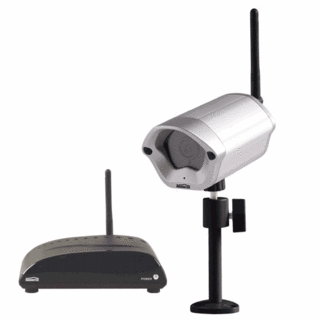 Just a few weeks ago, the world's tiniest video camera was as small as a grain of rice. Today, the world's NanoEst camera is even smaller.
more »
Just a few weeks ago, the world's tiniest video camera was as small as a grain of rice. Today, the world's NanoEst camera is even smaller.
more »
 During the experiment two research groups managed to overcome a symbolic 100 TB/s optical fiber data transmission speed limit.
more »
During the experiment two research groups managed to overcome a symbolic 100 TB/s optical fiber data transmission speed limit.
more »
 Apple’s long–awaited online storage service for iTunes could be named iCloud, if only rumours are to be believed.
more »
Apple’s long–awaited online storage service for iTunes could be named iCloud, if only rumours are to be believed.
more »
 The founders of video-sharing site YouTube have bought bookmarking service Delicious from Yahoo.
more »
The founders of video-sharing site YouTube have bought bookmarking service Delicious from Yahoo.
more »
 The successful raid by hackers on Sony’s PlayStation Network is already being ranked among the biggest data thefts of all time.
more »
The successful raid by hackers on Sony’s PlayStation Network is already being ranked among the biggest data thefts of all time.
more »
 Apple has denied that its iPhones and 3G iPads have been secretly recording their owners' movements.
more »
Apple has denied that its iPhones and 3G iPads have been secretly recording their owners' movements.
more »
 Customers who have waited nearly 10 months for the white version of the iPhone 4 won’t have to wait much longer. The Great White iPhone 4 is finally here.
more »
Customers who have waited nearly 10 months for the white version of the iPhone 4 won’t have to wait much longer. The Great White iPhone 4 is finally here.
more »
 Researchers at Georgia Tech University are teaching a robot the basics of dialogue. Named "Simon", the robot has already been taught how to attract a person's attention but eventually, it's hoped he'll be able to interact and converse with humans in daily life.
more »
Researchers at Georgia Tech University are teaching a robot the basics of dialogue. Named "Simon", the robot has already been taught how to attract a person's attention but eventually, it's hoped he'll be able to interact and converse with humans in daily life.
more »
 3D? Terribly lame when it's tossed into devices as a bullet point feature. Trimensional for iPhone takes a picture of your face and maps your mug in a 3D model.
more »
3D? Terribly lame when it's tossed into devices as a bullet point feature. Trimensional for iPhone takes a picture of your face and maps your mug in a 3D model.
more »
 The European Union is to investigate whether internet service providers (ISPs) are providing fair access to online services.
more »
The European Union is to investigate whether internet service providers (ISPs) are providing fair access to online services.
more »