The Council of the Baltic Sea States met in Pori on 10-11 June 2003 for its 12th Ministerial Session
Published:
12 June 2003 y., Thursday
At the invitation of the Minister for Foreign Affairs of Finland, the Council of the Baltic Sea States (CBSS) - consisting of the Ministers for Foreign Affairs of Denmark, Estonia, Finland, Germany, Iceland, Latvia, Lithuania, Norway, Poland, Russia and Sweden and a member of the European Commission - met in Pori on 10-11 June 2003 for its 12th Ministerial Session. The Presidency of the EU was present, and representatives from France, Italy, the Netherlands, Slovakia, Ukraine, the United Kingdom and the United States attended as observers.
Since the 10th anniversary meeting of the Council in Svetlogorsk in March 2002, several important events have shaped the CBSS agenda for its second decade. In particular, the Council welcomed the conclusions from the 4th Baltic Sea States Summit meeting in St. Petersburg in June 2002 and the role accorded to the CBSS therein. The Council confirmed its readiness to continue acting as co-ordinator and focal point for intergovernmental regional cooperation.
The Council underlined the significance of the conclusion of EU accession negotiations with Estonia, Latvia, Lithuania and Poland with a view to their accession by 1 May 2004. This enlargement of the Union is expected to create new opportunities for developing the Baltic Sea region as a whole and thus will be an important contribution to realizing the region’s great potential.
The Council welcomed the ongoing elaboration of a new EU initiative on Wider Europe. The CBSS has successfully overcome old dividing lines in our region. The Council will put this experience at the service of intensified regional and cross-border cooperation within this initiative.
The Council welcomed the results of the EU-Russia Summit in St. Petersburg on 31 May 2003 and expressed its conviction that the relationship between the enlarging Union and the Russian Federation will continue to develop in a constructive and mutually beneficial manner.
The 13th Ministerial Session of the CBSS will be held in Poland in 2005.
Šaltinis:
vm.ee
Copying, publishing, announcing any information from the News.lt portal without written permission of News.lt editorial office is prohibited.
The most popular articles
 Guinness World Records officially declares that an Australian man has the world's largest feet.
more »
Guinness World Records officially declares that an Australian man has the world's largest feet.
more »
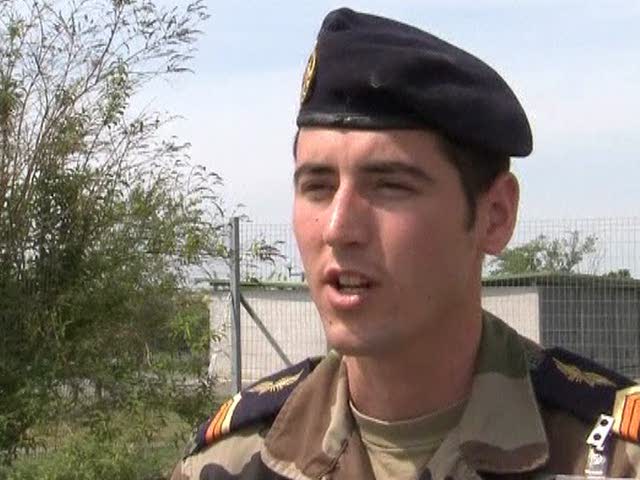 It's a sniffer dog with a difference: a military Belgian Shepherd that has been trained to detect signs of prostate cancer in patients' urine. According to French scientists, the dog can do it far more accurately than any currently available scientific technique.
more »
It's a sniffer dog with a difference: a military Belgian Shepherd that has been trained to detect signs of prostate cancer in patients' urine. According to French scientists, the dog can do it far more accurately than any currently available scientific technique.
more »
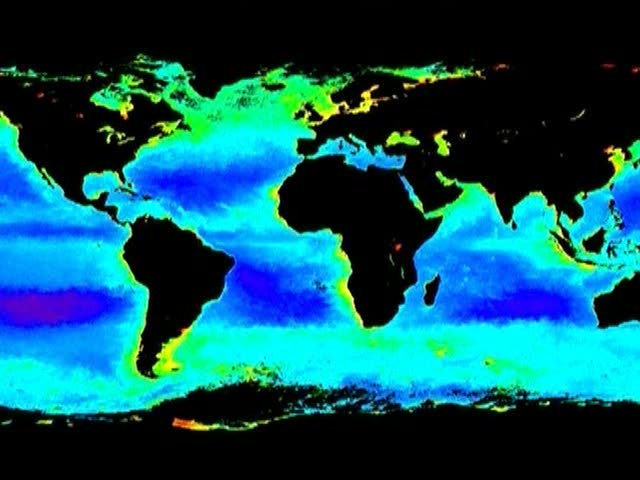 This week marks the beginning of hurricane season in the United States and scientists will be watching closely in the wake of extreme weather patterns that have devastated the Midwest. One of the questions they're trying to answer focuses on the impact of climate change and global warming.
more »
This week marks the beginning of hurricane season in the United States and scientists will be watching closely in the wake of extreme weather patterns that have devastated the Midwest. One of the questions they're trying to answer focuses on the impact of climate change and global warming.
more »
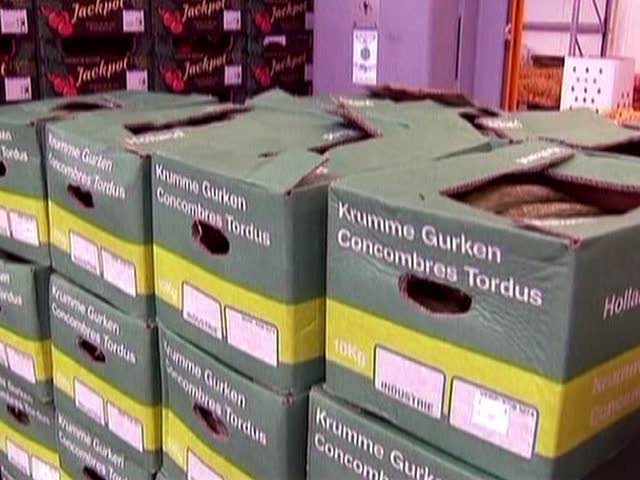 Spanish cucumbers are being blame for an E.coli outbreak that killed 10 people in Germany and sickened hundreds.
more »
Spanish cucumbers are being blame for an E.coli outbreak that killed 10 people in Germany and sickened hundreds.
more »
 Protesters clash with police as pro Mladic rallies continue in the Serbian capital.
more »
Protesters clash with police as pro Mladic rallies continue in the Serbian capital.
more »
 Japan, Geiger counters, radiation leak, Fuji Electric
more »
Japan, Geiger counters, radiation leak, Fuji Electric
more »
 Chinese artist Qi Baishi's ink-wash work is auctioned for 65.4 million U.S. Dollars (425 million yuan) in Beijing, setting a new record for contemporary Chinese painting.
more »
Chinese artist Qi Baishi's ink-wash work is auctioned for 65.4 million U.S. Dollars (425 million yuan) in Beijing, setting a new record for contemporary Chinese painting.
more »
 Georgian police wearing full riot gear used water cannons and rubber bullets to disperse protesters in Tiblisi.
more »
Georgian police wearing full riot gear used water cannons and rubber bullets to disperse protesters in Tiblisi.
more »
 CT scanning has allowed scientists to identify and recreate in stunning three-dimensional detail, an ancient spider trapped in amber for 50 million years...
more »
CT scanning has allowed scientists to identify and recreate in stunning three-dimensional detail, an ancient spider trapped in amber for 50 million years...
more »
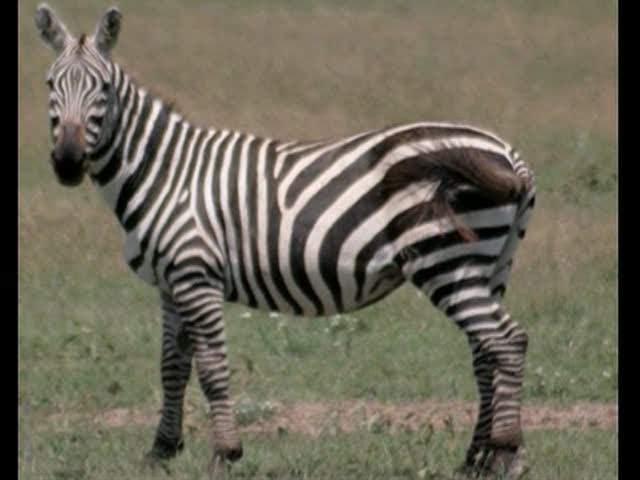 Researchers in Chicago have developed a new barcoding system that can identify and track zebras by their unique stripe patterns. The scientists say their computer program can also be modified to keep track of endangered species like tigers and some giraffe species.
more »
Researchers in Chicago have developed a new barcoding system that can identify and track zebras by their unique stripe patterns. The scientists say their computer program can also be modified to keep track of endangered species like tigers and some giraffe species.
more »