During a session of the European Commission in Brussels July 10, the Commissioner for Agriculture Franz Fischler presented a proposal for the reform of the European Union's Common Agricultural Policy (CAP).
Published:
30 July 2002 y., Tuesday
In accordance with the reform, the principles governing the financing of agriculture would change. According to observers, this should help close negotiations with EU candidate countries timely by the end of this year.
The proposed reform may, as one of the EU diplomats said, decrease the fears of net payers to EU coffers, in particular Germany, that enlarging the Union to include the poor Eastern European countries might increase the agricultural budget to a level that would be impossible to finance. In addition, if it is possible to push through the proposal to spend less EU funds on direct subsidies for production and more on the development of rural areas, it will be easier to integrate with the candidate countries' agricultural sectors.
"The commission's proposal...will have a positive side effect-it will facilitate the enlargement of the Union," said Fischler.
The CAP reform has been criticized by France and the EU farmers' unions. Germany and the Netherlands clearly indicated that they would support EU enlargement at the December summit in Copenhagen if at the same time a schedule of cost reduction for the CAP is approved. The candidate countries have welcomed the planned reform, because they believe it offers them more favorable conditions than they previously assumed for utilizing CAP after joining the EU.
Fischler said that farmers from candidate countries would receive the same funds as the EU farmers are getting now, in 2011 and not in 2013 as was planned earlier.
Commenting on the information from Brussels, head of the Sejm Committee
Šaltinis:
warsawvoice.pl
Copying, publishing, announcing any information from the News.lt portal without written permission of News.lt editorial office is prohibited.
The most popular articles
 The meeting will be followed by a joint press conference of the Baltic leaders.
more »
The meeting will be followed by a joint press conference of the Baltic leaders.
more »
 During his visit to Brussels, Prime Minister Andrius Kubilius met with German Chancellor Angela Merkel.
more »
During his visit to Brussels, Prime Minister Andrius Kubilius met with German Chancellor Angela Merkel.
more »
 Upon the completion of the second working session of the European Council, Prime Minister Andrius Kubilius welcomed its results and the agreements it had reached.
more »
Upon the completion of the second working session of the European Council, Prime Minister Andrius Kubilius welcomed its results and the agreements it had reached.
more »
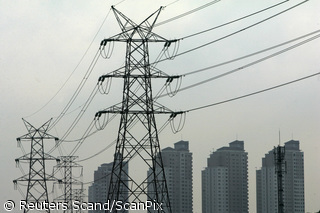 After the first working session of the European Council that ran late into the night, Lithuanian Prime Minister Andrius Kubilius welcomed the agreement on an additional EUR 5 billion investment in European energy and infrastructure projects.
more »
After the first working session of the European Council that ran late into the night, Lithuanian Prime Minister Andrius Kubilius welcomed the agreement on an additional EUR 5 billion investment in European energy and infrastructure projects.
more »
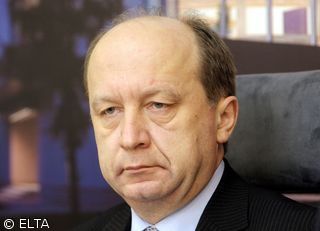 In Brussels, Prime Minister Andrius Kubilius attended the meeting of Nordic and Baltic Prime Ministers – the meeting which is traditionally held to discuss their opinions right before the first working session of the European Council.
more »
In Brussels, Prime Minister Andrius Kubilius attended the meeting of Nordic and Baltic Prime Ministers – the meeting which is traditionally held to discuss their opinions right before the first working session of the European Council.
more »
 Today the Lithuanian Government has approved nomination of Mindaugas Butkus as Ambassador Extraordinary and Plenipotentiary to Germany and has submitted his candidacy to the President.
more »
Today the Lithuanian Government has approved nomination of Mindaugas Butkus as Ambassador Extraordinary and Plenipotentiary to Germany and has submitted his candidacy to the President.
more »
 President of the Republic of Lithuania Valdas Adamkus met with President Georgi Parvanov of Bulgaria who arrived in Lithuania on a state visit.
more »
President of the Republic of Lithuania Valdas Adamkus met with President Georgi Parvanov of Bulgaria who arrived in Lithuania on a state visit.
more »
 President Valdas Adamkus extended congratulations to President Mary McAleese of Ireland on the occasion of national holiday – St. Patrick Day.
more »
President Valdas Adamkus extended congratulations to President Mary McAleese of Ireland on the occasion of national holiday – St. Patrick Day.
more »
 Prime Minister Andrius Kubilius sent a telegram with greetings to new Latvian Prime Minister Valdis Dombrovskis.
more »
Prime Minister Andrius Kubilius sent a telegram with greetings to new Latvian Prime Minister Valdis Dombrovskis.
more »
Next Monday, March 16, the President of the Republic of Bulgaria Mr. Georgi Parvanov and a delegation arrive in Lithuania on a three-day state visit.
more »