The presidents of Latvia and Russia met for the first time in a hastily arranged summit on February 11, raising hopes for an improvement in what have been frosty relations between the two neighboring states.
Published:
14 February 2001 y., Wednesday
The 90 minute meeting occurred after Russian President Vladimir Putin issued a surprise invitation just a day or two earlier to Latvian President Vaira Vike-Freiberga to fly to see him in Austria, where he was on an official visit.
The two leaders had never met before, and it was a rare encounter between top-ranking Latvian and Russian officials.
During the summit in the Austrian resort town of Saint Anton, the two reportedly discussed some of the touchy bilateral issues that have strained relations ever since the 1991 collapse of the Soviet Union.
"The meeting with the Latvian president was very important," Itar-Tass quoted Putin as saying later.
The Latvian president echoed that assessment, saying "this is a first step of a process that hopefully will be followed up." Upon her return from Austria, Vike-Freiberga confirmed that the two heads of state spoke about long-standing Kremlin allegations that Latvia discriminates against its large Russian-speaking population.
But while Vike-Freiberga said Putin appears to understand Latvia's desire to protect its culture, she said he was misinformed about the nature of Latvian language and citizenship laws.
The two also reportedly discussed Latvia's prosecution of elderly former agents of Stalinist repression, proceedings which Russia has strongly
criticized. The contentious issue of the Baltic drives to join NATO did not come up, according to Vike-Freiberga.
The Latvian president said she and Putin decided to broach the issue later.
She hastened to add that Latvia had no intention of ever abandoning its stated goal of full alliance membership.
Šaltinis:
balticsww.com
Copying, publishing, announcing any information from the News.lt portal without written permission of News.lt editorial office is prohibited.
The most popular articles
 On 26 November, Lithuania’s Minister of Foreign Affairs Vygaudas Ušackas delivered a lecture “The New NATO Strategic Concept: Lithuania’s Vision” to the participants of Higher Command Studies Course of the Baltic Defence College (BALTDEFCOL).
more »
On 26 November, Lithuania’s Minister of Foreign Affairs Vygaudas Ušackas delivered a lecture “The New NATO Strategic Concept: Lithuania’s Vision” to the participants of Higher Command Studies Course of the Baltic Defence College (BALTDEFCOL).
more »
 On 25 November at the European Information Bureau of the Seimas, Lithuania’s Minister of Foreign Affairs Vygaudas Ušackas took part in the round table discussion “Climate Change: from Kyoto to Copenhagen” and spoke about Lithuania’s contribution to combating climate change.
more »
On 25 November at the European Information Bureau of the Seimas, Lithuania’s Minister of Foreign Affairs Vygaudas Ušackas took part in the round table discussion “Climate Change: from Kyoto to Copenhagen” and spoke about Lithuania’s contribution to combating climate change.
more »
 President of the Republic of Lithuania Dalia Grybauskaitė goes for a working visit to Ukraine to attend a session of the Council of Presidents of the Republic of Lithuania and Ukraine and to meet with Ukraine's President Viktor Yushchenko.
more »
President of the Republic of Lithuania Dalia Grybauskaitė goes for a working visit to Ukraine to attend a session of the Council of Presidents of the Republic of Lithuania and Ukraine and to meet with Ukraine's President Viktor Yushchenko.
more »
 Today, November 26, meeting of the Baltic Chiefs of Defence will begin in General Adolfas Ramanauskas Warfare Training Centre in Nemenčinė (Vilnius distr.).
more »
Today, November 26, meeting of the Baltic Chiefs of Defence will begin in General Adolfas Ramanauskas Warfare Training Centre in Nemenčinė (Vilnius distr.).
more »
 November 24, Defence Attachés accredited to Lithuania met at MoND to address international defence cooperation of Lithuania, activities and plans of the Lithuanian-led Chaghcharan PRT.
more »
November 24, Defence Attachés accredited to Lithuania met at MoND to address international defence cooperation of Lithuania, activities and plans of the Lithuanian-led Chaghcharan PRT.
more »
 President Dalia Grybauskaitė extended congratulations to President Mikheil Saakashvili of Georgia on the occasion of national holiday.
more »
President Dalia Grybauskaitė extended congratulations to President Mikheil Saakashvili of Georgia on the occasion of national holiday.
more »
 This year marks the 20th anniversary of the collapse of communism in Europe and the end of the Cold War.
more »
This year marks the 20th anniversary of the collapse of communism in Europe and the end of the Cold War.
more »
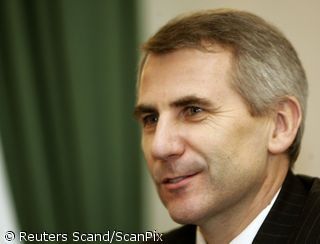 Today Lithuania‘s Minister of Foreign Affairs Vygaudas Ušackas is starting his official visit to Armenia where he will meet with the highest ranking officials of the state, as well as with the representatives of the international organizations and local authorities.
more »
Today Lithuania‘s Minister of Foreign Affairs Vygaudas Ušackas is starting his official visit to Armenia where he will meet with the highest ranking officials of the state, as well as with the representatives of the international organizations and local authorities.
more »
 On 20 November, Lithuania’s Minister of Foreign Affairs Vygaudas Ušackas congratulated Catherine Ashton who had just been elected as European Union‘s High Representative for Foreign Affairs and Security Policy.
more »
On 20 November, Lithuania’s Minister of Foreign Affairs Vygaudas Ušackas congratulated Catherine Ashton who had just been elected as European Union‘s High Representative for Foreign Affairs and Security Policy.
more »
 On 20 November, Lithuania’s Ministry of Foreign Affairs in cooperation with the Lithuanian business confederation | ICC Lithuania will host a seminar “Business in sub-Saharan Africa: Possibilities and Challenges”.
more »
On 20 November, Lithuania’s Ministry of Foreign Affairs in cooperation with the Lithuanian business confederation | ICC Lithuania will host a seminar “Business in sub-Saharan Africa: Possibilities and Challenges”.
more »