President Bush yesterday was bluntly told by European and Arab allies alike that a serious new push for a Palestinian-Israeli peace solution was vital
Published:
10 June 2004 y., Thursday
President Bush yesterday was bluntly told by European and Arab allies alike that a serious new push for a Palestinian-Israeli peace solution was vital if his vision of a stable Iraq at the heart of a reformed Middle East were to have any chance of success.
Boosted by the unanimous United Nations vote on sovereignty, Mr Bush used the first day of the G8 summit here to try and advance his agenda for Iraq, seeking to widen the role of Nato, gain relief for Baghdad's debt, and launch a much-touted initiative to promote democracy in the Middle East and the Islamic world.
But the Palestinian-Israeli conflict quickly leapt to the centre of proceedings, as Tony Blair attempted to secure a US commitment to revitalise the virtually moribund "road map" towards a comprehensive settlement. President Jacques Chirac of France - the fiercest critic of the 2003 invasion of Iraq - warned that "real progress" toward a peace deal was a "precondition" of any successful attempt at reform of the region.
But despite some nods of assent, there was little sign that Washington has agreed to a major rethink of its Middle Eastern policies, and its embrace of Israeli Prime Minister Ariel Sharon's controversial plan to withdraw from Gaza.
This latest annual gathering of the G8 powers, at the exclusive and massively guarded Sea Island resort, takes place in a much improved atmosphere from its predecessor a year ago, in the angry aftermath of the invasion of Iraq, which had split the Security Council and caused the worst rift in trans-atlantic relations in decades.
Šaltinis:
news.independent.co.uk
Copying, publishing, announcing any information from the News.lt portal without written permission of News.lt editorial office is prohibited.
The most popular articles
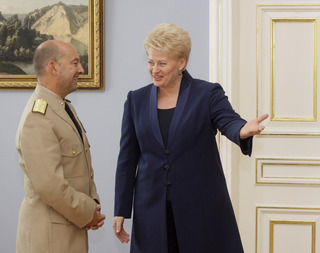 The President of the Republic of Lithuania, Dalia Grybauskaitė, met with the Commander of the US European Command and NATO's Supreme Allied Commander Europe, Admiral James G. Stavridis.
more »
The President of the Republic of Lithuania, Dalia Grybauskaitė, met with the Commander of the US European Command and NATO's Supreme Allied Commander Europe, Admiral James G. Stavridis.
more »
 The President of the Republic of Lithuania, Dalia Grybauskaitė, met with the Prime Minister of Estonia, Andrus Ansip, who is on a visit to Lithuania.
more »
The President of the Republic of Lithuania, Dalia Grybauskaitė, met with the Prime Minister of Estonia, Andrus Ansip, who is on a visit to Lithuania.
more »
 July 12 marks one year since President Dalia Grybauskaitė took office. What has changed in Lithuania over that time?
more »
July 12 marks one year since President Dalia Grybauskaitė took office. What has changed in Lithuania over that time?
more »
 On 8-9 July in Genval, Belgium, Political Director of Lithuania’s Ministry of Foreign Affairs Eitvydas Bajarūnas took part in the consultations of political directors from foreign ministries of 27 European Union member states.
more »
On 8-9 July in Genval, Belgium, Political Director of Lithuania’s Ministry of Foreign Affairs Eitvydas Bajarūnas took part in the consultations of political directors from foreign ministries of 27 European Union member states.
more »
 On 9 July, Lithuania’s Minister of Foreign Affairs Audronius Ažubalis received the outgoing Ambassador of Ukraine Ihor Prokopchuk.
more »
On 9 July, Lithuania’s Minister of Foreign Affairs Audronius Ažubalis received the outgoing Ambassador of Ukraine Ihor Prokopchuk.
more »
 On 7 July in Vilnius, Lithuania’s Minister of Foreign Affairs Audronius Ažubalis and Israel’s Foreign Minister Avigdor Liberman discussed bilateral political, economic and cultural cooperation, as well as possibilities to intensify economic, trade and tourist exchanges.
more »
On 7 July in Vilnius, Lithuania’s Minister of Foreign Affairs Audronius Ažubalis and Israel’s Foreign Minister Avigdor Liberman discussed bilateral political, economic and cultural cooperation, as well as possibilities to intensify economic, trade and tourist exchanges.
more »
 In the statement by U.S. President Barack Obama on the 10th Anniversary of the Community of Democracies that was released on 3 July, the President commended Lithuania for its Presidency of the Community and efforts to focus on the pressing challenges of today.
more »
In the statement by U.S. President Barack Obama on the 10th Anniversary of the Community of Democracies that was released on 3 July, the President commended Lithuania for its Presidency of the Community and efforts to focus on the pressing challenges of today.
more »
 "You offer us yet another opportunity to put ourselves and our civic mind to the test of time. Your example makes us raise our standards higher and higher," President of the Republic of Lithuania Dalia Grybauskaitė said at the ceremony of presenting state awards.
more »
"You offer us yet another opportunity to put ourselves and our civic mind to the test of time. Your example makes us raise our standards higher and higher," President of the Republic of Lithuania Dalia Grybauskaitė said at the ceremony of presenting state awards.
more »
 President Dalia Grybauskaitė offered personal congratulations by phone to President-elect Bronisław Komorowski on his victory in Poland's presidential elections.
more »
President Dalia Grybauskaitė offered personal congratulations by phone to President-elect Bronisław Komorowski on his victory in Poland's presidential elections.
more »
 Foreign states and international organizations extend condolences to Lithuania on the passing of President Algirdas Mykolas Brazauskas
more »
Foreign states and international organizations extend condolences to Lithuania on the passing of President Algirdas Mykolas Brazauskas
more »