European Union Demands of Transnistria Restoring Status Quo for Moldovan Schools
Published:
8 August 2004 y., Sunday
The European Union under the Dutch presidency issued a statement - signed by EU-candidates Bulgaria, Romania, Turkey, and Croatia - requesting that Transnistrian authorities restore the status quo for Moldovan-language schools and cancel its decision to have them closed.
To resolve this problem, said the document, it is imperative that Transnistrian government agree to the OSCE-proposed protocol signed by Moldova.
Having expressed "deep concern over the aggravation of conflict emerged after the closure of Moldovan schools by Transnistrian authorities", the EU condemned these actions and described them as a serious infringement on basic human rights. EU also condemned Transnistria's follow-up blocking of railway traffic and termination of the power service to Moldova. In light of the above, held the statement, the European Union has started introducing visa restrictions against the individuals responsible for the decisions leading to the closure of the Moldovan-language schools in Transnistria. Furthermore, the European Union is now considering the possibility of introducing a dual control system for certain categories of Transnistrian exports. In this respect, the EU confirms its interest toward participating in the establishment of more active control over the Moldo-Ukrainian border and calls on Ukraine for cooperation, said the statement. The European Union emphasized that it also awaits a constructive approach from the Russian Federation in terms of signing the Moldovan-school protocol.
We demand that the sides take necessary steps to de-escalate the conflict and urge the affected parties and mediators to immediately resume the five-sided dialogue on political settlement and to retain the transparency of this process, said the EU statement.
Šaltinis:
INFOTAG
Copying, publishing, announcing any information from the News.lt portal without written permission of News.lt editorial office is prohibited.
The most popular articles
 Ministry of foreign affairs of Lithuania invites foreign citizens to take the quiz “Millennium of Lithuania. Culture and history”.
more »
Ministry of foreign affairs of Lithuania invites foreign citizens to take the quiz “Millennium of Lithuania. Culture and history”.
more »
 President Adamkus underlines that today Lithuanian and Azerbaijani nations are linked by very special strategic ties that are strengthened even further by Azerbaijan‘s continuing efforts to develop relations with the European Union.
more »
President Adamkus underlines that today Lithuanian and Azerbaijani nations are linked by very special strategic ties that are strengthened even further by Azerbaijan‘s continuing efforts to develop relations with the European Union.
more »
 Many experts believe that the offshore pipeline project poses a serious threat to the Baltic Sea environment because hazardous chemical weapons from World War II are still dumped at the bottom of the sea.
more »
Many experts believe that the offshore pipeline project poses a serious threat to the Baltic Sea environment because hazardous chemical weapons from World War II are still dumped at the bottom of the sea.
more »
 President Valdas Adamkus extended, on behalf of himself and the people of Lithuania, congratulations to President Mikheil Saakashvili of Georgia on the occasion of Independence Day.
more »
President Valdas Adamkus extended, on behalf of himself and the people of Lithuania, congratulations to President Mikheil Saakashvili of Georgia on the occasion of Independence Day.
more »
 President of the Republic of Lithuania Valdas Adamkus sent congratulations on behalf of himself and the people of Lithuania to the President of the Federal Republic of Germany, Horst Köhler, on his victory in the presidential election.
more »
President of the Republic of Lithuania Valdas Adamkus sent congratulations on behalf of himself and the people of Lithuania to the President of the Federal Republic of Germany, Horst Köhler, on his victory in the presidential election.
more »
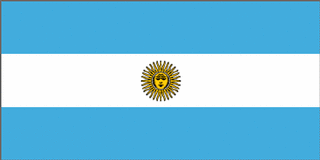 President Valdas Adamkus congratulated President Cristina Fernández de Kirchner of Argentina on the occasion of national holiday - Revolution Day - and extended best wishes for the well-being and prosperity of the Argentine people.
more »
President Valdas Adamkus congratulated President Cristina Fernández de Kirchner of Argentina on the occasion of national holiday - Revolution Day - and extended best wishes for the well-being and prosperity of the Argentine people.
more »
 On 22 May, Lithuania’s Minister of Foreign Affairs Vygaudas Ušackas met with the United Arab Emirates’ Minister of Foreign Affairs Sheikh Abdullah Bin Zayed Al Nahyan, who is paying an official visit.
more »
On 22 May, Lithuania’s Minister of Foreign Affairs Vygaudas Ušackas met with the United Arab Emirates’ Minister of Foreign Affairs Sheikh Abdullah Bin Zayed Al Nahyan, who is paying an official visit.
more »
 President Valdas Adamkus received letters of credence from the Apostolic Nuncio, Archbishop Luigi Bonazzi.
more »
President Valdas Adamkus received letters of credence from the Apostolic Nuncio, Archbishop Luigi Bonazzi.
more »
 On 18-19 May, Lithuania’s Undersecretary of Foreign Ministry took part in the meeting of European Union’s Ministers for Development Cooperation. The meeting was a on the agenda of the General Affairs and External Relations Council.
more »
On 18-19 May, Lithuania’s Undersecretary of Foreign Ministry took part in the meeting of European Union’s Ministers for Development Cooperation. The meeting was a on the agenda of the General Affairs and External Relations Council.
more »
On 15 May at Klaipėda University, Lithuania’s Minister of Foreign Affairs Vygaudas Ušackas opened an international conference “Baltic Marine Innovation Forum”, and welcomed the united forces of the Government, business and science representatives as well as diplomats, who care for the future of the Baltic Sea region.
more »