LITHUANIA BOTHERED WITH RUSSIAN OIL WELL PROXIMITY TO COURLAND SPIT
Published:
29 July 2004 y., Thursday
On Tuesday the Lukoil-Kaliningradmorneft subsidiary of the Russian Lukoil concern will put into operation the entire technological chain, beginning from the production of oil at the D-6 field on the Baltic shelf near Lithuania, the administration of the Kaliningrad region has said.
Lithuania will one more time ask Russia to provide the results of independent examination on the impact of the oil well on the environment and information on the exact time of putting into operation of the well, lying adjacent to the Lithuanian national park Courland Spit. It is listed among the UNESCO world heritage and Lithuania is concerned over possible oil leaks, threatening with an irreparable damage to the unique ecological system.
In the interview to the National Radio Alexandras Spruogis, secretary of the Environmental Protection Ministry, said that Russia has not carried out an independent examination of the well's impact on the environment.
The ministerial spokesman said that Russia has been obliged before February to conduct the examination with the inclusion of international experts in the assessment commission. If not, the Courland Spit will be automatically listed as an endangered global object.
Lithuania and Russia included the Courland Spit in the UNESCO list in 2000.
Discovered in 1983, the D-6 oil field is the largest on the sea shelf on the coast of the Kaliningrad region. By preliminary information, it can annually yield about 600,000 tons of oil. The well is located 23 kilometers away from the Courland Spit and five kilometers off Russia's sea border with Lithuania.
Inspecting the D-6 service forms and records last November, UNESCO experts found its operation being a danger to the environmental security of the Courland Spit national park.
Šaltinis:
RIA Novosti
Copying, publishing, announcing any information from the News.lt portal without written permission of News.lt editorial office is prohibited.
The most popular articles
 Ministry of foreign affairs of Lithuania invites foreign citizens to take the quiz “Millennium of Lithuania. Culture and history”.
more »
Ministry of foreign affairs of Lithuania invites foreign citizens to take the quiz “Millennium of Lithuania. Culture and history”.
more »
 President Adamkus underlines that today Lithuanian and Azerbaijani nations are linked by very special strategic ties that are strengthened even further by Azerbaijan‘s continuing efforts to develop relations with the European Union.
more »
President Adamkus underlines that today Lithuanian and Azerbaijani nations are linked by very special strategic ties that are strengthened even further by Azerbaijan‘s continuing efforts to develop relations with the European Union.
more »
 Many experts believe that the offshore pipeline project poses a serious threat to the Baltic Sea environment because hazardous chemical weapons from World War II are still dumped at the bottom of the sea.
more »
Many experts believe that the offshore pipeline project poses a serious threat to the Baltic Sea environment because hazardous chemical weapons from World War II are still dumped at the bottom of the sea.
more »
 President Valdas Adamkus extended, on behalf of himself and the people of Lithuania, congratulations to President Mikheil Saakashvili of Georgia on the occasion of Independence Day.
more »
President Valdas Adamkus extended, on behalf of himself and the people of Lithuania, congratulations to President Mikheil Saakashvili of Georgia on the occasion of Independence Day.
more »
 President of the Republic of Lithuania Valdas Adamkus sent congratulations on behalf of himself and the people of Lithuania to the President of the Federal Republic of Germany, Horst Köhler, on his victory in the presidential election.
more »
President of the Republic of Lithuania Valdas Adamkus sent congratulations on behalf of himself and the people of Lithuania to the President of the Federal Republic of Germany, Horst Köhler, on his victory in the presidential election.
more »
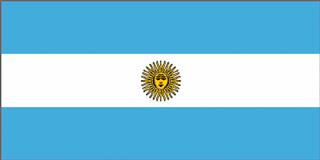 President Valdas Adamkus congratulated President Cristina Fernández de Kirchner of Argentina on the occasion of national holiday - Revolution Day - and extended best wishes for the well-being and prosperity of the Argentine people.
more »
President Valdas Adamkus congratulated President Cristina Fernández de Kirchner of Argentina on the occasion of national holiday - Revolution Day - and extended best wishes for the well-being and prosperity of the Argentine people.
more »
 On 22 May, Lithuania’s Minister of Foreign Affairs Vygaudas Ušackas met with the United Arab Emirates’ Minister of Foreign Affairs Sheikh Abdullah Bin Zayed Al Nahyan, who is paying an official visit.
more »
On 22 May, Lithuania’s Minister of Foreign Affairs Vygaudas Ušackas met with the United Arab Emirates’ Minister of Foreign Affairs Sheikh Abdullah Bin Zayed Al Nahyan, who is paying an official visit.
more »
 President Valdas Adamkus received letters of credence from the Apostolic Nuncio, Archbishop Luigi Bonazzi.
more »
President Valdas Adamkus received letters of credence from the Apostolic Nuncio, Archbishop Luigi Bonazzi.
more »
 On 18-19 May, Lithuania’s Undersecretary of Foreign Ministry took part in the meeting of European Union’s Ministers for Development Cooperation. The meeting was a on the agenda of the General Affairs and External Relations Council.
more »
On 18-19 May, Lithuania’s Undersecretary of Foreign Ministry took part in the meeting of European Union’s Ministers for Development Cooperation. The meeting was a on the agenda of the General Affairs and External Relations Council.
more »
On 15 May at Klaipėda University, Lithuania’s Minister of Foreign Affairs Vygaudas Ušackas opened an international conference “Baltic Marine Innovation Forum”, and welcomed the united forces of the Government, business and science representatives as well as diplomats, who care for the future of the Baltic Sea region.
more »