Foreign ministers of the six leading candidates for membership in the European Union have met in Prague to discuss progress toward expansion.
Published:
25 May 2001 y., Friday
At a press conference after the talks, some ministers did not conceal their frustration at the row now going on among EU members about restrictions on the free movement of labor from East to West.
The ministers -- from the Czech Republic, Estonia, Poland, Hungary, Slovenia, and Cyprus -- issued a diplomatically worded statement in which they expressed "satisfaction" that the Union had met the institutional preconditions for enlargement at its Nice summit five months ago. They reaffirmed their countries' "determination" to be ready for membership by the start of 2003, and they said they "expect" next month's EU summit in Sweden will spell out a timetable for the coming accession.
But the statement had a sting in its tail. At the end, it "invited" present EU member-states to avoid complicating the accession process by creating what it called "undue links" between different negotiating issues and by pursuing "short-term political interests."
This was a reference to the heavyweight quarrel now taking place among present EU members, which involves the linkage of two key issues that in themselves are quite separate. These issues are the free movement of labor and how development aid is to be shared among old and new members.
Germany and Austria, fearing a flood of cheap labor from the East when the newcomers join the Union, want a transition period of up to seven years during which Eastern workers would not have free access to Western labor markets.
At the same time, three of the poorer EU members -- Spain, Greece, and Portugal -- are worried that their massive levels of development aid from Brussels will be cut and the money assigned instead to the incoming Easterners.
The tie between the labor and aid issues is that Spain, supported by its two allies, wants guarantees that it will not lose access to high levels of development assistance after enlargement. It is threatening to block a compromise deal on the labor issue until it receives such guarantees.Estonia's Foreign Minister Toomas Ilves also cast doubt on the validity of the EU members' fears that they will be overrun by cheap labor from the East.
Šaltinis:
rferl.org
Copying, publishing, announcing any information from the News.lt portal without written permission of News.lt editorial office is prohibited.
The most popular articles
 President of the Republic of Lithuania Valdas Adamkus participated in the opening session of the Organisation for Security and Co-operation in Europe (OSCE) Parliamentary Assembly.
more »
President of the Republic of Lithuania Valdas Adamkus participated in the opening session of the Organisation for Security and Co-operation in Europe (OSCE) Parliamentary Assembly.
more »
 President Valdas Adamkus visited the Ministry of Foreign Affairs to bid farewell to its leadership and diplomatic corps.
more »
President Valdas Adamkus visited the Ministry of Foreign Affairs to bid farewell to its leadership and diplomatic corps.
more »
 June 22, Monday, President Valdas Adamkus is leaving for a working visit to Georgia.
more »
June 22, Monday, President Valdas Adamkus is leaving for a working visit to Georgia.
more »
 On Wednesday, Prime Minister Andrius Kubilius and his Baltic counterparts met with President of the European Commission José Manuel Barroso.
more »
On Wednesday, Prime Minister Andrius Kubilius and his Baltic counterparts met with President of the European Commission José Manuel Barroso.
more »
 This Thursday, June 18, President of the Republic of Lithuania Valdas Adamkus goes on a two-day working visit to Brussels, Belgium, to attend the European Council meeting.
more »
This Thursday, June 18, President of the Republic of Lithuania Valdas Adamkus goes on a two-day working visit to Brussels, Belgium, to attend the European Council meeting.
more »
 Lithuania has successfully tapped international financial markets with a 500-million euro benchmark eurobond transaction due 2014, with an annual coupon of 9.375 percent.
more »
Lithuania has successfully tapped international financial markets with a 500-million euro benchmark eurobond transaction due 2014, with an annual coupon of 9.375 percent.
more »
 July 6 will see a number of events dedicated to the Millennium of the Name of Lithuania.
more »
July 6 will see a number of events dedicated to the Millennium of the Name of Lithuania.
more »
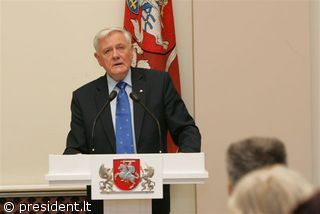 President of the Republic of Lithuania Valdas Adamkus attended the Swedish Business Awards 2009 Ceremony.
more »
President of the Republic of Lithuania Valdas Adamkus attended the Swedish Business Awards 2009 Ceremony.
more »
 President of the Republic of Lithuania Valdas Adamkus received Minister of Defence of the Federal Republic of Germany, Mr. Franz Josef Jung.
more »
President of the Republic of Lithuania Valdas Adamkus received Minister of Defence of the Federal Republic of Germany, Mr. Franz Josef Jung.
more »
President of the Republic of Lithuania Valdas Adamkus attended a reception as part of the international conference „The World Forum for Direct Investment 2009".
more »