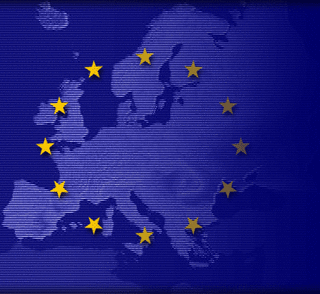
European Union leaders have opened a crucial two-day summit in Brussels in hopes of striking a deal over a new EU constitution
Published:
18 June 2004 y., Friday
European Union leaders have opened a crucial two-day summit in Brussels in hopes of striking a deal over a new EU constitution designed to facilitate decision-making in an enlarged bloc of 25 members.
But the leaders must still bargain over key points of the document and overcome differences on who should head the union's executive body, the European Commission.
The term of current European Commission president Romano Prodi ends in October, and the EU leaders have until next month to find a successor.
But the front-runner, Belgium's liberal prime minister Guy Verhofstadt, has been rejected by the British, who regard him as too much of a European federalist. Though he is backed by EU heavyweights France and Germany, the Belgian leader has also run into opposition from Italy and Poland, which, like the British, remember his strong opposition to the Iraq war.
One name nearly all EU leaders can agree on is Luxembourg Prime Minister Jean-Claude Juncker, an experienced and respected Christian Democrat who won re-election on Sunday. But Mr. Juncker has ruled himself out as a candidate for Europe's top job, preferring to govern his 450,000 countrymen to watching over the fate of 450 million Europeans.
The center-right forces in the European Parliament, which hold the biggest bloc of seats there, are pushing EU External Affairs Commissioner Chris Patten for the job. He is a former head of Britain's Conservative Party and the last governor of Hong Kong, but he is opposed by the French, who regard his French-language skills as not being up to par.
Šaltinis:
voanews.com
Copying, publishing, announcing any information from the News.lt portal without written permission of News.lt editorial office is prohibited.
The most popular articles
 On 28 July at the square in front of the Ministry of National Defence the solemn initiation ceremony of the assigning of the Chief of Defence of the Republic of Lithuania was held.
more »
On 28 July at the square in front of the Ministry of National Defence the solemn initiation ceremony of the assigning of the Chief of Defence of the Republic of Lithuania was held.
more »
 On 28 July, Lithuania’s Minister of Foreign Affairs Vygaudas Ušackas met with Minister of Foreign Affairs of Bosnia and Herzegovina Sven Alkalaj, who was paying an official visit to Lithuania.
more »
On 28 July, Lithuania’s Minister of Foreign Affairs Vygaudas Ušackas met with Minister of Foreign Affairs of Bosnia and Herzegovina Sven Alkalaj, who was paying an official visit to Lithuania.
more »
 Lithuanian Minister of National Defence and Estonian Defence Minister by phone discussed readiness of Baltic Battalion to be on duty in NATO Response Force after the information that due to extremely difficult economic situation Latvia will decrease its input into the battalion.
more »
Lithuanian Minister of National Defence and Estonian Defence Minister by phone discussed readiness of Baltic Battalion to be on duty in NATO Response Force after the information that due to extremely difficult economic situation Latvia will decrease its input into the battalion.
more »
 In the evening of 27 July in Brussels at the end of the EU foreign ministers’ meeting and before the EU-Belarus consultations, Lithuania’s Minister of Foreign Affairs V. Ušackas met with Minister of Foreign Affairs of Belarus S. Martynov.
more »
In the evening of 27 July in Brussels at the end of the EU foreign ministers’ meeting and before the EU-Belarus consultations, Lithuania’s Minister of Foreign Affairs V. Ušackas met with Minister of Foreign Affairs of Belarus S. Martynov.
more »
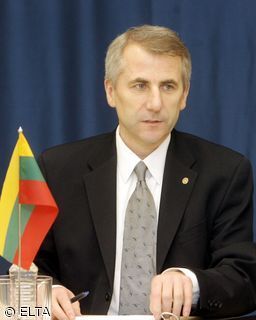 On 27 July in Brussels, Lithuania’s Minister of Foreign Affairs Vygaudas Ušackas and EU Foreign Ministers discussed the situation in Georgia and its neighbourhood.
more »
On 27 July in Brussels, Lithuania’s Minister of Foreign Affairs Vygaudas Ušackas and EU Foreign Ministers discussed the situation in Georgia and its neighbourhood.
more »
 Lithuania’s Minister of Foreign Affairs Vygaudas Ušackas met with Iceland’s Minister for Foreign Affairs Össur Skarphedinsson, Minister of Social Affairs and Social Security Árni Páll Árnason and Chairman of the Parliamentary Committee on Foreign Affairs Árni Thór Sigurdsson.
more »
Lithuania’s Minister of Foreign Affairs Vygaudas Ušackas met with Iceland’s Minister for Foreign Affairs Össur Skarphedinsson, Minister of Social Affairs and Social Security Árni Páll Árnason and Chairman of the Parliamentary Committee on Foreign Affairs Árni Thór Sigurdsson.
more »
 President Dalia Grybauskaitė received the Apostolic Nuncio to Lithuania, Archbishop Luigi Bonazzi.
more »
President Dalia Grybauskaitė received the Apostolic Nuncio to Lithuania, Archbishop Luigi Bonazzi.
more »
 On 23 July in Stockholm, Vice-Minister of Foreign Affairs of Lithuania Asta Skaisgirytė Liauškienė and Swedish Minister for European Affairs Cecilia Malmström discussed priorities of Sweden’s EU Presidency.
more »
On 23 July in Stockholm, Vice-Minister of Foreign Affairs of Lithuania Asta Skaisgirytė Liauškienė and Swedish Minister for European Affairs Cecilia Malmström discussed priorities of Sweden’s EU Presidency.
more »
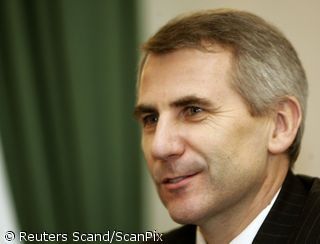 Lithuania’s Acting Minister of Foreign Affairs V. Ušackas had a telephone conversation with Iceland’s Minister for Foreign Affairs Össur Skarphedinsson, during which the Ministers discussed Iceland’s decision to apply for the European Union membership.
more »
Lithuania’s Acting Minister of Foreign Affairs V. Ušackas had a telephone conversation with Iceland’s Minister for Foreign Affairs Össur Skarphedinsson, during which the Ministers discussed Iceland’s decision to apply for the European Union membership.
more »
 Acting in conformity the Constitution of Lithuania and based on the proposal submitted by Prime Minister Andrius Kubilius, President D. Grybauskaitė has approved the Government of the Republic of Lithuania.
more »
Acting in conformity the Constitution of Lithuania and based on the proposal submitted by Prime Minister Andrius Kubilius, President D. Grybauskaitė has approved the Government of the Republic of Lithuania.
more »